
In 2021, the global apparel sector contributed an estimated 897 million tons of carbon dioxide equivalent (CO2e) to the global carbon budget— roughly 1.8 percent of global GHG emissions. Two years later, a baseline study estimated that number to be 1.7 billion tons of CO2e, accounting for 6-8 percent of global carbon emissions. Fueled by high demand and fast-fashion trends, apparel production has grown rapidly, but with few manufacturers employing environmentally conscious practices. As a result, both brands and consumers are increasingly motivated to work towards sustainable supply chains, a task that requires a close look at the production process all the way from the t-shirt to the cotton plant.
In 2007, the Natural Resources Defense Council (NRDC) established a Clean by Design (CbD) process. CbD is an approach to green supply chain efficiency that brings together apparel retailers and fashion brands to reduce the environmental impact in their factories. Mills that employ the CbD method use less water, burn fewer tons of coal, and save money in operational costs. Since its inception, CbD has been introduced to more than 200 mills worldwide.
The Clean by Design mill improvement program was the foundation upon which Aii was built. The Apparel Impact Institute (Aii) is a nonprofit organization that works to improve sustainable solutions in the apparel and footwear industry using the CbD model. Through its partnerships with brands, manufacturers, philanthropies, and financial institutions, Aii can identify business-friendly opportunities and fund and scale solutions to accelerate positive impact in the apparel supply chain.
Meet EP Investing — capital discovery for the energy transition.
The apparel supply chain comprises a complex, winding, and often unknown network of retailers, suppliers, and subcontractors. Each tier can be divided into four, the fourth being the earliest stage and the first being the final stage.
Tier 4 suppliers typically source the raw materials. Farmers in this phase grow cotton or raise livestock for wool and leather, as well as silk, furs, linen, and more.
In Tier 3, these raw materials are turned into fibers, one example being spinning cotton into yarn. This phase also includes slaughtering livestock for their hides.
In Tier 2, the most energy-intensive phase, suppliers produce the fabrics used in Tier 1 to make the final product. This stage requires lots of water and heat for pressing and dying. The thermal energy required is often derived from fossil fuels. Spinning, printing, embroidery, and tanning are all found in this phase.

Finally, Tier 1 suppliers cut, sew, package, and ship the final garment.
Aii aims to work with suppliers to implement strategies to save energy, water, and waste throughout this process, focusing heavily on the Tier 2 stage.
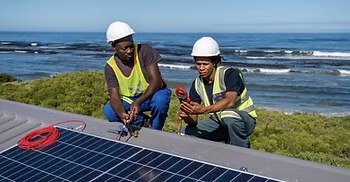
In conversation with Lewis Perkins, President and CEO of Aii, he discussed the importance of bringing all the stakeholders to the table. Aii assists brands in communicating their needs to suppliers while working with suppliers to meet the requirements of brands. One example of an Aii supplier pilot program is the rooftop solar energy project in Vietnam, an initiative supported by the brands Arc’teryx, Columbia, Gap Inc., Icebug, Lululemon, and Target Corporation. The proposal aggregates 10-20 manufacturers into one program with the goal of harnessing Tier 2 energy needs from a sustainable source.
Perkins emphasized that aggregating brands and suppliers like this significantly streamlines the process. If different brands are asking the same suppliers to meet their sustainability requirements, why not bring those brands together to make one uniform proposal? This is not to say, however, that manufacturers receive a “one-size-fits-all” solution. Aii works with each individual manufacturer to adapt the project to their needs.
According to Aii’s 2023 report, over 50 brands/retailers have partnered with the organization, and they have reached over 1070 producers to address climate change globally. The report states that the total CO2e saved by producers who have completed Aii programs is over 650,000 tons annually. By 2030, Aii aims to enable the reduction of 100 million tons of CO2e from the apparel supply chain.
Aii isn’t a member-based organization, allowing it to move fairly quickly. If three brands and three manufacturers come to Aii with a pilot program they want to deploy, Aii can identify funding partners or aggregate funding across those stakeholders. Having a rapid prototyping process such as this has the potential to bring industry solutions at a faster rate. With each pilot program and new project, Aii unlocks more funding.
Aii began with (and still pursues) relatively easy business opportunities or “low-hanging fruit,” which the industry is rife with, proving low-risk solutions in a seed-funding-like investment. This strategy attracted further investment and led to the development of the Fashion Climate Fund, an investment portfolio designed to strategically allocate capital across key areas such as subsidy grants to suppliers and ecosystem leadership grants.
The Fashion Climate Fund aims to raise $250 million in philanthropic and brand treasury funds to unlock a total of $2 billion in blended capital. Participating organizations pledge $10 million from now until 2030.
So, that’s Aii’s approach to decarbonizing the apparel sector–bringing actors across the supply chain, brands, and financiers together to create a plan that everyone can work with while leveraging each project to scale the next and unlock more capital. Could this model be used in other industries? Is it possible that Aii is creating a template for supply chain management that could be replicated? With every project, Aii tracks progress and collects data with the hope of fine-tuning, redeploying, scaling, and sharing information. By bringing together stakeholders and piloting innovative projects for sustainable growth, Aii is carving a new path toward decarbonization.
Meet EP Investing — the platform behind the stories.
1,300+ companies · 350+ investors · 47+ grants