

By Matshela Koko
From 2018 to 2023, South Africa endured a debilitating energy crisis as rolling blackouts paralysed the nation. This catastrophe stemmed from the premature decommissioning of coal plants without adequate replacement capacity. While South Africa struggled, China and India—two of the world’s top coal consumers—expanded their coal infrastructure with less scrutiny, revealing a global inequity in climate policy. This disparity—where major powers enjoy flexibility while smaller nations face rigid restrictions—undermines the fight against climate change.
Coal remains a key issue in climate debates. In 2024, China generated 10,000 terawatt-hours (TWh) of electricity, with 57% of the total coming from coal, according to the International Energy Agency. In 2023, it increased its renewable energy capacity by 250 gigawatts (GW), partnering this new renewable capacity with 47.4 GW of coal power plants, effectively leveraging its 141 billion tons of reserves. This strategy aims to enhance energy security and reduce dependence on imported liquefied natural gas, which is subject to geopolitical risks. However, China’s battery storage capacity of 50 GWh remains far below the 1,000 GWh needed to fully replace coal, resulting in 1.2 to 1.5 billion tons of CO₂ emissions annually from the power sector.
Meet EP Investing — capital discovery for the energy transition.
India’s energy blueprint closely follows China’s playbook, with a 74% coal dependence in its electricity mix as of 2023. The state-owned Coal India, the world’s largest coal producer, has unveiled ambitious plans to resurrect 30 abandoned mines and establish five new mining operations in 2025. This aggressive expansion responds to skyrocketing energy needs and the continued inability of renewable energy systems—coupled with existing battery technology—to provide dependable, around-the-clock electricity. Both nations justify coal as a bridge to stability, balancing economic growth with the expansion of renewable energy.
South Africa’s blackouts underscore the risks associated with forced energy transitions. After prematurely decommissioning coal plants, the country had to extend their lifespans to maintain grid stability. Eswatini’s proposed 200 MW coal plant, which would emit only 0.011% of global CO₂, aims to reduce reliance on South Africa’s unstable grid. However, funding restrictions tied to renewable energy mandates hinder Eswatini, despite its minimal emissions. The influence of the “no new coal” movement is limiting its options and threatening national security and sovereignty.
China and India’s vast grids—10,000 TWh and 2,100 TWh in 2024—contrast sharply with South Africa’s 195 TWh and Eswatini’s negligible output. Their size and coal reserves enable them to use coal as a transitional energy source, while smaller nations rely on conditional loans and face stricter oversight, despite having lower emissions. Geopolitically, China and India hold significant influence, unlike South Africa and Eswatini.
On June 11, 2025, the World Bank lifted its decades-old ban on funding nuclear power projects, providing developing nations with a low-carbon alternative to coal. While nuclear energy can enhance security and reduce emissions, its deployment is complex and slow, necessitating strong regulations and expertise.

South Africa’s blackout crisis highlights the challenges of rapid transitions, underscoring that coal remains essential for stability. The World Bank’s decision requires support through financial aid, technology transfers, and capacity building for effective transformation.
This inequity fuels resentment. South Africa’s electricity production has decreased by 0.8% annually over the past decade, despite a 12% annual increase in renewable energy, which has harmed GDP and employment. Meanwhile, countries like China and India, which have significant CO₂ emissions, continue to expand their coal usage with less oversight. South Africa and Eswatini face penalties for pursuing energy security despite having lower emissions. The issue isn’t coal at all costs, but instead using it as a transitional resource. Strict “no new coal” policies ignore developing countries’ needs, risking crises like those in South Africa. While renewables thrive in Morocco, nations lacking storage or grid capacity could face past challenges again.
The hypocrisy is stark: arguments for coal as a transitional resource are accepted for powerhouses but dismissed for smaller emitters, undermining climate justice. This burdens nations like South Africa and denies Eswatini autonomy. The issue is not Africa’s renewable potential, but rather the inequitable access to resources that hinders its harnessing. A fairer approach can be achieved through three principles.
First, reform international financing. International financial institutions should revise their lending criteria to prioritise emissions reduction and energy security equally. This could permit limited coal use as a transitional solution alongside verifiable mitigation strategies, similar to those in place for China and India. Flexible financing can help South Africa avoid energy crises while achieving decarbonization. Support for transitional coal should include sunset clauses, utilising revenue to fund just energy pathways, such as grid modernisation and battery storage.
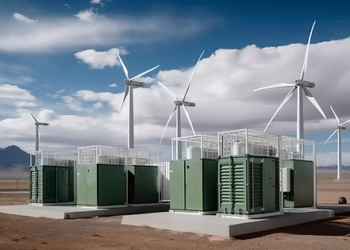
Second, accelerate technology transfers. Second, accelerate technology transfers. Share expertise and funding for battery storage to help stabilize renewable energy sources. China’s 1,000 GWh storage gap highlights the challenge; South Africa and Eswatini require support for robust grids and storage to facilitate effective transition.
Third, tailor policies to the context. Acknowledge each nation’s unique needs by allowing flexibility for low-emission countries and pragmatic timelines for others. For instance, Eswatini’s minimal emissions warrant resilience-building without strict bans, while South Africa’s experience shows the risks of hasty phase-outs. Policies should account for developmental stages, grid capacities, and energy needs to ensure a just energy transition at an affordable pace and cost.
The global community can learn from China’s coal-renewable energy balance, India’s push for energy sovereignty, South Africa’s blackout crisis, and Eswatini’s limited options. Ignoring the needs of smaller nations fractures global unity. A just transition requires collaboration for sustainable development and decarbonisation of the electricity sector.
The global effort to achieve net-zero emissions must prioritise genuine equity. South Africa’s frequent blackouts, declining electricity generation, and Eswatini’s energy security challenges highlight the risks of applying uniform climate policies. A just transition necessitates three key reforms: equitable financing that addresses the needs of those in transition, accelerated technology transfers to bridge capability gaps, and customised policy frameworks tailored to the unique circumstances of each nation. Such balanced approaches can ensure universal energy security while advancing sustainability goals.
Meet EP Investing — the platform behind the stories.
1,300+ companies · 350+ investors · 47+ grants