
Authors:
● Jean Rogers, Senior Operating Advisor at Pegasus Capital Advisors
Meet EP Investing — capital discovery for the energy transition.
● David Cogut, Co-Managing Partner at Pegasus Capital Advisors
1. How does Pegasus Capital find companies in which to invest? What criteria are they looking for?
Pegasus Capital Advisors seeks to identify solutions that address basic needs (e.g., food, water, energy, and oceans) in ways that can scale and make a real difference for communities. Much of our pipeline comes through partnerships with local governments, development banks, and UN agencies, as well as our own networks on the ground. For example, Pegasus has a formal partnership with the United Nations Development Program (UNDP) to finance projects identified by local governments. This allows us to source opportunities that are both locally prioritized and globally vetted.
The criteria Pegasus seeks in potential investments include:

● Essential services that people can’t live without, like electricity, refrigeration, broadband, or fertilizer.
● A clear path to scale, whether through established business models or technologies that can be adapted across countries.
● Tangible impact, from jobs created to emissions avoided to stronger local economies.
● Strong local support, so projects are aligned with national priorities and have lasting buy-in. Pegasus has backed projects that show how climate finance could deliver both community impact and solid returns, for example:
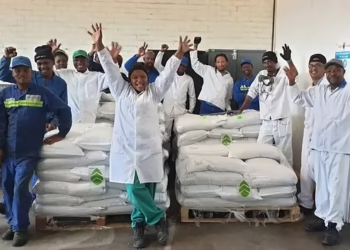
Project in Brazil, investment from Global Fund for Coral Reefs (GFCR): Produces organomineral fertilizers from sugarcane waste to improve soil health, reduce runoff, and protect coral reefs. The Global Fund for Coral Reefs committed up to $50 million to invest in this company, a strong example of circular economy innovation at scale.
Project in the Global South, investment from the Subnational Climate Fund (SCF): Expanding affordable, solar-powered broadband access for underserved communities. As of 2025, its technology can help reduce energy needs by up to 90% of conventional mobile networks, bridging the digital divide while slashing telecom emissions.
Project in Morocco & Senegal, investment from SCF: Building out sustainable cold- chain logistics to cut food waste and boost farmer incomes. With its recent acquisition of Lotraf, one of Morocco’s largest cold logistics operators, we believe IFRIA is on its way to creating a pan-African cold storage platform that will also improve vaccine distribution.
Project in Sri Lanka, investment from GFCR: South Asia’s first offshore barramundi farm, certified by global aquaculture standards. Oceanpick reduces destructive fishing practices, creates climate-resilient livelihoods, and provides a sustainable protein source.
Pegasus seeks out what some call ‘orphaned assets’ – projects that may be overlooked by other investors because of perceived complexity or market risk, but which Pegasus views as undervalued opportunities with outsized potential.
Pegasus is also helping push the next wave of climate innovation. Together with the SDG Digital Transformation and Sustainability Solutions Lab, they recently launched new work with UC Berkeley’s Center for Effective Global Action (CEGA) to use AI in strengthening agriculture and food security across Africa. The Lab also released a next-generation Digital Social Vulnerability Index, developed with Stanford’s Causal AI Lab, giving governments a clearer view of where climate risks are emerging and what actions will make the biggest difference.
2. How does the Subnational Climate Fund differ from the more traditional fund of venture investing?
The Subnational Climate Fund (SCF) is designed for projects that help deliver everyday essentials – clean power, cold storage, sustainable farming – in places that often get overlooked by private investors. Where traditional venture capital often funds early tech bets, the SCF seeks to back time- tested solutions that can be rolled out and scaled.
The fund blends public and private money, so investors are better protected. Public investment partners take on more of the risk, which encourages private capital to follow. Pegasus funds also have access to grant funding to support the groundwork – feasibility studies, environmental planning, and community programs – that make projects investable.
3. What challenges stem from an investment portfolio that spans the world? How can Pegasus account for political and economic trends in the countries in which it has investments?
Working across continents means navigating shifting policies, currencies, and infrastructure gaps. Our approach is to go deep in each country, rather than skim the surface. That means understanding local politics and economics, securing long-term agreements, and partnering with local governments, communities, and development banks so projects are resilient. This is part of what we call ‘perception arbitrage’ – turning what many investors may perceive to be high risk into a real opportunity by doing the hard work of structuring deals and understanding currency, creditworthiness, and contracts at the most local levels.
Pegasus seeks to balance risks across the portfolio. Emerging markets often carry lower credit ratings (below B+ in three-quarters of cases), which many investors shy away from. Our blended- finance structure, however, makes these markets accessible and investable at scale. For example, while some markets carry political uncertainty, others, like Morocco, with its currency pegged to the euro, offer more stability.
4. What is the traditional range of investment for early-stage companies?
Pegasus was founded nearly 30 years ago with the idea that investors don’t have to choose between financial returns and real-world impact. Pegasus seeks to invest in climate, food, water, and oceans with the intent to create good local jobs, strengthen communities, support a healthier environment, and deliver strong financial returns.
● Focus on essentials people can’t live without.
● Use blended finance to lower risk and unlock private investment.
● Measure impact in terms that matter – jobs created, emissions cut, food and water secured, reefs protected.
IMPORTANT NOTICES:
Specific investments described herein do not represent all investment decisions made by Pegasus Capital Advisors. The reader should not assume that investment decisions identified and discussed were or will be profitable. Specific investment advice references provided herein are for illustrative purposes only and are not necessarily representative of investments that will be made in the future.
Meet EP Investing — the platform behind the stories.
1,300+ companies · 350+ investors · 47+ grants