

The Energy Pioneer
No Result
View All Result
  • Home
  • Clean Tech
    • Electric Vehicles
    • Battery Storage
    • Energy Efficiency
    • Green Hydrogen
    • Smart Grid
  • Renewable Energy
    • Solar
    • Fossil Fuels
    • Hydrogen
    • Hydropower
    • Nuclear
    • Wind
  • Green Finance
    • Crash Course
    • Private Financing
    • Public Financing
    • Carbon Markets
  • Policy
  • Regions
    • Africa
    • Asia
    • West Asia
    • Latin America
    • North America
    • Europe
  • Features
  • Who We Are
    • About Us
    • Contact Us
    • EP Investing
  • Home
  • Clean Tech
    • Electric Vehicles
    • Battery Storage
    • Energy Efficiency
    • Green Hydrogen
    • Smart Grid
  • Renewable Energy
    • Solar
    • Fossil Fuels
    • Hydrogen
    • Hydropower
    • Nuclear
    • Wind
  • Green Finance
    • Crash Course
    • Private Financing
    • Public Financing
    • Carbon Markets
  • Policy
  • Regions
    • Africa
    • Asia
    • West Asia
    • Latin America
    • North America
    • Europe
  • Features
  • Who We Are
    • About Us
    • Contact Us
    • EP Investing
No Result
View All Result
The Energy Pioneer
No Result
View All Result
  • Home
  • Clean Tech
  • Green Finance
  • Policy
  • Renewable Energy
  • Regions
  • Features
  • Who We Are
Home Clean Tech

The Movement toward Microgrids

Otto GundersonbyOtto Gunderson
May 20, 2025
Reading Time: 4 mins read

The combination of new technologies and new financing methods has set the stage for microgrids to play a significant role in decarbonization. Companies that are providing energy as a service, and therefore moving the upfront cost for microgrids away from consumers, have shown considerable popularity. The falling costs of both battery storage and solar technology have made microgrids a more attractive option, while reports from the DoE emphasize the role they can play in grid stability and resiliency. It is no surprise that, as demand continues to grow and the US shifts to more renewables, microgrids will play an increasingly important role.

RELATED POSTS

Caught Between India’s Military Ambitions and Green Promises: The Future of the Andaman and Nicobar Islands

Decarbonizing Africa’s Road Passenger Transport

Unlocking Africa’s Renewable Potential with Battery Storage

A series of reports commissioned by the Department of Energy to create a microgrid program strategy found that the need for microgrids will increase as distributed energy resources (DER) increase. This is due to the ability of microgrids to act as a resilient and affordable tool in the push for decarbonization. In order to increase adoption, goals have been set to reduce microgrid cost, construction and commissioning time, and expand the amount of carbon-free sources in DER development. Microgrids are anticipated to grow in importance as DER continues to become a bigger share of energy generation. Should DER reach 30-50% of total generation capacity, microgrids will serve as a point of aggregation for these points of generation.

As Kirk Edelman, CEO of SolMicroGrid, explained, the interest in C&I Microgrids has exploded. The new financing methods allow companies to receive several significant benefits of green energy, including reliability and independence, without the upfront cost. SolMicroGrid, for instance, develops, builds, owns, and operates all its microgrids, providing energy as a service. Edelman explained that the combination of increased power outages and incentives by states has been a contributing factor in the demand for microgrids. The C&I interest in not being reliant on grid outages can be demonstrated by the work that SolMicroGrid has done in a partnership with Chick-fil-a. As Edelman outlined, even if all the restaurants on a street have lost power, the Chick-fil-a restaurants that installed microgrids will stay open. 

From The Energy Pioneer New memberships opening April 15, 2026

Meet EP Investing — capital discovery for the energy transition.

Visit EP Investing →

A report from Utility Dive found the new financing tools of companies such as SolMicroGrid to be on the rise across the industry. From 2019 to 2022, excluding the utility sector, microgrids as a service grew by 25% while end-user ownership fell by 31%. The growing number of outages and the adoption of improved storage technologies are among the reasons that the C&I sector accounted for almost half of all microgrid customers in 2022.

However, microgrids offer economic benefits to sectors outside of C&I. Microgrids, particularly in cities, could provide residential properties with the same resiliency and energy security. Property management companies in cities such as New York are seeing significant savings through investment in microgrids for both residential and commercial properties. Elena Lebensbaum, the Director of Sustainability at Time Equities Inc. (TEI), explained that a partnership with Microgrid Networks (MGN) will allow MGN to become an off-taker for the microgrids. As Lebensbaum explained, the limited space in densely packed cities makes battery storage a challenge, but by having an offtaker willing to purchase the energy credits from the utility, these projects can still achieve significant savings.

While battery storage may not always be an option, it still attracts significant investment. Andy Sofranko, Vice President of Engineering at REC Solar, outlined how the improvement of batteries was an integral step in the viability of microgrids. As Sofranko explained, the commercial viability of batteries and the commercial viability of microgrids went hand in hand. However, the new interest in microgrids is not without challenges, stemming from different customers’ unique needs. For instance, a manufacturing plant with a microgrid may need to prevent any loss of power, even for a short period of time, to prevent the line from being taken off production.
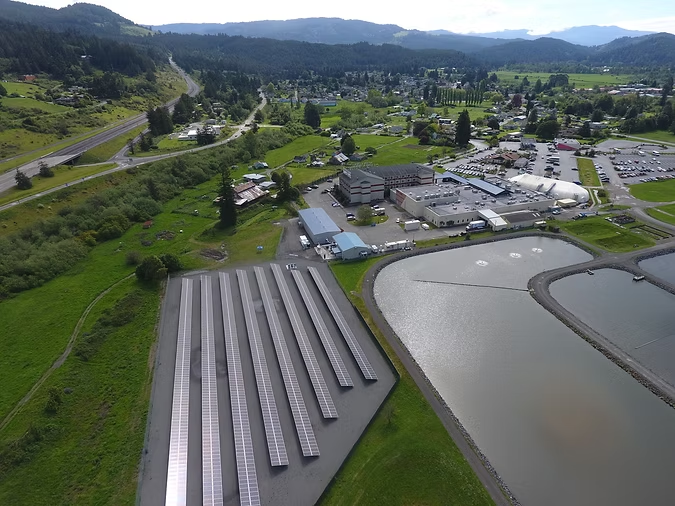
Solar Array and Microgrid built by REC Solar for the Blue Lake Rancheria Tribe of California: Photo provided by REC Solar

A significant advantage of microgrids, especially for those in the C&I market, is the opportunity to place energy generation close to large energy users. As Kevin Pratt, COO of Pacifico Energy, outlined during a conversation with The Energy Pioneer in April, allowing energy generation and consumption to be built next to each other negates the need for unnecessary transmission construction. This point is reiterated in a DoE Commissioned Report, where a primary goal for the microgrid program should be to place microgrids as a point of aggregation for larger numbers of DERs.

Buy JNews
ADVERTISEMENT

As the cost of materials has fallen and the efficiency has risen, the attractiveness of microgrids as an investment has increased. While the historically high upfront cost of design, equipment, and project installation has been a roadblock, new financing methods could prove to be as influential as new technological improvements in spurring the adoption of microgrids. The increases in DER and power outages, coupled with advancements in both financing methods and technology, put microgrids in a strong position for years to come.

From The Energy Pioneer New memberships opening April 15, 2026

Meet EP Investing — the platform behind the stories.

1,300+ companies · 350+ investors · 47+ grants
Visit EP Investing →
ShareTweetShare
Otto Gunderson

Otto Gunderson

Otto Gunderson has been working in clean energy for the last 7 years, with the last two being spent split between South America, Africa, and Southeast Asia, reporting on the transition to clean energy. After traveling and writing for two years, he founded The Energy Pioneer to create a news outlet with a global approach to clean energy journalism. He particularly enjoys writing about entrepreneurship, investment, and innovations that are contributing to greenhouse gas reduction and clean energy development.

Related Posts

Caught Between India’s Military Ambitions and Green Promises: The Future of the Andaman and Nicobar Islands
Renewable Energy

Caught Between India’s Military Ambitions and Green Promises: The Future of the Andaman and Nicobar Islands

March 19, 2026
Decarbonizing Africa’s Road Passenger Transport
Africa

Decarbonizing Africa’s Road Passenger Transport

March 3, 2026
Unlocking Africa’s Renewable Potential with Battery Storage
Solar

Unlocking Africa’s Renewable Potential with Battery Storage

February 25, 2026
Green Hydrogen in Tunisia: Ambitious Energy Strategy amidst Implementation Challenges
Africa

Green Hydrogen in Tunisia: Ambitious Energy Strategy amidst Implementation Challenges

February 13, 2026
Hurricane Melissa Shines Light on Jamaica’s Energy Sector
Renewable Energy

Hurricane Melissa Shines Light on Jamaica’s Energy Sector

February 10, 2026
The Race to Host AI: Data Centres in Water-Scarce India
Asia

The Race to Host AI: Data Centres in Water-Scarce India

February 9, 2026
Next Post
Argentina’s Environmental Budget Slashed Under President Javier Milei

Argentina's Environmental Budget Slashed Under President Javier Milei

The Race for Long-Duration Energy Storage

The Race for Long-Duration Energy Storage

Popular Stories

  • The Financiers and Startups Decarbonizing Africa’s ‘Anti-Fossil’ Fuel Nation

    The Financiers and Startups Decarbonizing Africa’s ‘Anti-Fossil’ Fuel Nation

    0 shares
    Share 0 Tweet 0
  • Caught Between India’s Military Ambitions and Green Promises: The Future of the Andaman and Nicobar Islands

    0 shares
    Share 0 Tweet 0
  • Decarbonizing Africa’s Road Passenger Transport

    0 shares
    Share 0 Tweet 0
  • Green Hydrogen in Tunisia: Ambitious Energy Strategy amidst Implementation Challenges

    0 shares
    Share 0 Tweet 0
  • South African Pension Funds Outshine $13 Billion Green Transition Funds

    0 shares
    Share 0 Tweet 0

Actionable Info

🔒 NEW MEMBERSHIPS OPEN APRIL 15
EP
EP Investing Climate Finance Intelligence

Our journalism is made possible by readers like you.

The founders, investors, and professionals reading The Energy Pioneer use EP Investing to find capital, partners, and opportunities.

1300+Companies
350+Investors
45+Grants
Explore EP Investing →

The Energy Pioneer

The Energy Pioneer covers the global energy transition — from clean tech and green finance to policy and renewable energy.

Recent Posts

  • Caught Between India’s Military Ambitions and Green Promises: The Future of the Andaman and Nicobar Islands
  • Decarbonizing Africa’s Road Passenger Transport
  • Unlocking Africa’s Renewable Potential with Battery Storage

Categories

  • Africa
  • Asia
  • Battery Storage
  • Carbon Markets
  • Clean Tech
  • Crash Course
  • Electric Vehicles
  • Energy Efficiency
  • Features
  • Fossil Fuels
  • Green Finance
  • Green Hydrogen
  • Hydrogen
  • Hydropower
  • Latin America
  • North America
  • Nuclear
  • Policy
  • Private Financing
  • Public Financing
  • Renewable Energy
  • Smart Grid
  • Solar
  • West Asia

Quick Links

  • Home

© 2026 The Energy Pioneer | All Rights Reserved. |

No Result
View All Result
  • Home
  • Clean Tech
    • Electric Vehicles
    • Energy Efficiency
    • Green Hydrogen
    • Smart Grid
    • Battery Storage
  • Green Finance
    • Public Financing
    • Private Financing
    • Carbon Markets
  • Policy
  • Renewable Energy
    • Wind
    • Solar
    • Hydropower
    • Nuclear
    • Hydrogen
    • Fossil Fuels
    • Geothermal
  • Regions
    • Africa
    • Asia
    • Europe
    • North America
    • Latin America
    • West Asia
  • Features
  • Who We Are
    • About Us
    • EP Investing
    • Contact Us

© 2026 The Energy Pioneer | All Rights Reserved. |