

Along with mitigation, adapting to climate change is one of the challenges of this era. This Latin American summit needs to take a step forward on indicators and financing for this issue.
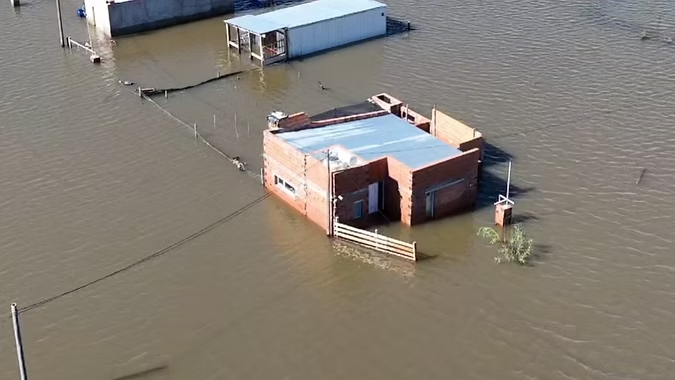
2024 was the hottest year on record. Climate change is increasingly harming both ecosystems and people. Beyond mitigation efforts, the world needs to prepare communities for the impacts that can no longer be avoided. According to the IPCC, there is still a window of time to act on adaptation, but that window is rapidly closing. COP30, which officially begins on November 10 in Belém, Brazil, must deliver on climate adaptation.
Adaptation refers to adjustments in ecological, social, or economic systems to respond to the actual or potential effects of climate change, as explained by the UNFCCC. While mitigation can be tracked through emissions data, adaptation is far more difficult to measure globally. Moreover, most of the climate finance has been directed towards mitigation, leaving funds for adaptation behind. Civil society organizations are hoping to see progress on these two issues.
Meet EP Investing — capital discovery for the energy transition.
“This is the COP of adaptation. There’s no room not to adapt, people’s lives are at risk”, said Pilar Bueno, Deputy Secretary for Climate Change for the city of Rosario, Argentina, and Director of Argentina 1.5°C, an organization focused on climate mitigation and adaptation policies.
Latin América is one of the regions that has contributed less to climate change, but it is also one of the most vulnerable to its effects. Additionally, inequality in the region has been a recurring historical factor. This “decreases human capacity to adapt to climate change,” according to IPCC.
The adaptation indicators: from 9.500 to 100
The Global Goal on Adaptation (GGA) was established in 2015 under the Paris Agreement to “enhance adaptive capacity, strengthen resilience, and reduce vulnerability to climate change.” Later, at COP28 in Dubai, Parties agreed on a framework for the GGA that includes 11 sub-goals. That agreement also launched a two-year work program to develop indicators for measuring progress in adaptation efforts. That program comes to an end at this COP in Belém.

The framework established that a group of experts would work on developing adaptation indicators. Initially, 9,500 indicators were submitted. After two years, the parties now have a shortlist of about 100 indicators to negotiate in Belém. These indicators should be useful for measuring every stage of the adaptation process, as Maritza Florian, Deputy Director of Diplomacy at Transforma, a Latin American think tank, explained to The Energy Pioneer. This process includes impact assessments, planning through National Adaptation Plans (NAPs), implementation, and monitoring, as Florian explained.
The list includes indicators for every sub-goal of the GGA, and the political discussions surrounding this topic in these climate negotiations will center on an item called “means of implementation” (MOI). This includes indicators about finance, capacity building, and technology transfer.
“They’re the most controversial ones because they address how the money will flow,” noted Florian.
The previous list was presented last September by the group of experts, and developing countries had numerous concerns about the MOI indicators, explained Bueno.
Experts consulted said that the COP presidency aims to reach an early agreement on this list during the first week of the summit. However, ahead of COP30, developing countries haven’t reached a common stance on the MOI. There is still no consensus within the Group of 77 and China, a negotiating bloc of developing nations that includes all Latin American countries. So far, only “Grupo SUR”, made up of Argentina, Brazil, Ecuador, Paraguay, and Uruguay, has submitted a new proposal for the MOI indicators.
At the same time, some organizations argue that the debate over the list of indicators should not be reopened.
“We already have that list of indicators, which is obviously not perfect, and from civil society we’re advocating for it to remain as it is,” Daniel Porcel, Specialist in Mobilization and Dialogue at Talanoa, a Brazilian Climate Think Tank, explained to a journalist from The Energy Pioneer.
Climate finance: the big discussion of every COP
Last year’s summit concluded with an insufficient agreement on climate finance. There had been high expectations around the New Collective Quantified Goal (NCQG), but finally, developed countries agreed to mobilize US$300 billion per year by 2035 for developing countries. But these nations and civil society groups had been calling for a much larger figure, US$1.3 trillion.
According to the Adaptation Gap Report (AGR), this new goal is “clearly insufficient” to meet adaptation finance needs. The NCQG covers mitigation and adaptation, and there is no sub-goal for adaptation, the report adds. According to the United Nations Developing Programme, 90% of climate finance has historically been allocated to mitigation. Moreover, the AGR claims that the cost of adaptation scales up to US$310-365 billion per year for developing countries by 2035. The adaptation finance gap is now estimated to be between US$284 billion and US$399 billion per year until 2035. Ahead of COP30, civil society organizations are pushing for increased funding, specifically for adaptation. But how could this outcome materialize at the Belém summit?
One of the options is to renew the Glasgow Climate Pact, adopted in 2021 at the conclusion of COP26, which is set to expire this year. The pact called on developed countries to double adaptation finance from 2019 levels to around US$40 billion by 2025. Based on the latest available data, developed nations mobilized US$26 billion in 2023, a lower amount than in 2022. This suggests that the goal of the Glasgow Pact will be missed if current trends continue, the AGR noted.
“The Glasgow Pact must be renewed”, pointed out Florian.
Developing countries are pushing for a new goal of tripling, not doubling, the climate finance on adaptation, added the expert. It should be a new goal for adaptation finance, said Bueno.“It’s not about reopening the NCQG, but about retaking the Glasgow pact,” he added.
In addition to this pact, parties and civil society had expectations regarding the Baku to Belém Roadmap. The NCQG document included an article that stated: “Calls on all actors to work together to enable the scaling up of financing to developing country Parties for climate action from all public and private sources to at least $1.3 trillion per year by 2035.” The decision also launched the Baku to Belém Roadmap to scale up climate finance to 1.3 T. The presidencies of COP29 and COP30 released the roadmap report on November 5.
Despite expectations that this roadmap will help scale up climate finance, some experts have expressed caution. “The roadmap cannot solve all the problems of climate finance because it is not based on a formal negotiation text,” explained Porcel.
The report outlines five action fronts on finance to scale up climate funding to $1.3 trillion per year by 2035. These actions include replenishing grants, concessional finance, and low-cost capital; rebalancing fiscal space and debt sustainability; rechanneling private finance; revamping capacity and coordination for scaled climate portfolios; and reshaping systems and structures to facilitate equitable capital flows. Although the document recommends actions, it is not a decision text that countries are required to adopt.
A positive aspect of the roadmap is that, despite being repeatedly stated as not a negotiation element, it does outline options to strengthen the path opened by this document. Thus, “allowing us to envisage a scenario that goes beyond the COP itself”, highlighted Sandra Guzmán, Director of the Climate Finance Group for Latin America and the Caribbean (GFLAC). On the negative side, the expert pointed out that the document “calls to improve access, without including measures to achieve it”. Guzmán also noted that adaptation is in the narrative, but not in the proposals.
COP30 has two weeks for parties to discuss and deliver on adaptation. As the IPCC notes, climate change is progressing more rapidly than we can adapt. With the summit set to begin Monday in Brazil, it is worth recalling that the GGA framework was initially proposed by Latin America, specifically by Argentina, and later adopted by the Parties at COP28. “There is a historic commitment from the region to adaptation. The issue began here, and now it could also come to a close here,” concluded Bueno ahead of COP30.
Meet EP Investing — the platform behind the stories.
1,300+ companies · 350+ investors · 47+ grants