

The Energy Pioneer
No Result
View All Result
  • Home
  • Clean Tech
    • Electric Vehicles
    • Battery Storage
    • Energy Efficiency
    • Green Hydrogen
    • Smart Grid
  • Renewable Energy
    • Solar
    • Fossil Fuels
    • Hydrogen
    • Hydropower
    • Nuclear
    • Wind
  • Green Finance
    • Crash Course
    • Private Financing
    • Public Financing
    • Carbon Markets
  • Policy
  • Regions
    • Africa
    • Asia
    • West Asia
    • Latin America
    • North America
    • Europe
  • Features
  • Who We Are
    • About Us
    • Contact Us
    • EP Investing
  • Home
  • Clean Tech
    • Electric Vehicles
    • Battery Storage
    • Energy Efficiency
    • Green Hydrogen
    • Smart Grid
  • Renewable Energy
    • Solar
    • Fossil Fuels
    • Hydrogen
    • Hydropower
    • Nuclear
    • Wind
  • Green Finance
    • Crash Course
    • Private Financing
    • Public Financing
    • Carbon Markets
  • Policy
  • Regions
    • Africa
    • Asia
    • West Asia
    • Latin America
    • North America
    • Europe
  • Features
  • Who We Are
    • About Us
    • Contact Us
    • EP Investing
No Result
View All Result
The Energy Pioneer
No Result
View All Result
  • Home
  • Clean Tech
  • Green Finance
  • Policy
  • Renewable Energy
  • Regions
  • Features
  • Who We Are
Home Clean Tech

Addressing EV Load Management

Otto GundersonbyOtto Gunderson
March 27, 2025
Reading Time: 4 mins read

As electric vehicles become more commonplace and charging stations continue to spring up around the United States, there is growing concern about the strain that this will cause on the grid. This problem needs to be approached first by the demand side; as more electric vehicles enter the market, the pressure on the grid will continue to increase. Improving existing transmission infrastructure and reducing delays in connecting new charging hubs will prove important.

RELATED POSTS

Decarbonizing Africa’s Road Passenger Transport

Green Hydrogen in Tunisia: Ambitious Energy Strategy amidst Implementation Challenges

The Players Driving Africa’s Decentralized Energy Revolution

However, simultaneously tackling the problem of EV strain on the grid through the supply side, with solutions such as ridesharing, location optimization, and bi-directional energy flow in batteries, can prevent bottlenecks. Similarly, software products such as dynamic load management could reduce unnecessary strain while saving EV owners on charging costs. Rather than pressure the grid and utility to provide the maximum power that may be required if all charging stations are being used at full capacity, software within the charger is capable of balancing loads, charge rates, and output.
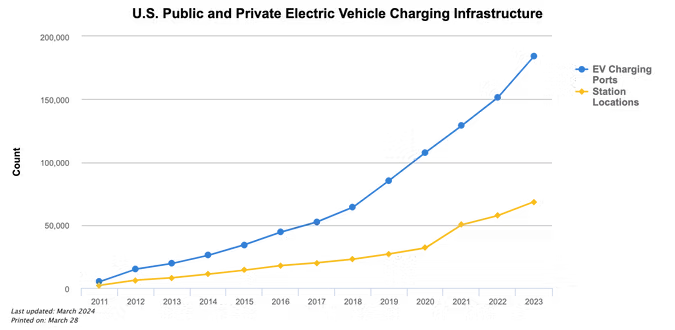
The growth of charging ports in the US is critical for EV adoption, but it must be handled from both the supply and demand side to not put additional strain on the energy grid: Graph provided by US Department of Energy.

Put simply, dynamic load management controls the total power applied to EV chargers, allowing more charging stations to be installed at a given location. The electric vehicle adoption goals set for 2030, in which EVs make up half of all car sales and 500,000 electric vehicle charges are installed, mean that bottlenecks in charging could prevent this goal from being reached. As outlined by an Eaton White Paper on the topic, load management software allows for more chargers to be installed than previously assumed, improving management and deployment of the stations along with the increased outlet.  

From The Energy Pioneer New memberships opening April 15, 2026

Meet EP Investing — capital discovery for the energy transition.

Visit EP Investing →

Regarding the reasoning behind dynamic load software, Johannes Copeland, Chief Operating Officer at Skycharger, outlined how delays with permitting and development could stagnate the deployment of more charging stations. By his estimate, a new DC fast charger could take between 6 and 9 months to design and another 9 to 12 months to work through connection with utility and acquire equipment. Therefore, achieving interconnection in a year and a half is considered a positive. Part of this delay is the result of the improvements made in electric vehicle batteries. As electric vehicle battery range continues to increase, the energy pull that they are able to place on the grid grows proportionally. 

This hold-up must be solved now to avoid a lack of charging stations as electric vehicles continue to enter the market. As Copeland described, the strain on the grid with more powerful batteries is not necessarily a plant capacity problem but a limitation due to grid transmission and distribution constraints. These constraints, he points out, are tied to a “worst-case scenario” situation for the charging station. The grid must provide the power capabilities for all ports to run at full charge for the largest batteries. This adds an unnecessary constraint to the development of the DC fast-charging industry. Rather than blaming grid development or excessive regulation, a solution would be implementing dynamic load management software to better handle charging scenarios.
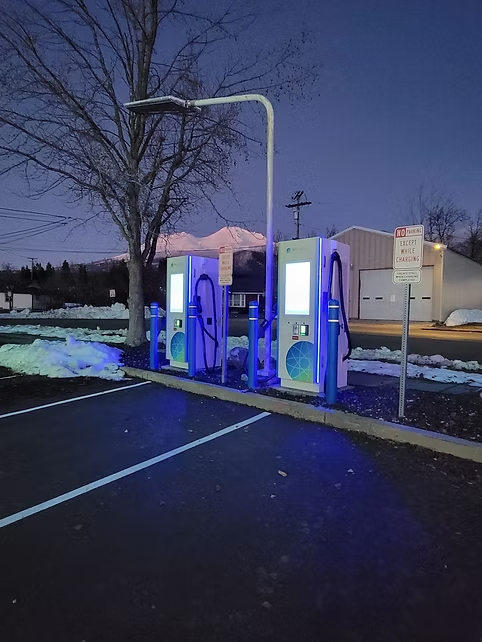
EV chargers can have software to limit strain on the grid from too many fast-charging sessions at once: Photo provided by Skycharger.

Solutions such as ridesharing of electric vehicles and the possibilities of a bi-directional flow of energy from charging EV models have the potential to reduce grid strain. Scott Macwilliam, Founder and CEO of Kite Mobility, mentioned this possibility during a conversation on EV ridesharing. Kite Mobility, a Canada-based start-up, provides electric vehicles to buildings such as apartments, offering clean transportation for residents without the cost and hassle of owning a car. In relation to load management, as these vehicles can charge at the most convenient time, Macwilliam explained how the growing number of vehicles could serve as a backup storage system. During times of peak energy use, the Kite vehicle could be turned off, allowing charging to stop and energy to flow back into the building.

Kite allows for ridesharing, maximizing the time vehicles are connected to a charger and actually serving as battery backup for the grid. Photo provided by Kite

Jamie Hall, Director of Policy at EV Realty, addressed preventing grid strain by choosing ideal charging locations for charging with strong existing transmission ability. As a company focusing on building high-powered commercial hubs for medium—and heavy-duty electric vehicles, grid access is critical to its success. One roadblock of its development thus far has been constraints to local electric grids and delays for upgrading. This leads to one of the most essential things that EV Realty looks for: capacity on local grid utilities and whether upgrades to the distribution grid will be required. 

Buy JNews
ADVERTISEMENT

Likewise, having access to information on chargers is essential for EV drivers. This starts by having access to data on charging locations and charging times. Erkki Tapola, CEO of SolidRoam, spoke with me about the importance of being able to charge different vehicles at different charging hubs. This, coupled with an application program interface (API), provides the required information for someone who wants to use a public charger (location, rate, availability). Additionally, information will be available to the customer on how long the charge will take and the cost of charging. This will put less pressure on the grid and optimize charging options as customers shy away from charging at peak consumption times and instead charge when costs are low and availability is high.

The challenge of incorporating millions of electric vehicles onto the grid will need to utilize new technologies and practices to prevent grid strain, promote economical charging, and address concerns about the availability of chargers. On the supply side, providing the necessary software to optimize charging and decreasing the delays in new charging stations ensures every EV driver can get a charge when needed. On the demand side, battery improvements could serve as energy backup while ride-sharing and location optimization minimize grid strain. These solutions are not mutually exclusive; rather, they will benefit each other and the EV industry as a whole.

From The Energy Pioneer New memberships opening April 15, 2026

Meet EP Investing — the platform behind the stories.

1,300+ companies · 350+ investors · 47+ grants

Visit EP Investing →
ShareTweetShare
Otto Gunderson

Otto Gunderson

Otto Gunderson has been working in clean energy for the last 7 years, with the last two being spent split between South America, Africa, and Southeast Asia, reporting on the transition to clean energy. After traveling and writing for two years, he founded The Energy Pioneer to create a news outlet with a global approach to clean energy journalism. He particularly enjoys writing about entrepreneurship, investment, and innovations that are contributing to greenhouse gas reduction and clean energy development.

Related Posts

Decarbonizing Africa’s Road Passenger Transport
Africa

Decarbonizing Africa’s Road Passenger Transport

March 3, 2026
Green Hydrogen in Tunisia: Ambitious Energy Strategy amidst Implementation Challenges
Africa

Green Hydrogen in Tunisia: Ambitious Energy Strategy amidst Implementation Challenges

February 13, 2026
The Players Driving Africa’s Decentralized Energy Revolution
Africa

The Players Driving Africa’s Decentralized Energy Revolution

February 2, 2026
South Africa’s Exciting Clean Tech Startups
Africa

South Africa’s Exciting Clean Tech Startups

January 15, 2026
3 Climate-Tech Innovators Powering Africa’s Agriculture
Africa

3 Climate-Tech Innovators Powering Africa’s Agriculture

January 5, 2026
Morocco Bets on Solar Desalination to Tackle Water Stress
Africa

Morocco Bets on Solar Desalination to Tackle Water Stress

December 29, 2025
Next Post
Trump’s Tariffs Could Hamper Much-Needed Steel Decarbonization

Trump's Tariffs Could Hamper Much-Needed Steel Decarbonization

Routes and Roadblocks to Green Hydrogen Growth

Routes and Roadblocks to Green Hydrogen Growth

Popular Stories

  • The Financiers and Startups Decarbonizing Africa’s ‘Anti-Fossil’ Fuel Nation

    The Financiers and Startups Decarbonizing Africa’s ‘Anti-Fossil’ Fuel Nation

    0 shares
    Share 0 Tweet 0
  • Decarbonizing Africa’s Road Passenger Transport

    0 shares
    Share 0 Tweet 0
  • Green Hydrogen in Tunisia: Ambitious Energy Strategy amidst Implementation Challenges

    0 shares
    Share 0 Tweet 0
  • South African Pension Funds Outshine $13 Billion Green Transition Funds

    0 shares
    Share 0 Tweet 0
  • Unlocking Africa’s Renewable Potential with Battery Storage

    0 shares
    Share 0 Tweet 0

Actionable Info

🔒 NEW MEMBERSHIPS OPEN APRIL 15
EP
EP Investing Climate Finance Intelligence

Our journalism is made possible by readers like you.

The founders, investors, and professionals reading The Energy Pioneer use EP Investing to find capital, partners, and opportunities.

1300+Companies
350+Investors
45+Grants
Explore EP Investing →

The Energy Pioneer

The Energy Pioneer covers the global energy transition — from clean tech and green finance to policy and renewable energy.

Recent Posts

  • Decarbonizing Africa’s Road Passenger Transport
  • Unlocking Africa’s Renewable Potential with Battery Storage
  • The Financiers and Startups Decarbonizing Africa’s ‘Anti-Fossil’ Fuel Nation

Categories

  • Africa
  • Asia
  • Battery Storage
  • Carbon Markets
  • Clean Tech
  • Crash Course
  • Electric Vehicles
  • Energy Efficiency
  • Features
  • Fossil Fuels
  • Green Finance
  • Green Hydrogen
  • Hydrogen
  • Hydropower
  • Latin America
  • North America
  • Nuclear
  • Policy
  • Private Financing
  • Public Financing
  • Renewable Energy
  • Smart Grid
  • Solar
  • West Asia

Quick Links

  • Home

© 2026 The Energy Pioneer | All Rights Reserved. |

No Result
View All Result
  • Home
  • Clean Tech
    • Electric Vehicles
    • Energy Efficiency
    • Green Hydrogen
    • Smart Grid
    • Battery Storage
  • Green Finance
    • Public Financing
    • Private Financing
    • Carbon Markets
  • Policy
  • Renewable Energy
    • Wind
    • Solar
    • Hydropower
    • Nuclear
    • Hydrogen
    • Fossil Fuels
    • Geothermal
  • Regions
    • Africa
    • Asia
    • Europe
    • North America
    • Latin America
    • West Asia
  • Features
  • Who We Are
    • About Us
    • EP Investing
    • Contact Us

© 2026 The Energy Pioneer | All Rights Reserved. |