
The Energy Pioneer
No Result
View All Result
  • Home
  • Clean Tech
  • Renewable Energy
  • Green Finance
    • Crash Course
    • Private Financing
    • Public Financing
    • Carbon Markets
  • Policy
  • Regions
    • Africa
    • Asia
    • West Asia
    • Latin America
    • North America
    • Europe
  • Features
  • Who We Are
    • About Us
    • Contact Us
    • EP Investing
  • Home
  • Clean Tech
  • Renewable Energy
  • Green Finance
    • Crash Course
    • Private Financing
    • Public Financing
    • Carbon Markets
  • Policy
  • Regions
    • Africa
    • Asia
    • West Asia
    • Latin America
    • North America
    • Europe
  • Features
  • Who We Are
    • About Us
    • Contact Us
    • EP Investing
No Result
View All Result
The Energy Pioneer
No Result
View All Result
  • Home
  • Clean Tech
  • Green Finance
  • Policy
  • Renewable Energy
  • Regions
  • Features
  • Who We Are
Home Africa

The Players Driving Africa’s Decentralized Energy Revolution

byNollen Mhondera
April 1, 2026
Reading Time: 5 mins read

Though renewable energy has moved from momentum to maturity across Africa, virtual free-wheeling remains rare. Virtual freewheeling is the transport of electricity across existing grids for financial transactions (selling power from one location to another via shared lines), explains Brian Molefe, former chief executive of South Africa’s Eskom (2015 to 2016). Eskom is the largest power utility on the continent.

RELATED POSTS

Iran War Triggers Oil Shock as Zimbabwe Turns to Ethanol Blending

Africa’s EV Future May Depend on Electrifying the Informal Sector

The Modular Approach to Direct Air Capture

“Absence of laws that allow freewheeling, red tape bureaucracy, aging colonial electricity grids, inability to understand the tech and financial modalities behind the low uptake of freewheeling across Africa,” he says. 

Of all these, the biggest stumbling block is state-owned coal power grids that consider independent renewable energy producers (IPPs) as existential threats, he stresses.

From The Energy Pioneer New memberships opening April 15, 2026

Meet EP Investing — capital discovery for the energy transition.

Visit EP Investing →

Bucking the trend

Despite challenges,  South Africa and Namibia have crossed the barrier and begun the continent’s first Virtual Wheeling operations.

The most prominent player in South Africa’s free-wheeling industry is SOLA Group. It is the first company on the continent to fully operate virtual freewheeling, connecting its PV solar power plant output to Vodacom, Africa’s largest telecoms company, among other clients. 
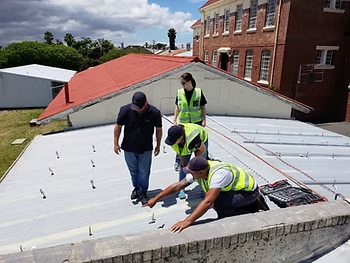
Workers for Sola Group have been instrumental in developing decentralized energy production and distribution in South Africa. Photo provided by author.

In September 2025, the SOLA Group officially began connecting supplies from its Springbok Solar Power Project in central South Africa. The plant is Africa’s first multi-buyer, flexible energy-wheeling solar facility, with a production capacity of 195 MW. Its modalities are straightforward. It enables multiple corporate buyers to procure clean energy from a single private, large-scale plant and direct it to their business operations. The Springbok project is now supplying power to multiple large corporate buyers in South Africa, including Amazon Web Services, Sibanye-Stillwater (one of the largest gold and platinum miners), Vodacom (South Africa’s biggest cellular phone network), and Sasol South Africa (one of the world’s biggest petrochemical processors), to enter into power purchase agreements. In the future, Springbok plans to generate up to 430 GWh of energy per year. 

Buy JNews
ADVERTISEMENT

“At SOLA Group, we’ve been at the forefront of South Africa’s energy transition as an experienced IPP, due to our pioneering role in developing and building Africa’s first multi-buyer, and various other utility-scale solar wheeling projects,” says Dom Willis, the executive director of SOLA.

Lowering pressure

The footprint of Independent Power Producers (IPPs) has expanded rapidly in recent years as South Africa opens its power market to private players, thereby gradually diluting the monopoly Eskom once held. In this context, IPPs are companies that generate electricity from solar, wind, landfill gas, and other renewable sources, and sell that energy into the grid or directly to corporate buyers through contracts such as Power Purchase Agreements (PPAs) with Eskom or directly with commercial customers. Around 9% of total power generation (as per 2025) is supplied by IPPs, with renewables being the main input, says Willis.
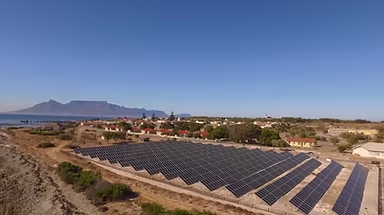
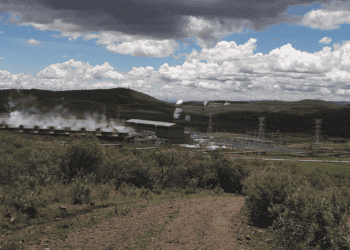
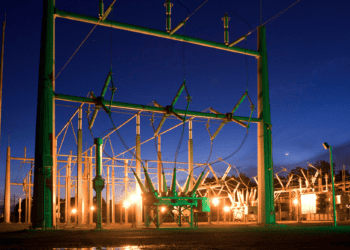
Solar plants in South Africa and Namibia demonstrate the feasibility of renewable energy being used for free-wheeling. Photo provided by author.

South Africa is one of the largest economies whose power generation is overwhelmingly dominated by coal. In this scenario, IPPs are important for decarbonizing South Africa’s grid and making a gradual march towards the green transition, says Irvin Jim, the secretary of the South African National Union of Metalworkers.

“Wheeling and bilateral contracts empower IPPs to send renewable power directly to business, reducing (the) complexity that comes with a model of one state-owned power company with a monopoly. This is good for savings, sustainability, and lowering pressure on the national grid,” he outlines.

Big step

Just across the border in Namibia, SPS, a leading renewable energy startup, is also driving progress in a semi-desert country that is among the world’s sunniest.

Sustainable Power Solutions (SPS) has just operationalized Namibia’s first solar wheeling project. Its 10 MW Maxwell solar power plant is located on a farm 250km from Namibia’s capital. The project’s beneficiaries receive financial credits or rebates on their electricity bills for the amount of clean energy generated, without a direct physical connection to the IPP’s plant. SPS has already entered into a working agreement with miner B2Gold Namibia, and other local corporates. SPS is taking advantage of Namibia’s NamPower’s Modified Single Buyer (MSB) Programme, which legalizes private independent power producers (IPPs) to sell electricity directly to large customers using the national grid.

“The Maxwell solar plant is a big step forward in opening up access to Namibia’s grid,” says SPS director, Francois van Themaat. “It proves that wheeling under the MSB Programme works and shows how private producers and corporate offtakers can collaborate with state power utilities to accelerate renewable-energy deployment.”

Freewheeling is a brilliant way to directly open the grid – and it saves IPPs from directly building their own separate transmission lines afresh, explains Trevor Manuel, the former South African finance minister (1996 – 2009).

“But I’d like to see the commercial offtake agreements that go beyond merely supplying corporates to IPPs (with) freewheeling power to municipalities and thus serve millions of households”, he concludes.
From The Energy Pioneer New memberships opening April 15, 2026

Meet EP Investing — the platform behind the stories.

1,300+ companies · 350+ investors · 47+ grants

Visit EP Investing →
ShareTweetShare
Nollen Mhondera

Nollen Mhondera

Related Posts

Iran War Triggers Oil Shock as Zimbabwe Turns to Ethanol Blending
Renewable Energy

Iran War Triggers Oil Shock as Zimbabwe Turns to Ethanol Blending

April 8, 2026
Africa’s EV Future May Depend on Electrifying the Informal Sector
Clean Tech

Africa’s EV Future May Depend on Electrifying the Informal Sector

March 31, 2026
The Modular Approach to Direct Air Capture
Clean Tech

The Modular Approach to Direct Air Capture

April 1, 2026
Lithium Lockdown: Zimbabwe’s Big Bet on Local Processing
Clean Tech

Lithium Lockdown: Zimbabwe’s Big Bet on Local Processing

April 1, 2026
Caught Between India’s Military Ambitions and Green Promises: The Future of the Andaman and Nicobar Islands
Renewable Energy

Caught Between India’s Military Ambitions and Green Promises: The Future of the Andaman and Nicobar Islands

March 19, 2026
Decarbonizing Africa’s Road Passenger Transport
Africa

Decarbonizing Africa’s Road Passenger Transport

April 1, 2026
Next Post
From Access to Sovereignty: Africa’s Renewable Energy Vision

From Access to Sovereignty: Africa's Renewable Energy Vision

The Race to Host AI: Data Centres in Water-Scarce India

The Race to Host AI: Data Centres in Water-Scarce India

Popular Stories

  • Caught Between India’s Military Ambitions and Green Promises: The Future of the Andaman and Nicobar Islands

    Caught Between India’s Military Ambitions and Green Promises: The Future of the Andaman and Nicobar Islands

    0 shares
    Share 0 Tweet 0
  • Two Paths Forward: How The Iran Conflict Is Reshaping the Energy Sector

    0 shares
    Share 0 Tweet 0
  • The Race to Host AI: Data Centres in Water-Scarce India

    0 shares
    Share 0 Tweet 0
  • The Modular Approach to Direct Air Capture

    0 shares
    Share 0 Tweet 0
  • Africa’s EV Future May Depend on Electrifying the Informal Sector

    0 shares
    Share 0 Tweet 0

Actionable Info

🔒 NEW MEMBERSHIPS OPEN APRIL 15
EP
EP Investing Climate Finance Intelligence

Our journalism is made possible by readers like you.

The founders, investors, and professionals reading The Energy Pioneer use EP Investing to find capital, partners, and opportunities.

1300+Companies
350+Investors
45+Grants
Explore EP Investing →

The Energy Pioneer

The Energy Pioneer covers the global energy transition — from clean tech and green finance to policy and renewable energy.

Recent Posts

  • What is Green Islamic Finance and How Could it Accelerate the Renewable Energy Transition?
  • Iran War Triggers Oil Shock as Zimbabwe Turns to Ethanol Blending
  • Hybrid Renewables for Sustainable Electrification in the Sundarbans

Quick Links

  • Home
  • Clean Tech
  • Renewable Energy
  • Green Finance
  • Policy
  • Regions
  • Features
  • Who We Are

© 2026 The Energy Pioneer | All Rights Reserved. |

No Result
View All Result
  • Home
  • Clean Tech
    • Electric Vehicles
    • Energy Efficiency
    • Green Hydrogen
    • Smart Grid
    • Battery Storage
  • Green Finance
    • Public Financing
    • Private Financing
    • Carbon Markets
  • Policy
  • Renewable Energy
    • Wind
    • Solar
    • Hydropower
    • Nuclear
    • Hydrogen
    • Fossil Fuels
    • Geothermal
  • Regions
    • Africa
    • Asia
    • Europe
    • North America
    • Latin America
    • West Asia
  • Features
  • Who We Are
    • About Us
    • EP Investing
    • Contact Us

© 2026 The Energy Pioneer | All Rights Reserved. |