
The Energy Pioneer
No Result
View All Result
  • Home
  • Clean Tech
  • Renewable Energy
  • Green Finance
    • Crash Course
    • Private Financing
    • Public Financing
    • Carbon Markets
  • Policy
  • Regions
    • Africa
    • Asia
    • West Asia
    • Latin America
    • North America
    • Europe
  • Features
  • Who We Are
    • About Us
    • Contact Us
    • EP Investing
  • Home
  • Clean Tech
  • Renewable Energy
  • Green Finance
    • Crash Course
    • Private Financing
    • Public Financing
    • Carbon Markets
  • Policy
  • Regions
    • Africa
    • Asia
    • West Asia
    • Latin America
    • North America
    • Europe
  • Features
  • Who We Are
    • About Us
    • Contact Us
    • EP Investing
No Result
View All Result
The Energy Pioneer
No Result
View All Result
  • Home
  • Clean Tech
  • Green Finance
  • Policy
  • Renewable Energy
  • Regions
  • Features
  • Who We Are
Home Africa

3 Climate-Tech Innovators Powering Africa’s Agriculture

byRay Mwareya
April 1, 2026
Reading Time: 5 mins read

As extreme weather reduces crop yields and drives farmers off the land, Africa’s agricultural players are gradually adopting climate-smart technologies, despite lagging the rest of the world in financing and expertise.

RELATED POSTS

Fighting Saltwater with Sunlight: How Solar Technology Is Tackling the Drinking Water Crisis in Southwest Bangladesh

The Rockefeller Foundation’s Catalytic Capital: Turning Early Investments into Lasting Energy Impact

The Power of Commitment: How Government Investment Accelerated Electrification in Tanzania

“Both the farmer and food consumer could face hunger disaster,” Shamiso Mupara, an organic food regeneration entrepreneur, says of the FAO’s assessment that agricultural yields across Africa could decline 50% by 2100 if temperatures increase between 1.5-4ºc in this century.

Africa’s agricultural processes have hardly evolved significantly to address the climate emergency. Financing for climate-smart agriculture remains limited, with major donors such as the World Bank providing small amounts, such as $40 million in March 2024. Climate-smart agriculture is crucial not only for the continent’s domestic food security but also for external factors, explains Mupara. For example, exports to the European Union, the most lucrative market for Africa’s farmers, would soon only enter the bloc if they comply with specific international regulations like the EU Deforestation Regulation and the Carbon Border Adjustment Mechanism.

From the team behind The Energy Pioneer — EP Network is where the energy transition connects.

Explore →

“Thus, climate tech is key for food traceability from farm to table,” she says. With this in mind, in 2025, there has been urgency around climate-tech smart farming initiatives that are powering resilience across the continent. 

We have found three of the most exciting innovations, from floating solar plants firming South Africa’s farms to solar-powered irrigation systems transforming agriculture in arid Botswana.

South Africa’s floating solar plants on farms

Despite South Africa producing 229-234 TWh (Terawatt-hours) of electricity, making it the continent’s power-generation leader, electricity blackouts are taking a toll on harvests, cold storage, and irrigation systems.

Buy JNews
ADVERTISEMENT
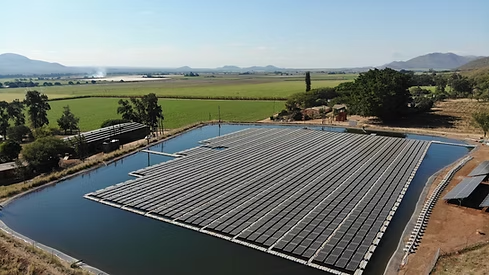
Floating solar array at Radley Farm in South Africa. Photo provided by author.

However, South Africa’s farmers are taking the initiative, with 10% of the country’s solar PV capacity now installed in the agricultural sector. A brilliant example is Radley Landgoed Farm in the country’s eastern Mpumalanga province, home to the largest coal-fired power plants. At this family-owned farm, a massive 3,350 square meters of solar panels are installed on the surface of the farm’s largest irrigation dam, powering 1.8 GWh and sustaining everything from staff quarters to 536ha of sucrose-producing sugar cane to 105 breeding cows. This is the largest solar-floating system in South Africa.
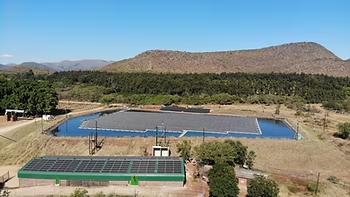
“Water-borne” solar plant in South Africa.

“These types of private ‘water-borne’ solar plants underline the country’s progress towards sustainably financing farm-based renewable energy mini-grids,”  Mooketsa Ramasodi, director of the South African agricultural ministry. 

Botswana’s eco-smart farming collectives 

Botswana is one of Africa’s most semi-arid countries, resulting in imports accounting for 60% of its fresh vegetables and fruits. But in recent years, Botswana has been relying on climate-smart agrotech to reduce its substantial food import bill. One such example is Kwenantle Farmers, the biggest grassroots farming enterprise in the country, producing beans, lucerne and white maize. They have taken advantage of the country’s considerable solar irradiation potential to install 1MW of solar output on their farms, thus reducing energy for production costs by 65%, says Lesego Osman, the head of business at Standard Bank Botswana, the country’s leading financier.

The cooperative’s solar plant networks have driven a significant increase in crop production, from 6,150 tons to 7,850 in just a year.

“Kwenantle is focused on greening agriculture in Botswana – turning desert-like conditions into greenbelts of crops and animals raised sustainably,” says Obonye Mmereki, the cooperative’s Principal.

Zambia’s satellite drought monitoring 

The worst drought in the last 100 years, driven by the El Niño weather pattern, hit Zambia in 2023-2024, reducing staple maize production by 53%. Severe food insecurity led 84 of Zambia’s 114 districts to declare a hunger crisis.
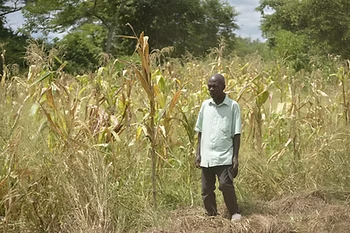
Rural farmers in Zambia are leveraging new agrotechnologies to mitigate drought. Photo provided by author.

The Zambia Drought Monitoring System (ZADMS), developed by the International Water Management Institute (IWMI) for Zambia’s Ministry of Agriculture, aims to turn the tide by digitizing early warning systems so that farmers at the grassroots level can be proactive in managing droughts. In the past, effective drought hedging in Zambia was complex due to the time-consuming, slow, and expensive tasks of mapping the threat and the computing power required to parse weather and agricultural data. The ZADMS addresses this by standardizing all data needed to monitor drought through a single open-source portal, accessible to any farmer or citizen with an internet-connected device.

Though technology can’t completely prevent drought, it can make government and farmers avoid costly, misinformed decisions, says Mark Smith, IWMI’s Director General. For example, if advanced satellite data indicate a drought is on the way, authorities can, in advance, import higher quantities of food at lower prices to help farmers and citizens get through the season, or increase irrigation infrastructure to help farming communities withstand climate shocks.
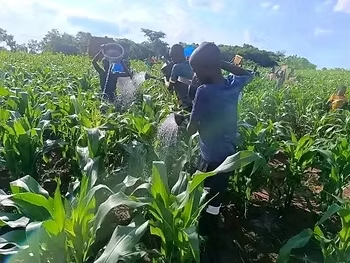
Farming in Zambia. Photo provided by author.

Adoption of climate-smart agrotech is urgent for Africa, says Mupara, because according to the Intergovernmental Panel on Climate Change, Africa bears a disproportionately high cost for basic climate adaptation compared to Asia, the Americas, or Europe, despite contributing just 3-4% of CO2 emissions. 

“Climate-proof agrotech, in Africa, is the difference between impoverished farmers who may never return to the land, or resilient livestock and crop yields that feed domestic consumers and earn forex billions,” she says.
Finished the story? Meet the people behind it.

EP Network is where energy journalists, investors, companies, and clean energy leaders connect.

Join EP Network →
ShareTweetShare
Ray Mwareya

Ray Mwareya

Related Posts

Fighting Saltwater with Sunlight: How Solar Technology Is Tackling the Drinking Water Crisis in Southwest Bangladesh
Solar

Fighting Saltwater with Sunlight: How Solar Technology Is Tackling the Drinking Water Crisis in Southwest Bangladesh

July 14, 2026
The Rockefeller Foundation’s Catalytic Capital: Turning Early Investments into Lasting Energy Impact
Private Financing

The Rockefeller Foundation’s Catalytic Capital: Turning Early Investments into Lasting Energy Impact

July 10, 2026
The Power of Commitment: How Government Investment Accelerated Electrification in Tanzania
Public Financing

The Power of Commitment: How Government Investment Accelerated Electrification in Tanzania

July 8, 2026
Reforming Government Fossil Fuel Subsidies
Public Financing

Reforming Government Fossil Fuel Subsidies

July 6, 2026
Scaling Mediterranean Impact: Morocco and Egypt Highlight Real-World Solutions at MedProgramme Meeting
Policy

Scaling Mediterranean Impact: Morocco and Egypt Highlight Real-World Solutions at MedProgramme Meeting

June 30, 2026
Bringing Decentralized Mini-Grids to Lesotho’s Mountains
Smart Grid

Bringing Decentralized Mini-Grids to Lesotho’s Mountains

June 29, 2026
Next Post
India’s Quietly Powerful Climate Warrior

India's Quietly Powerful Climate Warrior

A Crash Course in Climate Finance #2

A Crash Course in Climate Finance #2

Popular Stories

  • The Race to Host AI: Data Centres in Water-Scarce India

    The Race to Host AI: Data Centres in Water-Scarce India

    0 shares
    Share 0 Tweet 0
  • Vietnam’s Oil Buffer Faces Pressure as the Iran War Disrupts Global Oil Flows

    0 shares
    Share 0 Tweet 0
  • Caught Between India’s Military Ambitions and Green Promises: The Future of the Andaman and Nicobar Islands

    0 shares
    Share 0 Tweet 0
  • The Philippines’ Nuclear Gamble

    0 shares
    Share 0 Tweet 0
  • South Sudan’s Missed Opportunity: Untapped Renewables Leave Millions in the Dark

    0 shares
    Share 0 Tweet 0

Actionable Info

From The Energy Pioneer

Where the energy transition connects.

Journalists, investors, companies, and clean energy leaders — all in one network.

Explore EP Network →

The Energy Pioneer

The Energy Pioneer covers the global energy transition — from clean tech and green finance to policy and renewable energy.

Recent Posts

  • Fighting Saltwater with Sunlight: How Solar Technology Is Tackling the Drinking Water Crisis in Southwest Bangladesh
  • 88% Renewable, 100% Confused: Brazil’s Coal Problem
  • The Rockefeller Foundation’s Catalytic Capital: Turning Early Investments into Lasting Energy Impact

Quick Links

  • Home
  • Clean Tech
  • Renewable Energy
  • Green Finance
  • Policy
  • Regions
  • Features
  • Who We Are

© 2026 The Energy Pioneer | All Rights Reserved. |

From The Energy Pioneer

You read about the energy transition. EP Network connects you to it.

Join the network of journalists, investors, companies, and professionals building the clean energy future.

No thanks
Please enter a valid email.
You're in. We'll be in touch soon.
No Result
View All Result
  • Home
  • Clean Tech
    • Electric Vehicles
    • Energy Efficiency
    • Green Hydrogen
    • Smart Grid
    • Battery Storage
  • Green Finance
    • Public Financing
    • Private Financing
    • Carbon Markets
  • Policy
  • Renewable Energy
    • Wind
    • Solar
    • Hydropower
    • Nuclear
    • Hydrogen
    • Fossil Fuels
    • Geothermal
  • Regions
    • Africa
    • Asia
    • Europe
    • North America
    • Latin America
    • West Asia
  • Features
  • Who We Are
    • About Us
    • EP Investing
    • Contact Us

© 2026 The Energy Pioneer | All Rights Reserved. |