
The Energy Pioneer
No Result
View All Result
  • Home
  • Clean Tech
    • Electric Vehicles
    • Energy Efficiency
    • Green Hydrogen
    • Smart Grid
    • Battery Storage
  • Green Finance
    • Public Financing
    • Private Financing
    • Carbon Markets
  • Policy
  • Renewable Energy
    • Wind
    • Solar
    • Hydropower
    • Nuclear
    • Hydrogen
    • Fossil Fuels
    • Geothermal
  • Regions
    • Africa
    • Asia
    • Europe
    • North America
    • Latin America
    • West Asia
    • Oceania
  • Features
  • Who We Are
    • About Us
    • EP Network
    • Contact Us
No Result
View All Result
The Energy Pioneer
No Result
View All Result
  • Home
  • Clean Tech
  • Green Finance
  • Policy
  • Renewable Energy
  • Regions
  • Features
  • Who We Are
Home Europe

UnionDAC: Pioneering Direct Air Capture in the UK

Otto GundersonbyOtto Gunderson
October 23, 2026
Reading Time: 4 mins read

Moving a carbon capture project from inception to commissioning requires a broad coalition of expertise, resources and practical experience. A persisting challenge in developing direct air capture (DAC) projects is managing unexpected downtime caused by technical issues. Collaboration between companies can help accelerate this process, bringing together complementary expertise and enabling the industry to address the technical and practical challenges of scaling up.

RELATED POSTS

Building a Sustainable Blue Economy: Shipping, Fishing and Ocean Protection

ClimateTech Series: Building the Carbon Market

ClimateTech Series: Electrifying Fleets

The UnionDAC project, currently under development on Teesside in northeast England, exemplifies this approach. It brings together two independent companies, Airhive and Mission Zero Technologies, each developing its own direct air capture (DAC) technology. In the event that one technology experiences downtime, the other can continue operating. The two modular capture facilities can also be built in tandem, reducing risk and improving bankability.

Airhive

In a conversation with Rory Brown, Co-Founder and CEO of Airhive, he described the company’s approach of integrating novel technology with established, commercially proven components. Airhive’s technology uses fluidized beds, which treat solid particles like a liquid by blowing air through them from below. Brown compared this process to an air-hockey table, explaining how it eliminated friction and suspended particles in a turbulent cloud. This allows air to move through the particles and come into contact with the material that captures CO₂, enabling the system to extract carbon dioxide directly from the atmosphere.

When discussing how Airhive developed and tested its carbon capture technology in only four years, he explained how they focused on well-understood process equipment and mature industrial supply chains rather than adopting novel synthetic sorbents. With confidence in its technology, Airhive is now targeting a 10,000-tonne removal capacity as the cost-optimal modular scale, using it to establish standard engineering designs and supply chains for future projects. 

Mission Zero
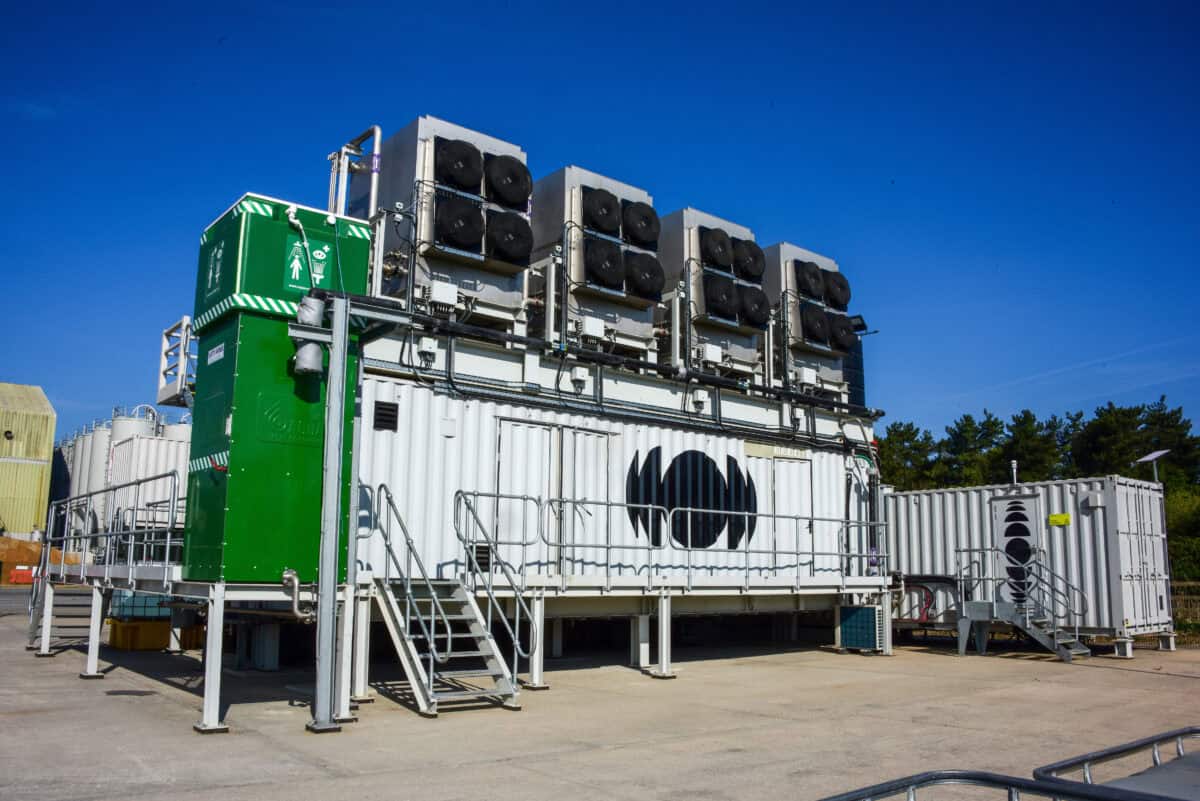
Direct Air Capture System in Norfolk, UK
Credited to Mission Zero Technologies

Unlike the Airhive emphasis on thermodynamic energy efficiency, Mission Zero built a liquid-based approach using electrochemical regeneration. In practice, this means pulling in and dissolving air using a water-based solvent. Their electrodialysis releases carbon from the solvent as a gas, either for storage or utilization. 

Buy JNews
ADVERTISEMENT

Despite the differing technologies, the companies have faced similar challenges in bringing their technology to market. During a September call with The Energy Pioneer, Mission Zero COO and Co-Founder Shiladitya Ghosh explained that they have also used mature, well-understood components from other industries to reduce scaling risks. 

When asked about the challenge of building out direct air capture technologies amid high capital expenditures, he offered a surprising answer. Higher energy consumption per tonne of CO₂ can actually reduce CAPEX, provided the energy source has a sufficiently low carbon footprint.. High upfront costs have thus far hindered the bankability and commercial viability of carbon capture projects at scale, making cost reduction a central priority. While it may seem counterintuitive for a carbon capture project’s bankability when combined with higher capture rates and proximity to renewable energy sources.

Combining DAC Technologies

Bringing together two distinct DAC technologies is one part of developing the UnionDAC project; coordinating their integration into a wider commercial project is another. This is where Progressive Energy comes in, serving as the project developer. John Egan, Project Director at Progressive Energy, explained how this initiative has been designed to reduce risk as well as demonstrate market viability. On risk reduction, Egan pointed to the advantages of using two different technologies side by side. Using both solvent-based and solid-sorbent technologies ensures that if one technology encounters a schedule challenge or technical problem, air capture continues.

Egan further emphasized the project’s potential to serve as a commercial-scale showcase for buyers to observe standardized modules in operation. Using a standardized 10,000-ton module size reduces the cost of bespoke designs. Egan compared this to the evolution of offshore wind turbines. Since the final project will include multiple modules from each of the two technology partners, the companies can utilize early learnings from the first modules to optimize design and installation, lowering project CAPEX.

The UnionDAC project aims for a final capacity of 60,000 tons of CO₂ removal per year, but its impact can reach beyond its direct air capture capabilities. If successful, the project will demonstrate the financial and technical capabilities of combined DAC technologies, offer a roadmap for profitable air capture projects in the future, and provide new industry and economic opportunities to the UK.

Readers can join our free climate and clean energy network for updates and developments from the UnionDAC project and the entire DAC industry, as well as follow along with Mission Zero, Airhive, and Progressive Energy.

Tags: carbon capture and storageDAC technologiesDirect Air CaptureEnglandUK
ShareTweetShare
Otto Gunderson

Otto Gunderson

Otto Gunderson has been working in clean energy for the last 7 years, with the last two being spent split between South America, Africa, and Southeast Asia, reporting on the transition to clean energy. After traveling and writing for two years, he founded The Energy Pioneer to create a news outlet with a global approach to clean energy journalism. He particularly enjoys writing about entrepreneurship, investment, and innovations that are contributing to greenhouse gas reduction and clean energy development.

Related Posts

Building a Sustainable Blue Economy: Shipping, Fishing and Ocean Protection
Features

Building a Sustainable Blue Economy: Shipping, Fishing and Ocean Protection

October 21, 2026
ClimateTech Series: Building the Carbon Market
Clean Tech

ClimateTech Series: Building the Carbon Market

October 20, 2026
ClimateTech Series: Electrifying Fleets
Clean Tech

ClimateTech Series: Electrifying Fleets

October 9, 2026
Producing vs Preserving
Africa

Producing vs Preserving

October 8, 2026
ClimateTech Series: Scaling Green Fuel Production
Clean Tech

ClimateTech Series: Scaling Green Fuel Production

October 7, 2026
As Russia Attacks Ukraine’s Grid, Solar Offers a Path to Resilience
Solar

As Russia Attacks Ukraine’s Grid, Solar Offers a Path to Resilience

October 1, 2026

Popular Stories

  • AI Can Scale Regenerative Agriculture – If Farmers Trust It

    AI Can Scale Regenerative Agriculture – If Farmers Trust It

    0 shares
    Share 0 Tweet 0
  • The Race to Host AI: Data Centres in Water-Scarce India

    0 shares
    Share 0 Tweet 0
  • The Sargassum Paradox: Why the Caribbean’s Clean Energy Hope is a Supply Chain Trap

    0 shares
    Share 0 Tweet 0
  • The Philippines’ Nuclear Gamble

    0 shares
    Share 0 Tweet 0
  • Vietnam’s Oil Buffer Faces Pressure as the Iran War Disrupts Global Oil Flows

    0 shares
    Share 0 Tweet 0

Actionable Info

From The Energy Pioneer

Where the energy transition connects.

Journalists, investors, companies, and clean energy leaders — all in one network.

Explore EP Network →

The Energy Pioneer

The Energy Pioneer covers the global energy transition — from clean tech and green finance to policy and renewable energy.

Recent Posts

  • UnionDAC: Pioneering Direct Air Capture in the UK
  • Can Pax Silica Deliver for the Philippines’ Tech Ambitions?
  • Building a Sustainable Blue Economy: Shipping, Fishing and Ocean Protection

Quick Links

  • Home
  • Clean Tech
  • Renewable Energy
  • Green Finance
  • Policy
  • Regions
  • Features
  • Who We Are

© 2026 The Energy Pioneer | All Rights Reserved. |

From The Energy Pioneer

Meet EP Network.

Enter your email and our team will reach out — or sign up directly.

Please enable JavaScript in your browser to complete this form.
Loading
or sign up directly →
From The Energy Pioneer

You read about the energy transition. EP Network connects you to it.

Leave your email and our team will reach out.

Please enable JavaScript in your browser to complete this form.
Loading
or
Sign up now →
No Result
View All Result
  • Home
  • Clean Tech
    • Electric Vehicles
    • Energy Efficiency
    • Green Hydrogen
    • Smart Grid
    • Battery Storage
  • Green Finance
    • Public Financing
    • Private Financing
    • Carbon Markets
  • Policy
  • Renewable Energy
    • Wind
    • Solar
    • Hydropower
    • Nuclear
    • Hydrogen
    • Fossil Fuels
    • Geothermal
  • Regions
    • Africa
    • Asia
    • Europe
    • North America
    • Latin America
    • West Asia
    • Oceania
  • Features
  • Who We Are
    • About Us
    • EP Network
    • Contact Us

© 2026 The Energy Pioneer | All Rights Reserved. |