

A Global Outlook on AI & Energy
Artificial intelligence is surging into every corner of modern life, and data centres are emerging as the backbone of this transformation. But as governments and corporations race to build this infrastructure, requiring vast amounts of electricity, water, land, and critical minerals, the key question becomes: where, and how, should it be built?
In 2024, data centres consumed approximately 415 terawatt-hours (TWh), or about 1.5% of global electricity. According to the International Energy Agency (IEA), that figure could more than double by 2030, reaching 945 TWh; this is slightly more than the entire electricity consumption of Japan today.
Meet EP Investing — capital discovery for the energy transition.
On July 23, 2025, the Trump administration released the US AI Action Plan, marking a sharp pivot in federal strategy. Framing AI infrastructure as critical to national security and technological sovereignty, the 28-page blueprint outlines over 90 federal actions to accelerate AI and data centre deployment. These include fast-tracking environmental approvals, streamlining permitting, and prioritizing grid interconnection; in essence, the plan adopts a deeply deregulatory approach.
This trend is already clear. Utilities in the US are planning 17.5 GW of new gas-fired power capacity, the highest level of activity since 2017, driven in part by the reliability demands of energy-intensive data centres. Industry analysts claim that without stable policy support for renewables, gas is likely to fill the gap despite rising capital costs and turbine manufacturing bottlenecks that could delay new capacity until 2029 or later. Moreover, while clean energy deployment faces geopolitical and supply chain uncertainty, some utilities are beginning to delay planned coal plant retirements to help meet surging load growth. At the same time, history shows that over-forecasting demand leads to stranded assets and higher consumer costs. Between 2005 and 2015, US utilities overestimated 10-year demand growth by 12%.
Nonetheless, researchers worldwide are converging on the same conclusion: AI infrastructure must be powered by dispatchable energy that can scale affordably, sustainably, and reliably, without overwhelming grids.
Abundant energy access doesn’t guarantee grid reliability. Last year, in Northern Virginia, home to the world’s highest concentration of data centres, sixty data centres using 1,500 MW of power simultaneously dropped off the grid abruptly due to an equipment fault. To prevent regional blackouts, operators had to act quickly, with all data centres switching to backup generators in Fairfax, a county with over 1.14 million residents.

For developing economies, the stakes are higher. Governments must decide whether to follow deregulated industrialisation or forge tailored, resilient models that integrate AI with climate and development goals from the outset.
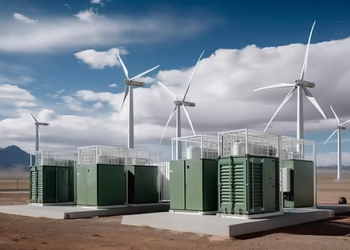
When co-located with renewable energy and battery storage, data centres can potentially help push positive industrial modernization, support grid stability, and lay the foundation for equitable digital access.
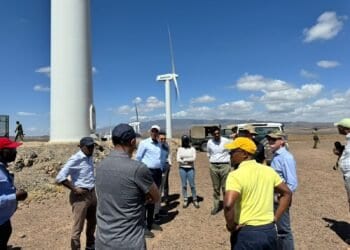
Africa, home to 1.4 billion people, hosts less than 2% of global data centre capacity. But momentum is building. Equinix is investing $390 million towards data centres in South Africa, Microsoft and UAE-based G42 invested in a $1 billion partnership with Kenya’s KenGen to build a geothermal-powered data centre in the newly declared special economic zone Olkaria, and Google opened a “cloud region” in Johannesburg. Besides demonstrating a strategy to embed AI infrastructure into Africa’s digital future, these projects are also part of a broader opportunity to harness Africa’s underutilized clean energy. Remarkably, Uganda’s grid is 99% powered by renewables, while Kenya and Ethiopia exceed 90%.
In India, renewables now offer cheaper, more stable power, and the largest data centres already source over half their energy from clean sources. Government support, including a 30% capital subsidy for standalone storage projects, is boosting the shift. With 6.1 GW of energy storage tenders issued in Q1 2025 alone, India’s AI-driven digital growth is well-positioned to align with its clean energy goals.
Vietnam, Malaysia, Indonesia, and Thailand are emerging as data centre hotspots, but face challenges from fossil-heavy grids. ASEAN’s energy strategy targets a 32% drop in energy intensity by 2025, based on 2005 levels. According to Ember, ASEAN’s data centre electricity demand is expected to reach 68 TWh by 2030 – an eightfold increase from 2024.
Malaysia is projected to see the sharpest rise, with data centres potentially consuming up to 30% of national electricity by the end of the decade. This could drive a sevenfold increase in emissions, given the country’s reliance on coal and gas. In response, Malaysia has recently introduced solar supply schemes and is developing a 1,000 MW solar farm to power data centre clusters.
While currently seeing modest demand growth, Vietnam is reforming its sector by lifting foreign ownership caps and streamlining permitting for projects like Viettel’s new hyperscale data facility near Ho Chi Minh City.
Yet across Southeast Asia, renewables adoption remains uneven. Ember estimates that up to 30% of 2030 data centre demand could be met by solar and wind via the grid without battery storage, underlining the need for increased deployment and expanded clean energy procurement options to prevent longer-term dependence on fossil fuels.
The EU’s approach to AI infrastructure also contrasts the US, emphasizing sustainability alongside competitiveness. The forthcoming Cloud and AI Development Act proposes tripling data centre capacity by 2030, but conditions this on water, energy, and circularity reporting. Under the EU Energy Efficiency Directive, data centres above 500 kW must disclose their energy and water use annually.
This United States’ approach to AI and energy, while likely geopolitically effective in the near term, may risk sacrificing long-term resilience. Fast-tracked permitting could encourage overbuilding in congested or water-stressed regions and will likely deepen fossil fuel reliance at a moment when decarbonization is urgent.
Meanwhile, China accounted for 25% of global data centre electricity consumption in 2024, second to the US at 45%. National policies have aimed to reduce energy use per computation and encourage the relocation of data centres to western provinces with more abundant wind and solar resources under its “East Data, West Computing” strategy. Yet most facilities remain concentrated in eastern industrial hubs where 70% of the electricity supply is coal-powered. Moreover, an estimated 80% of newly built data centres reportedly sit unused, largely due to rapid overbuilding, speculative investment, and shifting AI workload demands.
In the Gulf, Saudi Arabia and the UAE are leading as hosts of hyperscale AI projects. Elon Musk’s xAI is reportedly in talks with Saudi Arabia’s Public Investment Fund to lease several gigawatts of future data centre capacity to the newly established AI and infrastructure company Humain. But with limited water and grid flexibility, both countries are also exploring clean energy co-location models and allocating record-breaking investments into renewables and energy storage to future-proof their systems.
Water use is quickly becoming one of the most neglected yet consequential aspects of AI infrastructure. Many data centres consume millions of litres of water per day, especially when using evaporative cooling. In the Global South, water scarcity is already a serious constraint, and climate change is intensifying the challenge.
In response, some regions are testing novel solutions such as dry cooling, wastewater reuse, and even underwater systems. Submerged data centres have seen successful trials–including one by Microsoft, which has since discontinued the project. Meanwhile, China-based HiCloud Technology has recently begun construction of a wind-powered data centre placed in the ocean for passive cooling. However, scaling such solutions globally would require intentional infrastructure design and policy frameworks.
Alongside ocean cooling, space is emerging as another frontier, albeit more speculative and controversial. Companies like Starcloud, Axiom Space, and Lonestar propose space-based data centres powered by uninterrupted solar energy and cooled by the vacuum of outer space, where ambient temperatures can dip below –150°C. In orbit, solar panels can generate up to 13 times more electricity than on Earth, while bypassing land, water, and grid constraints. Such concepts aim to anticipate future infrastructure strain, especially if AI energy demand exceeds expectations and breakthroughs like nuclear fusion remain out of reach.
While AI consumes substantial amounts of resources, its promise to improve healthcare and advance broader societal progress warrants continued but careful pursuit. Furthermore, its potential to drive decarbonization shouldn’t be overlooked. According to the IEA, broad AI deployment could cut global energy sector emissions by up to 5% by 2035, with applications spanning grid optimization, predictive maintenance, and industrial efficiency. However, these climate benefits strongly rely on clean power to be meaningful.
This represents one of the many reasons the policy choices facing the Global South carry such high stakes. Instead of replicating deregulated, fossil-dependent growth, countries can plan a more resilient path by co-locating new data centres with renewables and battery storage. Geothermal and solar-rich regions, in particular, can host dedicated clean energy zones, combining interconnection guarantees, expedited permitting, and industrial alignment with agriculture, education, and healthcare goals.
Beyond centralized hubs, the Global South can also pioneer distributed, modular data systems that serve communities directly, especially in regions with limited grid access and internet connectivity. Although improving, over 660 million people still do not have basic access to electricity, and more than 2.5 billion – a third of humanity’s population – lack access to the internet despite network coverage reaching 92% of the world. Deploying off-grid, clean-powered data infrastructure in clinics, farms, or schools could unlock real-world positive impact without waiting for larger investments into grid expansions and data centres.
However, scaling modular systems in low-resource regions faces clear barriers such as limited access to capital and a lack of clear ownership models. Without targeted policy support, such as concessional financing or public procurement guarantees, modular data systems may struggle as a scalable solution.
Ultimately, building clean, intelligent infrastructure demands strategic planning rooted in regional priorities. As the AI and energy race accelerates, countries in the Global South have numerous opportunities to construct their own path and align digital infrastructure with fairness, sustainability, and overall development goals.
Meet EP Investing — the platform behind the stories.
1,300+ companies · 350+ investors · 47+ grants