

Piloted by women, EV-3 wheelers transport goods and humans in Uber-less rural Tanzania.
Aisha Shoza, 38, and a mother of one, is proud of defying norms.
Shoza and a dozen women in her drivers’ club work from Kagera Centre in Kagera, which is one of Tanzania’s poorest rural administrative regions. They drive around, operating Chinese-made but locally improvised EV three-wheelers that transport everything from packets of noodles to pregnant mothers and medicines across rural Tanzania.
Meet EP Investing — capital discovery for the energy transition.
“Call us the Bolt, the Uber of rural Tanzania,” she says proudly, turning the key to rush a box of fresh milk and uncut potatoes to a wedding reception 20km away.
Affordable EV wheelers
Her trade has now been widely adopted across rural Tanzania in the last three years, thanks to affordable three-wheeler EVs, which are enabling women to lay a claim in the emerging rural ride-hail economy of Tanzania. The global green transportation narrative is centered on pricey EV cars like Tesla, which are dominant in North America, Western Europe, and Australia.
But in Africa, that’s a non-starter due to the price of ‘clean’ EV cars like Tesla being way beyond the means of everyone except the very upper 1%. Moreover, the charging infrastructure is severely lacking on the continent. South Africa, the wealthiest economy in Africa, has only 400 public EV chargers for a country of 60 million, compared to 16,000 in New York state alone, a situation that experts have called the new EV-charging ports’ apartheid’.

Hence, Shoza, like most Tanzanians, says: “I have never seen an Uber car in my life”.
Tanzania does have Uber and Bolt ride-hail apps, but these restrict themselves to big cities like Dar es Salaam, leaving rural districts (where 63% of the 65 million population lives) in a lurch. It is not just the apparent lack of reliable broadband mobile internet signals, but also residents’ diminished ability to pay for Uber or Bolt rides in rural districts of Tanzania.
The rural roads, too, are bad, often filled with gullies, holes, and sometimes impassable during rainy seasons. This deters Uber and Bolt drivers from operating in rural districts. As such, unlicensed gasoline-powered vehicles, which are male-owned and driven, continue to keep women out of participation in the country’s polluting public transportation economy via patriarchy and affordability rules.
So, women like Shoza – shut out of earning a living from public transportation ownership- found a new opening in the rural ride-hail economy thanks to EV wheelers. Chinese EV three-wheelers are arriving in droves in rural Tanzania due to demand, a better price point, and the fact that Tanzania is home to the Port of Dar es Salaam, which is the biggest port connecting South Asia and the African continent.
“I can’t put an exact figure, but in 2024, about 30,000 EV three-wheelers passed through the port from China – and of course, a significant number were re-exported to neighboring African countries. The majority head to customers in rural Tanzania,” says Jima Yuna, the acting state warehouses and logistics manager at the Port of Dar es Salaam.
Thousands more EV-wheelers are surely landing in Tanzania via informal channels unrecorded from the tax database, adds Yuna.
Opportunity
This is welcome news for women EV-wheelers like Shoza driving on the country’s rural roads. For the women riders, their typical day starts at 5 am. Unlike Uber and Bolt, whose ride-hail contracts operate via apps, rural EV-wheelers don’t need apps.
“Our customers are the community. They know us. If a pregnant woman needs a ride to the hospital, she dials my number, and I crank my bike to her home. If a schoolchild needs a ride back home, they ring a call, and I race there,” she says.
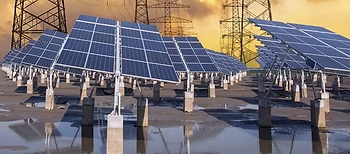
The biggest advantage of the EV three-wheelers is their less sophisticated but highly useful tech, explains Sandra Wana, who owns three EV three-wheelers and is the president of the local Kagera Women in Transport Club. The vehicles run on Chinese-made lithium-ion batteries, which are replenished by solar panels at home, a major advantage as high petrol or diesel prices would have been a barrier.
The EV wheelers, when they land in Tanzania from China, are re-engineered – sort of, says Damafa Sulawei, the head of mechanics at Gereji Bubu, an informal yard of mechanics in the port city of Dar es Salaam.
“That means the women who own these EV-wheelers pay us local mechanics, carpenters, and artisans to mount wooden trailers to the EV wheelers so that the trailers can safely carry babies, moms, groceries, or perishable goods”, he says.
That way, it’s not just Chinese EV-wheeler exporters gaining all the money, but creation of a rural supply chain that extends from mechanical services and repairs, he adds.
The Chinese could have easily chosen to export lower-priced EV cars like BYD, which, priced at $20,000, are making waves in Europe, says Sulawei. But Tanzania is a ‘typical’ poor African country, and a Chinese BYD EV car would take a fortune even for the middle class in Tanzania to afford.
“The Chinese EV wheelers are within our means. One costs $400 to buy. Re-engineering costs just $40. We pay over 12 months credit, and off we are out on the highways carrying goods and passengers for short distances of up to 30km,” says Shoza.
It’s a real opportunity for green development, as these vehicles are less polluting than car diesel fumes. However, it should be noted that the air quality in rural Tanzania is a bit cleaner than in cities.
As Shoza explains, “(These vehicles provide) our localized way to participate in the clean energy transport economy we see on TV in wealthier countries like Europe.”
Meet EP Investing — the platform behind the stories.
1,300+ companies · 350+ investors · 47+ grants