
Though still modest by global standards, clean tech is taking off in South Africa, and its fortunes are closely tied to the country’s booming renewable energy sector. The Energy Pioneer showcases 5 exciting clean energy tech startups driving innovation across South Africa in 2026. These include compressed air energy storage, high-performance concentrated solar technology, and an intelligence service for land regeneration.
Compressed Air Technology
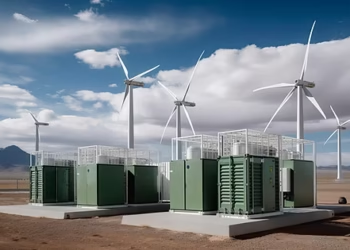
Air batteries generate electricity when oxygen in the air reacts with aluminum. According to the Environmental and Energy Storage Study Institute, air batteries are attractive because they offer longer storage duration (via reverse rusting) for clean energy while using readily available, inexpensive, non-toxic materials (iron, zinc, air, salt).
Meet EP Investing — capital discovery for the energy transition.
In South Africa, Leaper Innovate Green Energies, a startup that has raised nearly $1 million in seed funding, is at the forefront of the country’s air battery sector. Founded in 2012, Leaper is led by Warwick Leaper, who says compressed air energy technologies are not new. The first system (290 MW) was installed at Huntorf, Germany, in the late 70s and remains in operation today.
“There is (a) thrilling opportunity in South Africa where 1.3GwH of installed battery storage makes the country 8th in the world for installed battery energy storage systems,” he says.
The greatest advantage of air batteries is that they are the opposite of lithium-ion batteries, which operate via lithium, a scarce metal that requires more fossil fuels to mine, he explains.
Jan Fourie, CEO of Mulilo, a leading South African independent renewable power producer that has received $200mn from Copenhagen Infrastructure Partners to expand the country’s electricity transmission, agrees on the potential of compressed air.

“Compressed air tech – like all battery energy storage systems – empowers South Africa to tackle triple challenges of eliminating power blackouts, decarbonize the power grid, and support green energy production”, he says.
Solar Thermal Technology
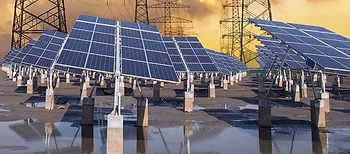
Solar thermal technology is less well known within the solar energy ecosystem because it harvests the sun’s radiant energy and converts it into heat, in contrast to PV, which directly generates electricity. In South Africa, the more traditional solar PV power generation has dominated the market with 8.97 Gw of installed capacity. Greenline Africa Ltd, a renewable startup, is an exciting frontrunner in the concentrated solar thermal market in South Africa.
“Our (products) produce heat, steam, and cooling at temperatures in the range of 60 to 160 Degrees Celsius, (with) a thermal efficiency of 80%. A single T160 collector (a high-efficiency concentrating solar collector) can save on average 660 Liters of Diesel, 2 tonnes of wood, or 1.5 tonnes of coal (per year),” Henning Brand, the technology chief of Greenline, explains.
Greenline’s energy is designed specifically for the food and beverages sector, which emits 1.24 Gigatonnes (Gt) of CO2 annually, making it one of the continent’s largest sources of industrial emissions.
Lighting up Informal Settlements
While 1.6 million households in South Africa lack access to electricity, the situation is especially dire in informal settlements. Although these settlements house millions of people, only 40-50% of informal settlements in South Africa are electrified.
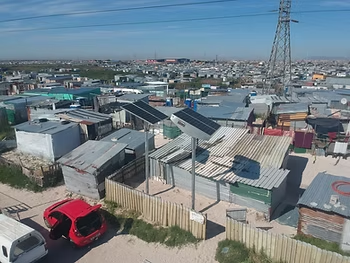
“For dwellers of informal settlements, being in (the) dark (is) an existential crisis. That means no street lighting for nighttime safety, no cheap optic fibre internet connection, no refrigeration for safe storage of infant formula milk,” says Hendrik Schloemann, founder of Zonke Energy, a startup whose mission is simple: to deliver clean and affordable energy to informal settlements.
Without cheap, clean energy, many residents of informal settlements must pay over R400 ($30) per month for dirty, low-quality fuels such as paraffin and petrol for generators. They are also forced to rely on risky, illegal, and unreliable poaching of electricity from loose wires connected to the country’s grid.
Zonke Energy simplifies informal settlements via its Kunye Payments, a digitized tool that allows various payment platforms so that users of its renewable energy packages can pay for power via debit cards, vouchers or mobile money. “This is crucial in South Africa because those living in informal settlements are also largely excluded from formal banking products due to lack of proper addresses, verifiable salary slips, etc.,” he says.
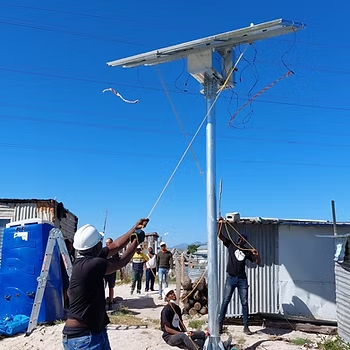
Informal settlements in South Africa are often associated with urban sprawl, stretching for miles with no proper address coding. This makes deployment of traditional PV solar infrastructure ‘extremely challenging’, Schloemann says. Zonke has a solution to this, which they call the Insika Flat-Pack – a unique flat-pack mounting to rapidly deploy PV and supporting hardware in a secure package. Once these flat packs are installed, Zonke works with community leaders and households to “build a sense of ownership” and lessen incidents of theft.
Regenerating Degraded Landscapes
Land degradation is a significant ecological strain in South Africa, with 60% of the land considered ‘degraded’ due to rampant mining, overflowing landfills, unplanned, informal urban settlements, and pollution.
TERRAGRN is a SA private-sector venture/ subsidiary of TERRAGRN PRIVATE LIMITED (UK-based), a new player in regenerating degraded landscapes across South Africa. They work to create biodiverse agroforests that absorb CO2, promote chemical-free soils, and introduce millions more indigenous trees into degraded landscapes.
The revenue of Terragen is via “the sale of bamboo-based products, carbon credits, and fruits/ nuts”, says Sundar Bharadwaj, the co-founder.
Its flagship innovation is TERRAGRN Nature-Tech: an Actionable Intelligence Platform. This technology uses data on soil, land, climate, and operational information to create clear, decision-ready intelligence for farmers, SMEs, project developers, insurers, and asset managers. “This makes complex, disparate data get automated into something simple, adaptable – and quick to decide on,” he explains.
Nature-Tech is integrated into TERRAGRN’s own agroforestry and regenerative farming operations.
“This is a very important innovation in Africa,” says Shamiso Mupara, a forestry regeneration hero in Southern Africa. The technology Terragrn uses is especially beneficial for rural farmers, providing actionable data that improves soil health, crop performance, water management, and resilience to climate shocks.
Insect Protein Technology
INSECO is a South African startup that uses insects to convert food waste and other organic byproducts into proteins, oils, and fertilizer. Roughly 10.3 million tons of edible food, 45% of the total available supply, is wasted annually in South Africa. Yet, paradoxically, 15 million people (about 25.8% of the population) experience food insecurity, and around 6.8 million (11.4%) suffer severe food insecurity.
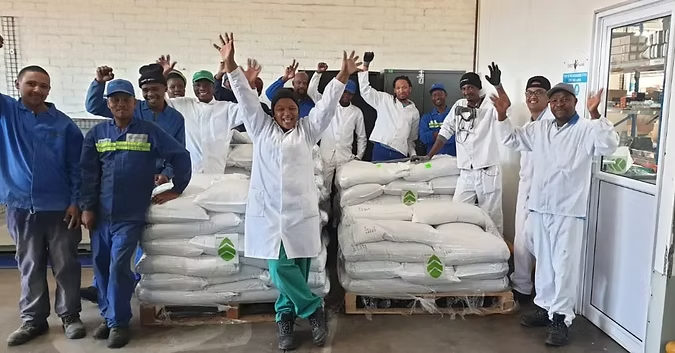
This is where INSECO, which raised $5.3 million in 2022 (the country’s largest ever seed funding milestone), is innovating. Co-founder of INSECO, Simon Hazell, says they began by innovating with black soldier fly larvae to consume food waste and produce food. They then tested insect-based products to identify their potential uses.
“Today, at the end of the production process, Inseco operates a 10,000 square meter, tech-enabled facility that produces more than 100 metric tons of defatted insect meal and oil per month,” he says.
The key point is that this goes into EntoMeal and EntoOil, Inseco’s flagship products, which they say are nutritious, affordable, and environmentally friendly, compared with conventional animal feed ingredients such as fishmeal and fish oil.
Meet EP Investing — the platform behind the stories.
1,300+ companies · 350+ investors · 47+ grants