

The Energy Pioneer
No Result
View All Result
  • Home
  • Clean Tech
    • Electric Vehicles
    • Battery Storage
    • Energy Efficiency
    • Green Hydrogen
    • Smart Grid
  • Renewable Energy
    • Solar
    • Fossil Fuels
    • Hydrogen
    • Hydropower
    • Nuclear
    • Wind
  • Green Finance
    • Crash Course
    • Private Financing
    • Public Financing
    • Carbon Markets
  • Policy
  • Regions
    • Africa
    • Asia
    • West Asia
    • Latin America
    • North America
    • Europe
  • Features
  • Who We Are
    • About Us
    • Contact Us
    • EP Investing
  • Home
  • Clean Tech
    • Electric Vehicles
    • Battery Storage
    • Energy Efficiency
    • Green Hydrogen
    • Smart Grid
  • Renewable Energy
    • Solar
    • Fossil Fuels
    • Hydrogen
    • Hydropower
    • Nuclear
    • Wind
  • Green Finance
    • Crash Course
    • Private Financing
    • Public Financing
    • Carbon Markets
  • Policy
  • Regions
    • Africa
    • Asia
    • West Asia
    • Latin America
    • North America
    • Europe
  • Features
  • Who We Are
    • About Us
    • Contact Us
    • EP Investing
No Result
View All Result
The Energy Pioneer
No Result
View All Result
  • Home
  • Clean Tech
  • Green Finance
  • Policy
  • Renewable Energy
  • Regions
  • Features
  • Who We Are
Home Clean Tech

Trump’s Tariffs Could Hamper Much-Needed Steel Decarbonization

byFares Arafat
April 1, 2025
Reading Time: 5 mins read

In a bid to move the US off foreign products and ” take other countries’ jobs”, the Trump administration has imposed a 25% tariff on all steel and aluminum imports. This isn’t new. Similar policies were seen in 2018 under his first administration, but its breadth today is much broader and is set to affect $1.4 trillion worth of goods as opposed to $380 billion in 2018 and 2019. It’s also more targeted, as seen by last week’s announcement of a 25% tariff on foreign-made cars and car parts—an industry that is the second-largest consumer of domestic steel.

RELATED POSTS

Decarbonizing Africa’s Road Passenger Transport

The Financiers and Startups Decarbonizing Africa’s ‘Anti-Fossil’ Fuel Nation

Green Hydrogen in Tunisia: Ambitious Energy Strategy amidst Implementation Challenges

Among the immediate consequences are stock market fluctuations and broader economic uncertainty. Yet a critical, though less discussed, question remains: how will these tariffs affect clean steel decarbonization efforts? While some, like the CEO of Cleveland Cliffs, one of the largest steel producers in the US, have praised the recent policy changes, experts have cautioned against the uncertainty this would introduce for climate progress. 

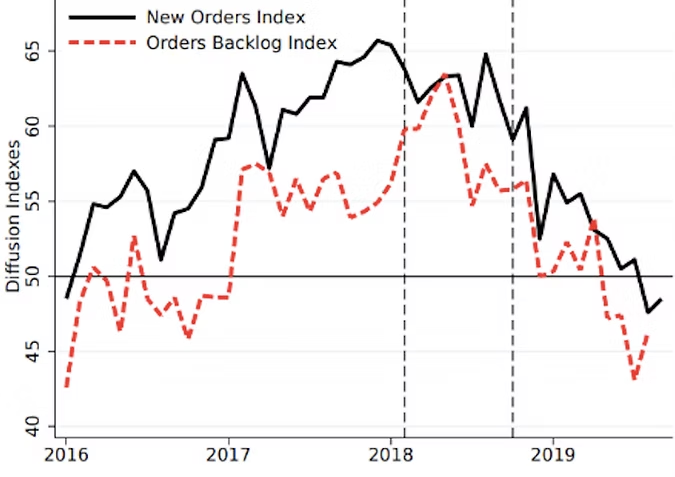
Nonetheless, understanding the impacts of Trump’s new tariffs shouldn’t be tough, considering the hindsight we now have from his first presidency. One of the first direct results of tariffs is a rise in the prices of the related products, allowing domestic producers to rake in more profits and boosting employment. But crucially, they disincentivize industries that rely on those products, making costs higher and prices costlier for consumers. Research found that 75,000 manufacturing jobs had to be laid off following the 2018 tariffs to absorb the higher costs. Moreover, a 2024 study by the Federal Reserve Board also revealed a significant decline in projected manufacturing demand following the tariffs, as illustrated in the figure below.

From The Energy Pioneer New memberships opening April 15, 2026

Meet EP Investing — capital discovery for the energy transition.
Visit EP Investing →
Graph Provided by Federal Reserve Board

One thing is clear: global steel demand will continue growing. Vaclav Smil, a prominent energy analyst, highlights this clearly in his book How the World Really Works; from street light poles to life-saving machines in hospitals to the oil and gas sector, steel touches almost every sector in our economy. And in the shift to a clean energy system, the role of steel becomes even more crucial. For example, generating 1 kWh from a 14 MW offshore wind turbine requires 50 times more steel than generating the same amount from a fossil fuel plant. This underscores how, without a robust green industrial policy, the United States risks falling behind in technological innovation and stagnating its once-dominant steel industry.

Cleaning up the steel industry, responsible for 7% of global CO2 emissions and 2,000 deaths per year in the US, means transitioning away from coking coal-based blast furnaces to electric arc furnaces (EAFs) powered by clean hydrogen, steel scrap, and electricity. The U.S. is already ahead in this transition, with EAFs accounting for 70% of domestic steel production (compared to 30% globally). However, natural gas, not clean hydrogen, remains the primary reductant. Given that the U.S. remains one of the largest net importers of steel, and considering the current administration’s stringent policies on reducing foreign reliance, addressing this dependency will require significant investment in new domestic steelmaking capacity. 

When asked if recent policies would further delay producers from switching to green steel to protect margins, Yong Kwon, Senior Policy Advisor at Sierra Club, shed some light: “If there were strong movements from the domestic primary steelmakers to transition to new iron reduction technologies that release near-zero greenhouse gases, the tariffs could be an instrument to shield the domestic steel industry while the costly technology adoption is taking place. However, absent such movements, the tariffs artificially buoy capacity utilization and make relining of existing blast furnaces more enticing than adopting emerging technologies for domestic primary steelmakers.”. In short, the industry in the US is too young to benefit from these tariffs and will instead be stalled.

In contrast, the Biden administration understood the importance of the steel transition in its Inflation Reduction Act and Infrastructure and Investment Jobs Act (IIJA), which allocated $1.5 billion for six iron and steel decarbonization projects. While a strong start, these projects are projected to save only 4% of the US steel emissions, highlighting the need for continued investment.

Buy JNews
ADVERTISEMENT

This issue is only compounded by the new tariffs on automakers. Among major automakers in North America and Europe, only four have pledged to procure fossil-free steel by 2030, accounting for just 2% of their global steel use. Considering that off-takers, like the automaker industry, are key to kickstarting green hydrogen, it is easy to see why their willingness to procure clean steel may decline. And while Trump might see “tariffs” as the most beautiful word in the dictionary, investors dread the word “uncertainty”. Case in point: Atlas Agro has delayed the final investment decision on its $1.5bn green-hydrogen-based fertilizer plant in Washington state, which was due to come online in early 2025, stating that the recent tariffs are the primary concern.  

Without a stringent green industrial policy, the US risks not only succumbing to climate change impacts but also geo-strategically missing out on being a dominant exporter of green technologies and repeating history. If US Steel, once the dominant domestic and global steel producer whose decline was driven by its obstinate desire not to innovate, doesn’t prove a valuable lesson for the current administration, it’s hard to imagine what will.

From The Energy Pioneer New memberships opening April 15, 2026

Meet EP Investing — the platform behind the stories.

1,300+ companies · 350+ investors · 47+ grants

Visit EP Investing →
ShareTweetShare
Fares Arafat

Fares Arafat

Fares Arafat is a civil engineer driven by a deep awareness of the environmental challenges posed by human activity. This passion led him to pursue an MSc in Sustainable Energy at Imperial College London where his research focused on analyzing the integration of renewables into the grid, its impact on electricity markets, and the potential of green hydrogen as a transformative solution. Beyond his academic work, Fares has cultivated a broad interest in energy geopolitics, the feasibility of industrial decarbonization, and the financial viability of clean technologies in the Global South. Today, he is dedicated to leveraging his expertise to deliver articles grounded in transparency, factual accuracy, and insightful analysis.

Related Posts

Decarbonizing Africa’s Road Passenger Transport
Africa

Decarbonizing Africa’s Road Passenger Transport

March 3, 2026
The Financiers and Startups Decarbonizing Africa’s ‘Anti-Fossil’ Fuel Nation
Africa

The Financiers and Startups Decarbonizing Africa’s ‘Anti-Fossil’ Fuel Nation

February 16, 2026
Green Hydrogen in Tunisia: Ambitious Energy Strategy amidst Implementation Challenges
Africa

Green Hydrogen in Tunisia: Ambitious Energy Strategy amidst Implementation Challenges

February 13, 2026
The Race to Host AI: Data Centres in Water-Scarce India
Asia

The Race to Host AI: Data Centres in Water-Scarce India

February 9, 2026
The Players Driving Africa’s Decentralized Energy Revolution
Africa

The Players Driving Africa’s Decentralized Energy Revolution

February 2, 2026
South Africa’s Exciting Clean Tech Startups
Africa

South Africa’s Exciting Clean Tech Startups

January 15, 2026
Next Post
Routes and Roadblocks to Green Hydrogen Growth

Routes and Roadblocks to Green Hydrogen Growth

The Importance of New Technologies for Grid Development

The Importance of New Technologies for Grid Development

Popular Stories

  • The Financiers and Startups Decarbonizing Africa’s ‘Anti-Fossil’ Fuel Nation

    The Financiers and Startups Decarbonizing Africa’s ‘Anti-Fossil’ Fuel Nation

    0 shares
    Share 0 Tweet 0
  • Decarbonizing Africa’s Road Passenger Transport

    0 shares
    Share 0 Tweet 0
  • Green Hydrogen in Tunisia: Ambitious Energy Strategy amidst Implementation Challenges

    0 shares
    Share 0 Tweet 0
  • South African Pension Funds Outshine $13 Billion Green Transition Funds

    0 shares
    Share 0 Tweet 0
  • Unlocking Africa’s Renewable Potential with Battery Storage

    0 shares
    Share 0 Tweet 0

Actionable Info

🔒 NEW MEMBERSHIPS OPEN APRIL 15
EP
EP Investing Climate Finance Intelligence

Our journalism is made possible by readers like you.

The founders, investors, and professionals reading The Energy Pioneer use EP Investing to find capital, partners, and opportunities.

1300+Companies
350+Investors
45+Grants
Explore EP Investing →

The Energy Pioneer

The Energy Pioneer covers the global energy transition — from clean tech and green finance to policy and renewable energy.

Recent Posts

  • Decarbonizing Africa’s Road Passenger Transport
  • Unlocking Africa’s Renewable Potential with Battery Storage
  • The Financiers and Startups Decarbonizing Africa’s ‘Anti-Fossil’ Fuel Nation

Categories

  • Africa
  • Asia
  • Battery Storage
  • Carbon Markets
  • Clean Tech
  • Crash Course
  • Electric Vehicles
  • Energy Efficiency
  • Features
  • Fossil Fuels
  • Green Finance
  • Green Hydrogen
  • Hydrogen
  • Hydropower
  • Latin America
  • North America
  • Nuclear
  • Policy
  • Private Financing
  • Public Financing
  • Renewable Energy
  • Smart Grid
  • Solar
  • West Asia

Quick Links

  • Home

© 2026 The Energy Pioneer | All Rights Reserved. |

No Result
View All Result
  • Home
  • Clean Tech
    • Electric Vehicles
    • Energy Efficiency
    • Green Hydrogen
    • Smart Grid
    • Battery Storage
  • Green Finance
    • Public Financing
    • Private Financing
    • Carbon Markets
  • Policy
  • Renewable Energy
    • Wind
    • Solar
    • Hydropower
    • Nuclear
    • Hydrogen
    • Fossil Fuels
    • Geothermal
  • Regions
    • Africa
    • Asia
    • Europe
    • North America
    • Latin America
    • West Asia
  • Features
  • Who We Are
    • About Us
    • EP Investing
    • Contact Us

© 2026 The Energy Pioneer | All Rights Reserved. |