

Access to clean energy remains one of the biggest challenges facing many people in Africa. Up to 600 million people —nearly half the continent’s population—do not have reliable electricity. A 2021 study revealed that air pollution was responsible for 1.1 million deaths across Africa in 2019, with household air pollution—primarily driven by indoor cookstoves—accounting for approximately 700,000 of these fatalities.
While some countries in Africa have made great strides in tackling the electricity and clean energy crisis, there is a new threat to electricity generation on the continent: climate change. Climate change-induced droughts have become more frequent and severe, knocking hydropower stations off the national grid in many African countries.
Currently, Zambia and Zimbabwe are experiencing severe electricity crises induced by drought. The two countries primarily rely on hydropower from the Kariba Dam to meet their electricity needs. In 2024, a devastating El Niño-induced drought ravaged countries in Southern Africa, leaving Zambia and Zimbabwe in prolonged power outages as the water level in the Kariba Dam had fallen too low to generate enough electricity. Zambia has 2,800 MW of installed electricity generation capacity, of which 83 percent is from hydropower, 9 percent from coal, 5 percent from heavy fuel oil, and 3 percent from solar.
Meet EP Investing — capital discovery for the energy transition.
Despite this, “Zambia has abundant potential to generate additional solar power as it possesses ample and intense sunlight, averaging about 2,000-3,000 hours of sunshine per year,” reports the U.S International Trade Administration.
The lack of funding for new solar projects remains one of the major setbacks for Zambia in diversifying its energy sources away from hydropower. Many countries in Africa face similar funding challenges. As such, for the past several months, residents in Zambia have been enduring long hours of electricity cuts, as the El Niño-induced drought has significantly reduced water levels in the Kariba Dam.
A recent study revealed that Zambia’s overdependence on hydroelectricity in its energy sector exposes the country to significant vulnerabilities during droughts caused by climate change. This study reports how “people experience these vulnerabilities through electricity rationing, commonly termed load shedding or power outages.”
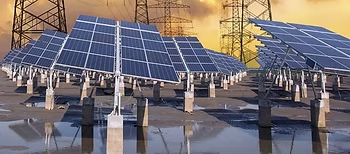
Amid a crippling electricity crisis, Zambia is now exploring new sources of renewable energy, primarily solar energy. In June this year, Zambian President Hakainde Hichilema launched a 100MW Chisamba Solar Power plant. This is one of the largest solar plants in Africa, ranking third in sub-Saharan Africa, behind the top two in South Africa.

At the same time, the African Development Bank’s Sustainable Energy Fund for Africa (SEFA) has announced that it has signed a US$26.5 million deal with partners for Zambia’s Ilute solar project, which will supply the regional power market through an innovative trading structure. SEFA—a multi-donor Special Fund—provides finance to enhance private sector investments in renewable energy and energy efficiency in Africa.
To remove market barriers, SEFA offers technical assistance and concessional finance instruments to build a more robust pipeline of projects and improve the risk-return profile of individual investments. This fund aims to contribute to universal access to affordable, reliable, sustainable, and modern energy services across Africa, in line with the New Deal on Energy for Africa and the M300.
The M300, or Mission 300, is an African electrification initiative aimed at providing electricity access to 300 million Africans by 2030. The New Deal on Energy for Africa is a partnership-driven initiative launched by the African Development Bank in 2016, aiming to achieve universal access to electricity across the African continent by 2025.
According to the African Development Bank, the Ilute project—an Independent Power Producer (IPP) located in Western Zambia—will supply electricity via the Southern African Power Pool (SAPP) under a market-based Power Purchase Agreement (PPA) with regional power trader GreenCo Power Services Ltd, an innovative regional power trader. The Southern African Power Pool was established in 1995 under the Southern African Development Community (SADC) to coordinate and enhance electricity trade among member countries. Its members include national power utilities and Independent Power Producers (IPPs) in the region.
Importantly, the funding structure for Zambia’s Ilute solar project will avoid burdening the country’s balance sheet and bypass the need to secure sovereign guarantees.
“It is expected to provide a model that can be replicated in other countries seeking to attract private capital and promote regional energy integration,” the African Development Bank said in a recent statement.
Representatives of the project’s financiers and developers signed the financing agreement in Cape Town, South Africa, in June this year during the Africa Energy Forum. Daniel Schroth, Director of the African Development Bank Group for Renewable Energy and Energy Efficiency, signed on behalf of SEFA. Representatives from private companies, Serengeti Energy, Kwama Energy, EDFI Management Company, and FMO also signed the financing agreement.
“SEFA is proud to be a key catalytic partner in the Ilute Solar Project, which exemplifies our commitment to supporting innovative solutions that accelerate Africa’s energy transition,” Schroth said.
He outlined how the project’s unique financing structure, coupled with its regional integration benefits, made it a model for other African countries seeking to attract private investment and modernise their power sectors.
“SEFA’s strategic investment is crucial in making this project a reality,” he added.
The Ilute Solar Project aligns with Zambia’s strategic objective of leveraging the SAPP to mobilise private capital, reinforce energy security, and modernise its electricity system. It further aligns with the African Development Bank’s New Deal on Energy for Africa and the M300 initiative.
Additionally, the African Development Bank stated that, under a biodiversity plan developed in collaboration with the World Wide Fund for Nature (WWF), the project allocates 1 percent of its annual revenues to a community trust governed by local representatives to fund locally prioritized development initiatives.
With innovative financing for clean energy, such as the Ilute solar project, the future looks bright for the expansion of solar energy in Zambia. However, it remains to be seen whether such a financing structure will be replicated in other African countries. Only time will tell.
Meet EP Investing — the platform behind the stories.
1,300+ companies · 350+ investors · 47+ grants