
With the rising electricity consumption in Algeria, particularly in the construction sector, the need to shift toward green architecture has grown significantly. The aim is to improve energy efficiency, reduce consumption, and cut emissions.
A 2022 study revealed that household emissions in Algeria are seven times higher than those of eco-friendly homes. The study attributed this to poor design quality and weak thermal performance in Algerian buildings, as well as the country’s location within the high-intensity “solar belt.”
It is estimated that between 69% and 75% of Algeria’s total greenhouse gas emissions originate from electricity generation, primarily used for heating and air conditioning in public buildings.
Meet EP Investing — capital discovery for the energy transition.
Globally, the construction sector is in crisis, consuming 32% of global energy and contributing 34% of CO₂ emissions. The industry also relies heavily on materials such as cement and steel, which account for 18% of global emissions and are considered a significant source of construction waste.
Algeria’s National Climate Strategy
In response, Algeria has adopted a national climate strategy aiming to cut carbon emissions by 22% during 2020–2030. This strategy includes mitigation, adaptation, and strengthening legal and institutional frameworks, including the construction sector. The country’s renewable energy plan targets 30% of energy consumption from renewables by 2035.
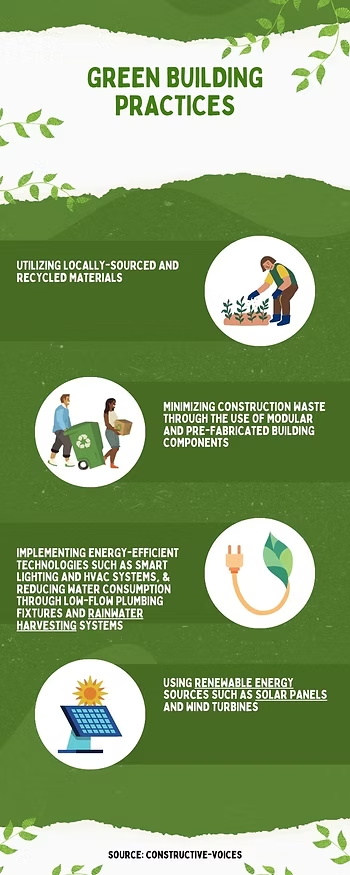
In recent years, several Algerian green startups—mostly youth-led—have emerged in line with this official direction. These are working alongside international companies with branches in Algeria, offering solutions to transform the construction sector. These include producing eco-friendly building materials, thermal insulation systems, solar-powered buildings, and waste recycling initiatives.

Among them is Eco Tashira, led by Algerian researcher Fella Bouti, who explains: “Our company was officially founded in April 2023, but the project started in 2020. We focus on eco-construction, providing green solutions that make buildings sustainable by using natural, recycled materials, such as palm residues, to design vertical gardens and green roofs. We also work on water-efficient irrigation and thermal insulation to ensure energy efficiency.”
She adds, “We live in a time of rising demand for construction and urbanization at the expense of nature and resources. This turns our cities into asphalt clusters that consume large amounts of energy, deplete natural resources like water, and worsen climate change. Our interest in this field comes from our passion for nature, biodiversity, and sustainable green architecture.”
Regarding costs, she notes that their prices are relatively low compared to markets in the northern Mediterranean and South Asia. Offers are customized depending on client categories, plant t
ypes, whether the wall is indoor or outdoor, and design accessories such as lighting. Prices for green walls listed on the company’s website range between 3,000 and 4,000 Algerian dinars (USD 23–30).
Fella highlights the main challenges: low environmental awareness, Algeria’s de
sert climate,
and the lack of skilled labor in this interdisciplinary
sector. “That is why we work on raising awareness and engaging more community stakeholders to adopt such projects, and we are currently working on relocating part of our nursery activities to a coastal region,” she says.
“We also received support by joining government and private business incubators that helped us initially with funding, training, and capacity development.”, she added.
On the positive impact, she explains: “We are still at the beginning, and larger spaces need to be developed with environmental and social impact assessments. But initially, we observed that such projects enhance biodiversity within urban areas, reduce air pollution, and provide natural aesthetics. We also managed to recycle around 30 tons of agricultural waste annually.”
Other Innovative Ventures
Another startup, Eco Isol, provides thermal insulation systems for buildings that improve efficiency, reduce carbon emissions, and cut operating costs. These systems stabilize indoor temperatures with minimal energy consumption, ensuring comfortable living conditions. Insulation also improves acoustic performance, reduces noise pollution, and limits fire risks from overheated systems.
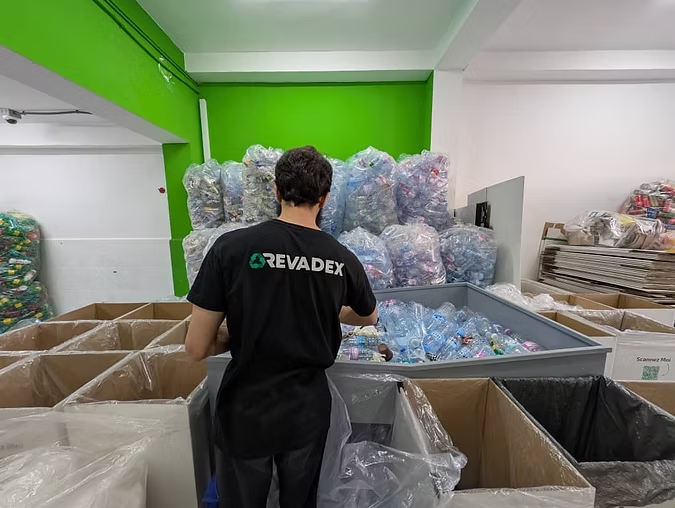
Beyond eco-materials and insulation, several Algerian startups specialize in waste recycling and solar panel installations for buildings, such as Revadex and Lagua Solaire.
According to Revadex’s official data, their recycling solutions save 200 watts of energy, reduce CO₂ emissions by 20%, save 10,000 liters of water, and collect 1,500 tons of waste.
Walid Hadjadj, the founder of Revadex, said, “Revadex was established in 2019 in Algiers. From the beginning, our mission has been to help companies reduce their environmental footprint by managing and recycling office waste.”
He added that the company has expanded its focus to include “sustainable workplace solutions—helping businesses design cleaner, more efficient, and environmentally responsible offices.”
He mentioned that their motivation comes from “a simple idea: sustainability starts at the workplace, with small daily actions that create lasting change.”
According to Walid, promoting recycling and circular practices in offices encourages companies to “rethink their resource use and waste flows.”
Walid explained that they have been collecting environmental data for several years, which allows them to “estimate the average footprint per employee, per sector, or even per department.” He emphasized that this data-driven approach helps clients better understand their environmental impact and indicates that more of them are viewing sustainable workplaces as essential for “attracting and retaining young talent.”
Walid expressed pride in working with leading companies such as Faderco, Siemens, DHL, and AstraZeneca.
He noted, “With these partners, we have implemented complete waste management programs.”
He mentioned that “over 16,000 office employees across Algeria now participate in our daily recycling initiatives, proving that sustainability can become a shared corporate culture.”
He identified the main challenges as “limited regulation, low environmental awareness, and the cost of logistics and recycling infrastructure.” To combat these issues, Walid stated, “We focus on education, transparency, and collaboration.”
He added that each client receives “measurable impact reports,” which help foster a data-driven sustainability culture.”
Looking ahead, Walid mentioned that green building in Algeria is “still emerging but gaining momentum.” He is optimistic, stating that with increasing corporate commitments and public initiatives, “sustainability will soon become a core business value.”
Dr. Manel Sakhri, Algerian Environmental Policy Expert and Researcher, emphasizes the strategic role of green construction: “Promoting green building represents a strategic step towards a sustainable future in Algeria. Green buildings reduce energy consumption and carbon emissions while enhancing quality of life through a healthy, comfortable environment. Additionally, this approach opens significant economic opportunities by developing sustainable construction sectors, renewable energy, and innovations in materials and environmental technologies, strengthening Algeria’s position in the transition toward a low-carbon economy.”
She further explains that green building is a practical tool for climate change adaptation, helping cities withstand heat waves and droughts while protecting natural resources.
Dr. Sakhri also advises companies to adopt a gradual approach—introducing elements such as solar energy or eco-friendly materials—while partnering with universities and research centers to drive innovation. Public awareness, she stresses, is crucial to building demand, and government incentives must complement private efforts to secure long-term investment.
Regional and Comparative Insights
A 2025 study found that Algeria remains behind in adopting sustainable construction, despite initiatives such as the ECO-PACK project to build energy-efficient homes. The main barriers include the absence of a comprehensive regulatory framework, high initial costs, weak awareness, and limited expertise among professionals.
Data show that more than half of respondents consider the lack of government support and rising costs as the most significant obstacles, while 85% affirmed that community involvement enhances project success. The study recommended developing a locally adapted environmental assessment framework, providing financial incentives, awareness campaigns, and professional training.
Meanwhile, a 2023 study in Tunisia assessed the effectiveness of eco-friendly buildings by evaluating design and operational features, including building orientation, window size, high-performance glazing, insulation levels, energy-efficient lighting, daylighting controls, and optimized heating and cooling systems. The study found that applying these measures could reduce annual energy consumption by 50%.
Although Algeria’s adoption of green building is still in its early stages, the combination of government strategies, expert advocacy, and innovative startups is laying the foundation for a more sustainable construction sector.
Meet EP Investing — the platform behind the stories.
1,300+ companies · 350+ investors · 47+ grants