

The AI boom is here, and with it comes a high demand for data centers. To meet the new technology’s immense computational power needs, data centers require large amounts of energy, resulting in high levels of carbon emissions. Some innovators are looking for sustainable solutions.
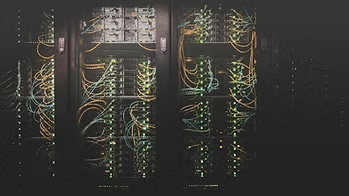
When you upload a photo, document, or project file to the cloud, it may sound like your data is floating freely in the sky, but in reality, it lives right here on the ground in a large, cold building. That building is a data center, a physical facility that organizations use to house their critical applications and data. Data centers serve as the warehouses for all our digital content, public and private clouds.
A single data center can consume the equivalent electricity of 50,000 homes. Cooling systems, backup power systems, security systems, air purification, lighting, and IT equipment such as servers and networking devices all require an immense amount of electricity to function seamlessly 24 hours a day, seven days a week. Additionally, operational continuity is crucial to prevent data loss, operational downtime, damage to equipment, and reputation impact, all of which come with significant financial implications for both the customer and the provider.
Meet EP Investing — capital discovery for the energy transition.
But the continuous operation of a litany of energy-intensive devices comes at a heavy carbon cost. The International Energy Agency reported that data centers accounted for 1% to 1.5% of global energy consumption in 2022. As the AI boom surges, that number is sure to increase substantially.
According to McKinsey, data center demand has exploded as a result of generative AI, but supply is lagging. The demand for data center capacity as of 2024 was 60 GW. That number is projected to reach 219 GW by 2030 and could reach as high as 298 GW. To meet these demands, twice the data center capacity built since 2000 will have to be built in a quarter of the time. Data centers are soon to be popping up everywhere, which begs the question: how can facility operators meet the growing data center needs without emitting excessive amounts of carbon?
Tony Abate, VP and CTO of AtmosAir Solutions, explains that data centers will need creative solutions to meet this challenge. One of the most energy-intensive systems of a data center is heating, ventilation, and air conditioning (HVAC), which accounts for about 40% of the center’s total power. The most significant energy demand comes from conditioning outside air.
Abate’s company, AtmosAir, has developed an air purification system that utilizes bi-polar ionization, a technology that generates positive and negative ions which bind with airborne particles and break down specific organic compounds like VOCs, pathogens, and pollutants. This is a key process for data centers as servers are sensitive to impurities, such as dust pollutants like sulfur dioxide and chlorine, which can result in costly damage to equipment.

Abate explained that, to maintain proper air quality, data centers are constantly “turning over air,” meaning they’re bringing in outside air and pushing out inside air, a process that is highly energy intensive. Bi-polar ionization purifies existing air, thus decreasing the need to bring in and condition outside air, saving power and reducing the number of contaminants that need to be filtered.
This same methodology, working with already available air rather than forcefully cycling in new conditioned air, is essential when considering heat mitigation and the distribution of cold air. Servers generate immense amounts of heat. If that heat is not adequately dispersed, it can accumulate, resulting in slower operating function, downtime, and damage to hardware. Data centers rely heavily on air conditioning to maintain optimal temperature levels and prevent catastrophic data loss.
In a discussion with Richard Halsall, CEO of Exhale Fans, he explained that many data centers are going about air conditioning the wrong way. Richard Halsall’s company developed the world’s first bladeless fan. Halsall, a former US Army pilot and inventor, drew inspiration from a high-bypass jet engine and created a cooling system that circulates air and maintains temperature more efficiently than bladed fans. The design utilizes a process that Halsall says could significantly improve energy efficiency in data centers: thermal destratification.
Thermal destratification is the process of mixing the air to equalize temperature and eliminate thermal layers. Cold air is more dense, causing it to sink to the floor, while warm air is less dense, causing it to rise. This creates temperature layers and, in a data center, can lead to harmful heat accumulation at the ceiling. Many data centers focus solely on force and volume to keep racks cool, meaning they prioritize moving large amounts of cold air through the facility, relying heavily on blower power. Halsall argues that operators focus too heavily on the supply side of cool air but have ignored what proper distribution can do.
Rather than simply bringing in as much cold air as possible, he says operators should consider how well their air is being distributed throughout the space. If air is effectively distributed, less cold air will need to be brought in, saving energy needed to cool air and power blowers.
While it’s important to have systems that create cold air, Halsall explains that “distribution of that cold air has been ignored as a critical function of energy reduction.” He suggests that HVAC systems with effective distribution can save 10% on energy needs, and that’s just the beginning. Employing innovative technologies like AtmosAir’s bipolar ionization purifiers and Exhale Fan’s bladeless fans in a data center’s HVAC system are steps that operators can take to begin reducing the carbon footprint of these facilities.
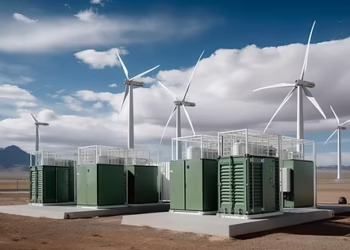
It is worth noting that improving internal systems is only one piece of the puzzle. A considerable portion of a data center’s carbon footprint is attributed to the computational power needs supplied by the grid. To meet this challenge, facilities will need to source their energy from renewables. Abate says that further innovations such as rooftop solar panels, reusing grey water for cooling, or possibly building facilities in colder climates are the creative solutions needed to make sustainable data centers a reality. By the end of 2025, there will be 6,111 public data centers worldwide. By 2030, that number is anticipated to reach 8,378. The potential of AI is limitless, but it has thus far been a direct creator of emissions. By improving data center technologies and access to power, the benefits of increased computing power can be achieved without contributing to climate change.
Meet EP Investing — the platform behind the stories.
1,300+ companies · 350+ investors · 47+ grants