
America’s clean energy transition has supercharged demand for advanced batteries, from powering electric vehicles to balancing renewable energy on the grid. Analysts project U.S. battery demand will grow nearly tenfold by 2030, yet domestic production is struggling to keep up. Today, China dominates over 70% of the global battery manufacturing market, along with critical mineral processing essential for cathodes and anodes.
That foreign dependence leaves the United States vulnerable to geopolitical risks, trade disruptions, and environmental concerns. Meanwhile, America’s battery recycling capacity is underdeveloped, raising the stakes for both supply chain security and a sustainable circular economy. Without a stronger domestic foundation, the nation’s clean energy and climate goals could stall before they truly accelerate.
In response, policymakers and industry leaders have raced to build gigafactories — giant battery plants aiming to match China’s scale. However, relying solely on size is a fragile strategy. Gigafactories require billions of dollars in capital, years of construction, and may still lag if innovation stalls. The lesson from the semiconductor industry is clear: thriving in the global technology race demands more than just bigger factories. It takes innovation, robust ecosystems, and a skilled workforce to stay competitive. That is why a new approach is emerging — battery innovation centers and accelerators that combine shared infrastructure, cutting-edge research and development, and workforce development. By prioritizing innovation alongside scale, the United States can build a more resilient, future-ready battery industry.
Meet EP Investing — capital discovery for the energy transition.
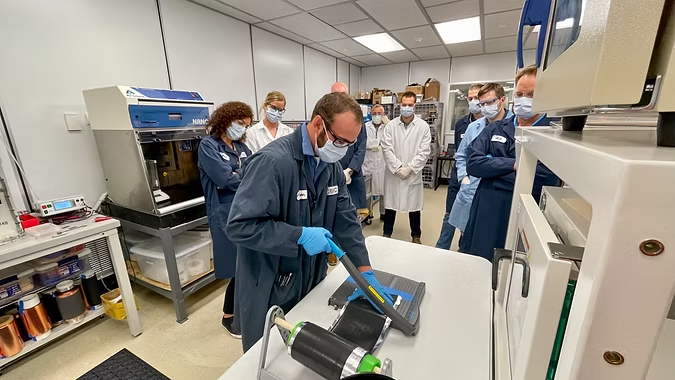
Across the country, new battery innovation centers are transforming the way the U.S. addresses its energy storage challenge. These hubs combine advanced research, hands-on prototyping, and workforce training to help companies bring promising technologies to market faster. Indiana’s Battery Innovation Center (BIC), for example, offers shared manufacturing tools and testing labs that lower barriers for startups, enabling them to develop and scale products without incurring enormous upfront costs.
These battery innovation centers support companies like Ateios Systems, a start-up developing an innovative solvent-free electrode manufacturing process. In conversation with Ateios, they attribute the BIC ecosystem’s ability to foster collaboration and accelerate problem-solving, enabling them to develop products quickly and efficiently.
The CEO of Ateios Systems, Rajan Kumar, shared how they were able to grow at a sustainable pace as they mature their technology without having to raise more than $5M since 2020. Similar to a WeWork for batteries, Ateios was able to incubate with a monthly cost of $5K-15/month for office space and get access to a US$15 million battery pilot facility, compared to traditional battery startups on the coasts having to raise an average of US$15-20 million and 2-3 years to build their capabilities. Based on the incubation model, Ateios Systems has secured over US$5 million in contracts and shipped production-grade products.
Hoping to better understand the work of the BIC, The Energy Pioneer spoke with Les Alexander, the President and CEO of the Battery Innovation Center. He explained how the BIC has worked with over 500 companies since its inception and how their lab-scale equipment provides the necessary tools for testing and improving processes without the significant up-front costs. Additionally, the BIC employs a non-IP generating policy, enabling it to help start-ups avoid pitfalls and provide space, equipment, and support while the intellectual property remains with the company.

Meanwhile, the ChargeUp accelerator in New York is supporting early-stage battery companies with mentorship, customer discovery, and business guidance, ensuring their ideas don’t get stuck in the lab. At the time of our conversation, ChargeUp was the only purely battery-focused accelerator program in the United States. Together, these programs demonstrate how America can create an ecosystem that fosters both technological breakthroughs and the talent necessary to deploy them, thereby securing a leadership role in the future battery industry.
A conversation with Fernando Gómez-Baquero, Director of the Translation Pillar for the NSF Energy Storage Engine in Upstate New York, outlined how the ChargeUp incubator assists early-stage battery start-ups by working closely with the companies to define both the value proposition and the target customer base. Meera Sampath, CEO of the Upstate New York Energy Storage Engine, outlined the additional goal of workforce development. This includes connecting with educational institutions, such as high schools and universities, as well as industry employers, to create a trained and prepared workforce.
The team working to build the domestic battery manufacturing includes Nobel Laureate Stan Whittingham, who leads R&D funding for NSF Engines and serves as co-chair of the ChargeUp Advisory Board. During a conversation with The Energy Pioneer, Whittingham explained the hands-on opportunities given to the companies selected to be a part of ChargeUp. These companies are required to be on-site one week per month and receive guidance on various industry aspects to facilitate scaling.
The impact of these innovation hubs reaches far beyond any single battery company. By lowering the cost of experimentation and fostering collaboration among researchers, manufacturers, and educators, they significantly accelerate the time it takes for next-generation battery technologies to reach commercial scale. They also help build a skilled workforce ready to install, service, and manufacture advanced batteries nationwide. In the long run, these centers strengthen America’s energy security, create new high-paying jobs, and reduce dependence on imported batteries and materials. Perhaps most importantly, they enable a circular battery economy, where materials are recovered and reused rather than wasted, ensuring the clean energy transition remains sustainable.
Still, these innovation centers face their challenges. Sustained funding, coordinated policy support, and continued industry buy-in are crucial to maintaining the growth and effectiveness of these programs. Suppose the U.S. fails to expand and connect these hubs nationwide. In that case, there is a risk of innovation gaps or fragmented supply chains that could leave American battery makers outpaced by global competitors. Going forward, investing in additional regional battery hubs, scaling battery recycling, and aligning workforce development directly with emerging manufacturing needs will be crucial. With the right support, these centers can transform America from a battery into a global battery leader — but without it, the country could once again fall behind.
Battery innovation centers and accelerators offer a powerful blueprint for America to build leadership in the evolving global energy market. By blending research, manufacturing, and workforce development under one roof, they help transform bright ideas into scalable, sustainable solutions. If the nation continues to invest in these hubs — and ensures their lessons spread nationwide — the U.S. can build a battery ecosystem that is not only competitive but resilient, clean, and ready for the future.
Meet EP Investing — the platform behind the stories.
1,300+ companies · 350+ investors · 47+ grants