
A push uniting South Africa’s labor, lobbyists, the state’s competition tribunal, and industrialists seeks to levy tariffs on foreign renewable energy equipment exports into Africa’s wealthiest economy.
RE boom
Though the total installed capacity of renewable energy generation hit 12GW in South Africa (a 19.28% total share of the power pool), local industry players say that such progress hides an unflattering reality.
Foreign manufacturers bringing materials into South Africa have cornered the local market, thereby accelerating the forced closures of domestic manufacturers, stifling job creation, and hindering the development of local technical expertise.
Excessive imports
It’s an emergency that must be addressed, warns Brian Kamanzi, a decarbonization expert from the Trade Unions for Energy Democracy, South Africa. “I think almost every component is currently being imported. We have panels, brackets, cables, inverters, wind blades, and wind turbines,” he says.
This situation is quite damaging in South Africa, to the extent that local solar module manufacturers are often overlooked, even in public procurement deals where state entities issue contracts to build clean energy infrastructure.

“That’s a big concern,” he adds.
To establish a strategic domestic footing, the Congress of South African Trade Unions (the country’s largest union, with 1.8 million members), the Trade Unions for Energy Democracy, RE equipment manufacturers, and the International Trade Commission for South Africa are singing the same tune.
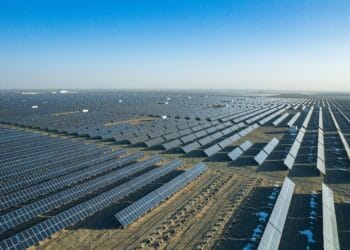
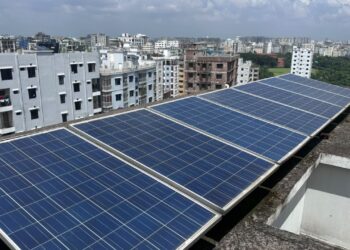
Excessive imports have forced domestic industry players into a corner. For example, global firms such as Jinko Solar, Solaire Direct, SunPower, JA Powerway, and SMA have shuttered local production in South Africa and shifted to imports. When ArtSolar and Seraphim raised this point, the International Trade Commission of South Africa (ITAC), a state tribunal, imposed a 10% tariff regime in early July, aiming to protect manufacturers of photovoltaic cells, modules, and panels.
ITAC is ploughing ahead, seeking to impose a 15% customs levy on New Energy Vehicle batteries. The dual goal is to incentivize domestic producers and encourage foreign equipment manufacturers to establish operations in South Africa. In total, ITAC aims for the local input component to reach 50% in end products.
Positive impact
South Africa expects robust growth in energy storage demand. Suppliers’ revenue is projected to jump from $541.4 million in 2022 to $12.82 billion, according to projections by Grandview Research consultancy. In November 2024, Balancell, a domestic champion, unveiled Ndabeni, a battery production facility in Cape Town, aiming to provide 1 GWh of storage. The plant will also aim to supply clients in other African nations and Europe with lithium ferro-phosphate smart batteries for electric vehicles, which it is already manufacturing. Seventy workers are already employed, with 1,500 indirect jobs supported throughout its value chain.
South Africa can never make actual battery cells from scratch, but can create tremendous energy jobs for itself, outlines Ian de Vries, the Balancell founder.
Not yet there
Though South Africa’s switch to renewable energy sources is the most advanced across sub-Saharan Africa in terms of grid expansion, power generation, and job creation, the country doesn’t yet have a significant domestic industry that can meet the advancing needs for renewable energy, argues Tapuwa O’bren Nhachi, consultant at the Institute for Law, Democracy, and Development, and critic of how climate carbon credits mechanism in Africa.
“Renewable energy technologies are highly concentrated in their manufacturing within China, where the sophisticated skillset, financing, and production scale, the US and Europe can’t match, let alone South Africa,” he says.
However, China’s extreme dominance of the renewable energy supply chain can be leveraged to South Africa’s advantage to some extent, he explains. For instance, if a manufacturer from Chongqing is selling their biogas plant sensors in South Africa, they need to invest more in local manufacturing.
“It’s about aligning Africa’s industrial incentives. The short-term opportunity here is not necessarily in the lower levels of processing, where China has a higher competitive advantage”, he says.
Critical minerals loophole
To gain a competitive advantage, Brian Kamanzi urges South Africa to rethink its critical minerals advantage. In this sector, it leads the world after supplying 75% of platinum output and 90% of rhodium. However, South Africa’s Achilles’ Heel is its disjointed mining policy regarding the export of critical minerals, which are key to the global decarbonization drive.
“We need a dual strategy – localizing renewable energy manufacturing here and making sure critical minerals don’t leave our shores without being super-refined into high-end products,” he says.
For example, an ambitious goal would be for ‘critical minerals’ dug in South Africa to be refined at home for downstream solar manufacturing, battery production, and finished high-end gear.
An opening
Overall, South Africa should emulate China, which processes lithium-ion batteries, PV cells, and other high-end products closer to where demand is located, whether in Europe or other Asian economies.
“That’s the low level or low-hanging fruit for South Africa to copy, to localize some of those key technologies,” Kamanzi explains.
There is admirable progress in South Africa that can be rapidly expanded.
“Wind turbine towers are successfully localized in South Africa, so we can produce towers in South Africa,” Kamanzi says.
That isn’t to say that towers cannot be imported, but it is one area in which local industry has been successful.