
The opportunity to curb emissions, promote economic growth, and facilitate a more equitable transition to renewable energy is evident in the global expansion of clean cooking solutions. The scope of the problem is immense, over 2 billion people cook with either kerosene or smoky biomass, resulting in between 2 and 3 million premature deaths per year. The climate degradation caused by unclean cooking, which accounts for 2% of greenhouse gas emissions, has led to significant deforestation. Alongside its environmental concerns, the disproportionate impact on women and children of dirty fuels could be replaced by both health and economic benefits if switched to improved systems.
Chris McKinney, Chief Commercial Officer at Burn Manufacturing, a major Kenya-based clean cooking manufacturer, outlined the developments he has seen in the market during recent years. The most notable growth, as McKinney explains, has been in the electric cooking sector. He attributes this growth to the new cost-effectiveness of induction-based electric cooking. The cost-effectiveness is made possible through advancements in financing. These include selling carbon credits and a pay-as-you-go system that limits the upfront cost. The growth of Burn over the last several years has been significant. From one manufacturing facility in Kenya, Burn has spread across the continent to include a manufacturing plant in Nigeria, as well as assembly locations in Tanzania, Ghana, and Malawi.
Along with the health and environmental benefits of transitioning to cleaner cooking solutions, localized manufacturing of cookstoves presents an opportunity to drive economic and job growth across the region. When asked about the benefits of localized manufacturing practices, McKinney discusses how this often results in producing cheaper products rather than attempting to import them. A significant investment in R&D has also been crucial in creating electric stoves well-suited for a variety of grid conditions.
Meet EP Investing — capital discovery for the energy transition.
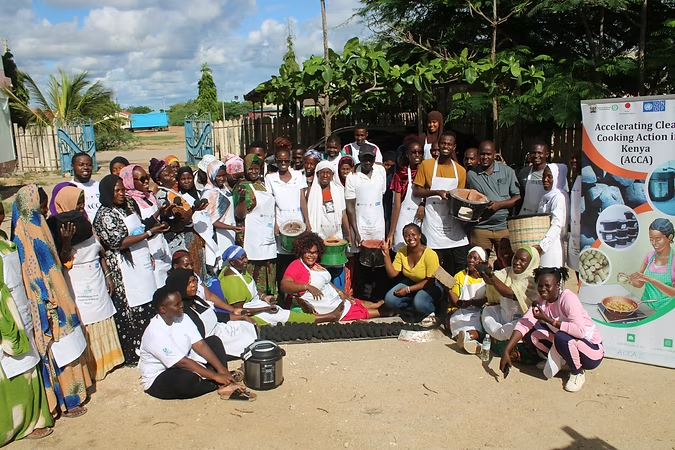
The solution to a problem of this scope will need collaboration across the spectrum. The goal of the Clean Cooking Association of Kenya (CCAK), a Nairobi-based non-profit, is to encourage growth and adoption across the entire industry. To achieve this, the CCAK has established partnerships with key players in the clean cooking sector, including manufacturers, and oversees advocacy, research & development, and training. During a conversation with CCAK National Coordinator Elly Odhiambo, he mentioned the role that CCAK can play in improving policies for clean adoption. Their focus on policy, advocacy, and member representation is critical in developing comprehensive clean cooking policies in the country.
While the emphasis in the past may have been on the affordability of clean cooking stoves, it is often the cost of clean fuel that acts as a deterrent. A report led by the Energy & Resources Group at the University of California, Berkeley, outlines the problem surfacing from “stacking,” in which unclean fuels continue to be used alongside clean cooking stoves due to the cost of clean fuels. This creates an additional layer of complexity. It is not enough to provide a clean cooking stove to each household; these stoves must be the ones that are utilized day in and day out. If clean fuel remains unaffordable, the health effects from dirty cooking will continue to result in premature deaths.
To accurately understand the cost of clean cooking, a metric that accounts for the cost of fuel as an indicator of household income is crucial. That ratio, of fuel expenditure per month as a factor of total household expenditure, is a more accurate way to gauge whether clean cooking fuels can be used. While this may be more complex than the traditional view of equating cost and affordability, it will create a more accurate result.
The key takeaways from a study on the affordability of clean cooking, conducted by ScienceDirect Energy Research & Social Science, are critical. For low and medium-income families in Nairobi, the study found that a group of clean, affordable fuels needs to be available. If not, vulnerable families could be forced to spend “upwards of 10% of their income on clean fuel or suffer the health consequences of a dirty stack.”

Tom Price, the Co-Founder and CEO of Ecosafi, explained how there will not be a single cookstove technology in use. In some instances, electric induction is the best solution, in others, Liquified Petroleum Gas (LPG), but the solution Ecosafi has developed is a cleaner biomass stove. Their clean pellet solution enables clean cooking without the expense of LPG or the potential strain on the grid of electric induction. Additionally, by seeing revenue continuously from the sale of pellets, Ecosafi can expand without customers forced to bear a high up-front cost. The use of pellet fuel in urban environments is particularly impactful because it reduces the use of charcoal. Along with health risks, the demand for charcoal, which is used as the primary or secondary form of cooking in 80% of urban households, threatens deforestation.
The role of LPG is anticipated to increase as traditional methods decrease. A report by The International Energy Agency expects LPG to be used by 50% of households for cooking if the 2028 goal of universal clean cooking access is to be reached. To this end, in 2023, the government removed the 16% VAT that developed standardizations of cylinders.
In discussing the challenges of financing, Price emphasized the need for validity in carbon credits, as they create a market that provides an important part of the capital stack for clean cooking solutions. A report by The Goldman School of Public Policy at the University of California, Berkeley, found that overcrediting from cookstoves is pervasive. While carbon credits will undoubtedly remain a necessary aspect of clean cooking financing, the methodologies must be accurate and systematized.
The collaboration between investors, businesses, governments, and NGOs can utilize their combined resources to solve this challenge. Carbon credits, pay-as-you-go financing, and international investors will lower the upfront cost barrier. Government policies across Kenya, which encourage adoption, are critical, as is maintaining localized production efforts.
Kenya is undoubtedly on the right path to achieving universal clean cooking, with a significant increase in access to clean cooking from 10% in 2013 to 31% in 2023. While this puts Kenya in a leading position in the region, the population growth during that time means that those without access to clean cooking remained around 40 million people. However, the collaboration between companies, government policies, and non-profit organizations has set the stage for Kenya to become a leader in clean cooking in the region.
Meet EP Investing — the platform behind the stories.
1,300+ companies · 350+ investors · 47+ grants