
The Energy Pioneer
No Result
View All Result
  • Home
  • Clean Tech
    • Electric Vehicles
    • Battery Storage
    • Energy Efficiency
    • Green Hydrogen
    • Smart Grid
  • Renewable Energy
    • Solar
    • Fossil Fuels
    • Hydrogen
    • Hydropower
    • Nuclear
    • Wind
  • Green Finance
    • Crash Course
    • Private Financing
    • Public Financing
    • Carbon Markets
  • Policy
  • Regions
    • Africa
    • Asia
    • West Asia
    • Latin America
    • North America
    • Europe
  • Features
  • Who We Are
    • About Us
    • Contact Us
    • EP Investing
  • Home
  • Clean Tech
    • Electric Vehicles
    • Battery Storage
    • Energy Efficiency
    • Green Hydrogen
    • Smart Grid
  • Renewable Energy
    • Solar
    • Fossil Fuels
    • Hydrogen
    • Hydropower
    • Nuclear
    • Wind
  • Green Finance
    • Crash Course
    • Private Financing
    • Public Financing
    • Carbon Markets
  • Policy
  • Regions
    • Africa
    • Asia
    • West Asia
    • Latin America
    • North America
    • Europe
  • Features
  • Who We Are
    • About Us
    • Contact Us
    • EP Investing
No Result
View All Result
The Energy Pioneer
No Result
View All Result
  • Home
  • Clean Tech
  • Green Finance
  • Policy
  • Renewable Energy
  • Regions
  • Features
  • Who We Are
Home Latin America

Colombia’s Distributed Generation Potential

Otto GundersonbyOtto Gunderson
April 29, 2025
Reading Time: 5 mins read

With just over half of Colombia’s land area currently classified as Non-Interconnected Zones (NIZ), the country has the opportunity to simultaneously reach its emission reduction goals and provide access to renewable power to the entire country. The push for renewables is partly in response to the emission reduction targets that Colombia has set, which include a 51% reduction in emissions compared to a 2030 reference scenario. Rural areas of the country, which continue to rely heavily on diesel for energy generation, could instead adopt alternative forms of distributed power generation, such as solar microgrids and small-scale hydropower, to provide economic benefits to the country while reducing carbon emissions.

RELATED POSTS

Caught Between India’s Military Ambitions and Green Promises: The Future of the Andaman and Nicobar Islands

Decarbonizing Africa’s Road Passenger Transport

Unlocking Africa’s Renewable Potential with Battery Storage

Policies implemented by the Colombian government are converging into a comprehensive approach to enhancing rural electrification rates. This has thus far included incentives for renewable energy investment and tariffs to encourage distributed generation in rural communities. The reliance on diesel generators, which continue to supply the majority of power in these areas, is expensive and receives state subsidies to drive down the price. In 2020, the usage of diesel in NIZ reached almost 14 million liters a month, due to both the rise in demand and poor efficiency of the generators. The Colombian government has made strides to replace diesel due to the hazardous impact its emissions can have on health, the high cost of diesel transportation, and the opportunity for renewables in those areas.

Solar is perhaps the most effective solution for electrifying many parts of the NIZ in Colombia. Distributed generation solar projects can provide the power necessary for communities without the up-front cost and delays of wind or hydropower. One of the primary drivers for solar energy in Colombia is the goal of diversifying the country’s energy matrix. With 66% of Colombia’s energy mix coming from hydropower, there is certainly plenty of inexpensive power available. However, the cost of building or expanding distribution networks to remote areas hundreds of miles from hydropower plants makes this a costly option.

From The Energy Pioneer New memberships opening April 15, 2026

Meet EP Investing — capital discovery for the energy transition.

Visit EP Investing →

As hinted above, it is not the generating capacity but the distribution network that has resulted in communities not having access to energy. In conversation with Juan Diego Gomez, CEO and Founder of SunColombia, he explained that the most significant roadblock to 100% access to electricity remains the transmission network. The solution created by SunColombia has been the development of microgrids. The microgrids developed by SunColombia have thus far been used to provide power to the most remote areas of Colombia. Additionally, SunColombia also used its products to operate pop-up schools in rural areas.

These microgrids exemplify the potential benefits of distributed generation beyond providing power. In an interview with Forbes Colombia, Gomez mentioned that providing a distributed generation solar solution is just one step in improving the situation for the most remote communities in Colombia. As he puts it, the impact of these installations lies in the opportunities to improve access to education as well as for businesses to grow due to access to new power sources.
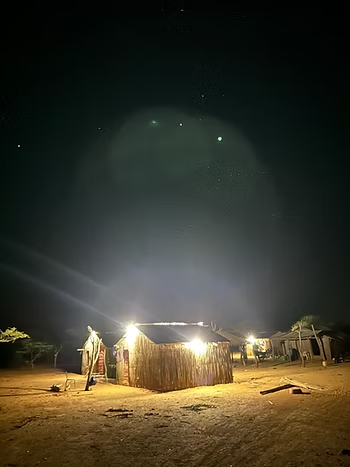
Microgrid in Colombia: Photo Provided by SunColombia

One interesting alternative to traditional distributed generation projects is the community-owned system. This offers several benefits for remote areas communities, including the ability to increase project size to procure necessary materials in bulk, sell excess energy to businesses, and negotiate better prices from installers and project developers. This results in a lower upfront cost for communities, which can then adopt longer-term payment methods such as “pay as you go.” Another option is to utilize small-scale hydropower, of which more than 140 are currently in operation and over 100 are under development.

Despite the potential of distributed generation, a report by the Universidad Internacional de Colombia found that one barrier to the development of new distributed generation projects is the procedures and permitting processes, which can take up to a year. By streamlining this process and incorporating tax incentives that support individuals and small to medium-sized enterprises (SMEs), distributed generation projects could experience significant growth.  

Buy JNews
ADVERTISEMENT

While the potential of microgrids is being recognized across areas of Colombia not connected to the grid, the deployment of rooftop solar has also found markets across the country.  In conversation with Santiago Ortega, Co-Founder and Innovation Director at Emergente Energía Sostenible, he explored the potential of rooftop solar, which he sees as an integral part of the country’s transition to renewables. Estimates for rooftop solar in the country range from 4.2 to 10.2 GW of new rooftop PV capacity by 2030. This could result in as many as 1 million new installations per year until 2030. The benefits of a strong rooftop solar industry range from improving grid resiliency and reducing fossil fuel dependence to creating a more equitable energy transition.
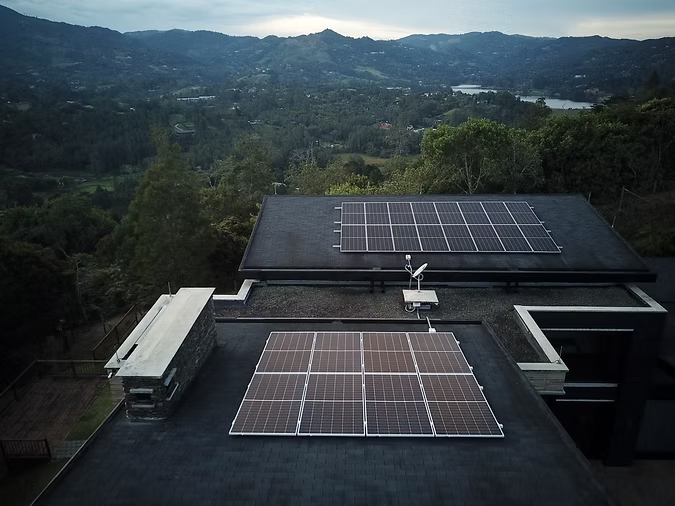
Rooftop solar in Colombia has experienced significant growth, yet still holds considerable potential: Photo provided by Emergente Energía Sostenible.

Ortega further explained how policies such as the 2014 tax breaks for renewable development and the 2018 implementation of net metering encouraged growth from the development angle, while high energy prices and grid limitations created higher levels of demand. Ortega made it clear that the high rates of return for rooftop solar are a driving reason for what he anticipates to be 7 GW of rooftop solar by 2030. These rates of return vary between residential and industrial projects, with residential rates of return reaching 25% and large industrial projects achieving up to 60%.
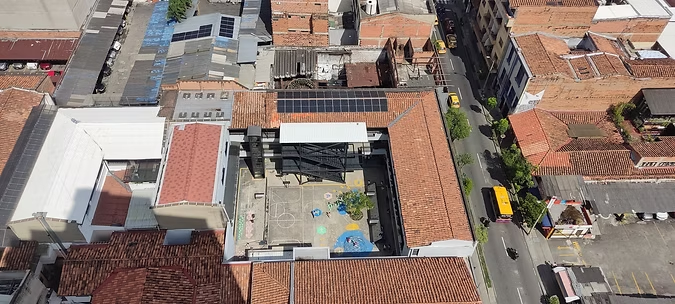
Rooftop Solar Installation in Colombia: Photo Provided by Emergente Energía Sostenible.

By encouraging the development of distributed generation, Colombia can provide power to millions of residents without the delays that come with broad infrastructure build-out. Incorporating new renewable projects, especially solar, into the matrix can take advantage of Colombia’s naturally high radiation, reduce reliance on hydropower in the overall energy matrix, and allow communities currently relying on diesel to switch to a more sustainable option.
From The Energy Pioneer New memberships opening April 15, 2026

Meet EP Investing — the platform behind the stories.

1,300+ companies · 350+ investors · 47+ grants

Visit EP Investing →
ShareTweetShare
Otto Gunderson

Otto Gunderson

Otto Gunderson has been working in clean energy for the last 7 years, with the last two being spent split between South America, Africa, and Southeast Asia, reporting on the transition to clean energy. After traveling and writing for two years, he founded The Energy Pioneer to create a news outlet with a global approach to clean energy journalism. He particularly enjoys writing about entrepreneurship, investment, and innovations that are contributing to greenhouse gas reduction and clean energy development.

Related Posts

Caught Between India’s Military Ambitions and Green Promises: The Future of the Andaman and Nicobar Islands
Renewable Energy

Caught Between India’s Military Ambitions and Green Promises: The Future of the Andaman and Nicobar Islands

March 19, 2026
Decarbonizing Africa’s Road Passenger Transport
Africa

Decarbonizing Africa’s Road Passenger Transport

March 3, 2026
Unlocking Africa’s Renewable Potential with Battery Storage
Solar

Unlocking Africa’s Renewable Potential with Battery Storage

February 25, 2026
Green Hydrogen in Tunisia: Ambitious Energy Strategy amidst Implementation Challenges
Africa

Green Hydrogen in Tunisia: Ambitious Energy Strategy amidst Implementation Challenges

February 13, 2026
Hurricane Melissa Shines Light on Jamaica’s Energy Sector
Renewable Energy

Hurricane Melissa Shines Light on Jamaica’s Energy Sector

February 10, 2026
The Race to Host AI: Data Centres in Water-Scarce India
Asia

The Race to Host AI: Data Centres in Water-Scarce India

February 9, 2026
Next Post
Trump’s Aversion to Green Tech Financing Risks Leaving America Last

Trump's Aversion to Green Tech Financing Risks Leaving America Last

The Companies Democratizing Climate Investing

The Companies Democratizing Climate Investing

Popular Stories

  • The Financiers and Startups Decarbonizing Africa’s ‘Anti-Fossil’ Fuel Nation

    The Financiers and Startups Decarbonizing Africa’s ‘Anti-Fossil’ Fuel Nation

    0 shares
    Share 0 Tweet 0
  • Caught Between India’s Military Ambitions and Green Promises: The Future of the Andaman and Nicobar Islands

    0 shares
    Share 0 Tweet 0
  • Decarbonizing Africa’s Road Passenger Transport

    0 shares
    Share 0 Tweet 0
  • Green Hydrogen in Tunisia: Ambitious Energy Strategy amidst Implementation Challenges

    0 shares
    Share 0 Tweet 0
  • South African Pension Funds Outshine $13 Billion Green Transition Funds

    0 shares
    Share 0 Tweet 0

Actionable Info

🔒 NEW MEMBERSHIPS OPEN APRIL 15
EP
EP Investing Climate Finance Intelligence

Our journalism is made possible by readers like you.

The founders, investors, and professionals reading The Energy Pioneer use EP Investing to find capital, partners, and opportunities.

1300+Companies
350+Investors
45+Grants
Explore EP Investing →

The Energy Pioneer

The Energy Pioneer covers the global energy transition — from clean tech and green finance to policy and renewable energy.

Recent Posts

  • Caught Between India’s Military Ambitions and Green Promises: The Future of the Andaman and Nicobar Islands
  • Decarbonizing Africa’s Road Passenger Transport
  • Unlocking Africa’s Renewable Potential with Battery Storage

Categories

  • Africa
  • Asia
  • Battery Storage
  • Carbon Markets
  • Clean Tech
  • Crash Course
  • Electric Vehicles
  • Energy Efficiency
  • Features
  • Fossil Fuels
  • Green Finance
  • Green Hydrogen
  • Hydrogen
  • Hydropower
  • Latin America
  • North America
  • Nuclear
  • Policy
  • Private Financing
  • Public Financing
  • Renewable Energy
  • Smart Grid
  • Solar
  • West Asia

Quick Links

  • Home

© 2026 The Energy Pioneer | All Rights Reserved. |

No Result
View All Result
  • Home
  • Clean Tech
    • Electric Vehicles
    • Energy Efficiency
    • Green Hydrogen
    • Smart Grid
    • Battery Storage
  • Green Finance
    • Public Financing
    • Private Financing
    • Carbon Markets
  • Policy
  • Renewable Energy
    • Wind
    • Solar
    • Hydropower
    • Nuclear
    • Hydrogen
    • Fossil Fuels
    • Geothermal
  • Regions
    • Africa
    • Asia
    • Europe
    • North America
    • Latin America
    • West Asia
  • Features
  • Who We Are
    • About Us
    • EP Investing
    • Contact Us

© 2026 The Energy Pioneer | All Rights Reserved. |