

The convening of the COP30 climate summit in Belém, Brazil, posed a significant challenge to the participation of many young people worldwide due to the high cost of travel and accommodation and the difficulty of reaching the conference site. This was clearly reflected in the decline of youth attendance from the Middle East and North Africa this year, pushing youth movements and coalitions to search for alternative ways to influence the process, through virtual events or by sending a limited number of representatives to ensure their voices and messages on achieving a just energy transition continue to be heard.
Calls for Fair Islamic Finance
Nouhad Awwad, Campaign Coordinator at Ummah for Earth at Greenpeace MENA—a youth coalition working to integrate religious values into climate action—said that every year they organize campaigns during the COP, including digital actions and some on-ground activities. Their slogan this year is “Finance a climate resilient earth.” The campaign calls for signing a petition urging the Global North to fund climate adaptation efforts effectively and encourages religious leaders to play a stronger role in climate action, given their influence within communities. The campaign also advocates the use of Islamic finance tools—such as green sukuk, Zakat funds, and Takaful—to support climate adaptation, renewable energy, and resilience.
An Arab Coffee Session… A Bridge Between Youth and Negotiators
Inside the Blue Zone in Belém, an “Arab Coffee Session” was held at the Children and Youth Pavilion to bring together young participants at COP30 with Arab negotiators, allowing them to exchange views and ensure youth messages reach the closed negotiating rooms, according to Mohab Sherif, Coordinator of Relations and Cooperation for the MENA Youth Network and representative of Ummah for Earth at COP30.
Meet EP Investing — capital discovery for the energy transition.
Mohab emphasized the vital role of Arab youth in negotiations, explaining, “While we have made some progress in incorporating youth voices into discussions, we have not yet reached the essential level of participation. The perspectives of young people have not sufficiently influenced decision-makers to prompt the just and urgent actions needed.”
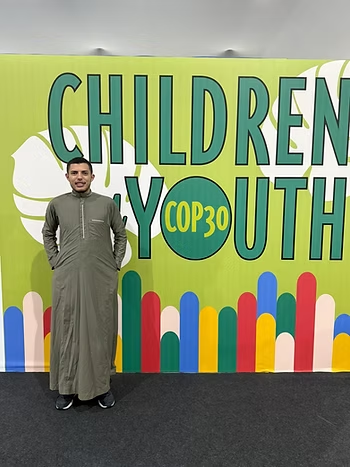
He hopes that COP30 will contribute to strengthening the role of the Arab region as a key hub for a just energy transition and to advancing climate action, particularly adaptation, by coordinating efforts to enhance the role of communities in climate adaptation and resilience, towards a brighter future for the region and the world at large.
For her part, Hala Murad, Executive Director of the Dibeen Association for Environmental Development in Jordan, outlined how “many Arab youth were absent this year due to a lack of funding and the distant location of the conference, not due to a lack of interest. Yet they continue working in their countries, leading important initiatives in adaptation, agriculture, and community work.”
She added that young people in the region work very hard, but their voices inside negotiation rooms remain limited, noting a clear difference between “active youth presence” and “actual youth influence” in shaping positions and decisions. “We need a clear mechanism to guarantee youth participation within official delegations and negotiation tracks—not just in side events.”

Arab Youth Messages at COP30
Hala Murad participated in several sessions in Belém, focusing on the need for companies to shift from voluntary pledges to science-based legal obligations, stressing that voluntary action is not enough to ensure transparency, justice, and the protection of vulnerable communities. She also took part in another session with EcoCode, RAED Network, and the Union for the Mediterranean Pavilion on opportunities to build an innovation bridge between the Mediterranean and the Gulf in water, the circular economy, and environmental governance. In addition, she contributed to drafting the Arab Watch Coalition statement marking ten years since the Paris Agreement, addressing climate finance imbalances, ongoing debt burdens on Global South countries, and the weak flow of finance to local communities.
Hala brings three key messages to COP30: climate and financial justice are rights, not slogans. Corporate responsibility must shift from voluntary initiatives to binding legal obligations. Local communities—especially women, heat-exposed workers, and farmers—must be at the center of solutions.
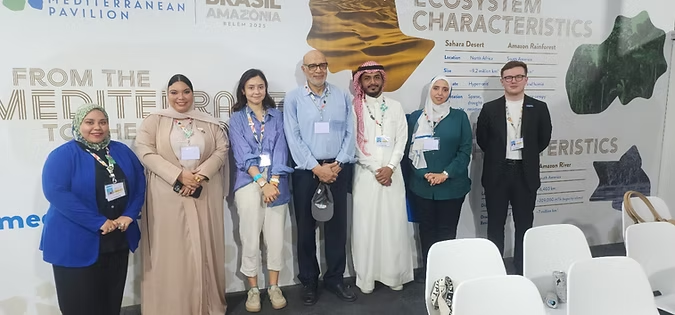
She also hopes to strengthen the role of Arab civil society in evaluating climate finance, build partnerships for local adaptation projects in Jordan—especially northern Jordan—and advance a fair discussion on the use of AI in MRV.
Hala believes COP30 offers several opportunities for the Arab region, including putting “corporate accountability” on both the Arab and international agenda, strengthening the region’s leadership in water and adaptation, and pushing for climate finance reforms that ensure funding reaches local communities. She also highlights the importance of strengthening Arab networks to support government efforts through a unified civil voice that presents realistic solutions.
Climate Justice at the Heart of the Discussion
Meanwhile, some delegations included youth voices. Mahmoud ElDaba, Executive Director of the Humanitarian Volunteer Team Foundation and the Climate Ambassadors Initiative, notes that Egyptian youth have gained an influential presence at international conferences thanks to empowerment programs and the preparation of a new generation of youth negotiators since COP27 in Sharm El-Sheikh. El-Dobaa participated in a session recommending the creation of an independent international body to monitor carbon markets and establish unified global standards for carbon pricing to ensure transparency and fairness, alongside strengthening voluntary carbon market tools and encouraging innovation in emission-reduction technologies.
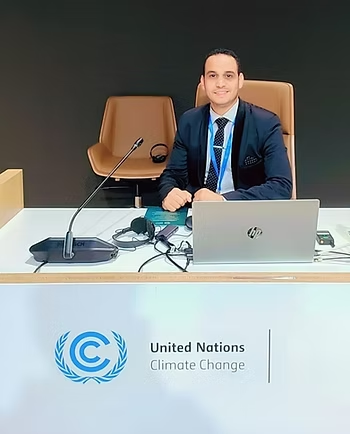
The session also called for boosting investment in clean-energy solutions such as solar, wind, and green hydrogen, offering incentives to companies adopting circular-economy practices, and developing sustainable projects through cooperation between governments and the private sector, especially in developing countries. El-Dobaa explains that their participation aims to prepare young cadres capable of negotiating and shaping climate policies across key tracks, including adaptation, mitigation, finance, loss and damage, and just transition. He stresses that climate change is an existential issue requiring global youth solidarity.
He adds that COP30 has highlighted the challenges facing Arab countries in finance, historical responsibility, technology transfer, and environmental protection—issues that complicate negotiations but also open space for essential global dialogue on climate justice and international cooperation. The summit also comes amid mounting pressure to achieve the goals of the Paris Agreement, particularly limiting global warming to below 1.5°C, while ongoing disputes continue to hinder the development of practical, binding agreements.
The active involvement of young people—both within negotiation rooms and in broader movements—continues to steer climate discussions toward greater equity and pragmatism. Their voices are crucial in demanding real change and holding decision-makers accountable for just and realistic climate action.
Meet EP Investing — the platform behind the stories.
1,300+ companies · 350+ investors · 47+ grants