
The Energy Pioneer
No Result
View All Result
  • Home
  • Clean Tech
  • Renewable Energy
  • Green Finance
    • Crash Course
    • Private Financing
    • Public Financing
    • Carbon Markets
  • Policy
  • Regions
    • Africa
    • Asia
    • West Asia
    • Latin America
    • North America
    • Europe
  • Features
  • Who We Are
    • About Us
    • Contact Us
    • EP Investing
  • Home
  • Clean Tech
  • Renewable Energy
  • Green Finance
    • Crash Course
    • Private Financing
    • Public Financing
    • Carbon Markets
  • Policy
  • Regions
    • Africa
    • Asia
    • West Asia
    • Latin America
    • North America
    • Europe
  • Features
  • Who We Are
    • About Us
    • Contact Us
    • EP Investing
No Result
View All Result
The Energy Pioneer
No Result
View All Result
  • Home
  • Clean Tech
  • Green Finance
  • Policy
  • Renewable Energy
  • Regions
  • Features
  • Who We Are
Home Clean Tech Battery Storage

The Uses of Flow Batteries

Otto GundersonbyOtto Gunderson
April 1, 2026
Reading Time: 3 mins read

For someone unfamiliar with the topic of flow batteries, Eugene Beh, the Founder and CEO of Quino Energy, put it in easy-to-understand terms. The simplest way to understand flow batteries is to think of them like a conventional car: a fuel tank and an air intake are used in the engine to produce movement. Similarly, flow batteries require fuel, oxidizer, water, and solvent to extract chemical energy. Flow batteries store the liquid electrolytes (think fuel) separately, and they then flow into the central cell. This flow into the central cell will then result in the charging, or discharging, of the battery.

RELATED POSTS

Zimbabwe’s Growing Solar Garbage Problem

A Policy Lag in Zimbabwe’s Energy Sector

David Energy, Distributed Energy Resources, and the Future of the Grid

The use cases for flow batteries are centered on energy storage. With solar projects continuing to have intermittency problems, having a way to store additional energy so as to avoid negative pricing is crucial. Negative pricing for excess renewable energy continues to strain the industry, and the low cost of flow batteries could be a significant possibility.

Flow batteries have the ability to store hundreds of megawatt hours of energy, with the capability to power thousands of homes for hours with a single charge. MIT Associate Professor Fikile Brushett described the difference between flow batteries and those in EVs and phones. As he puts it, “A flow battery takes those solid-state charge-storage materials, dissolves them in electrolyte solutions, and then pumps the solutions through the electrodes.” This makes them excellent candidates for long-duration storage.
From The Energy Pioneer

Meet EP Investing — now live and free through July 15th.

1,300+ companies · 350+ investors · 185+ grants. Capital discovery for the energy transition.

EP Investing is now live
Register Free →
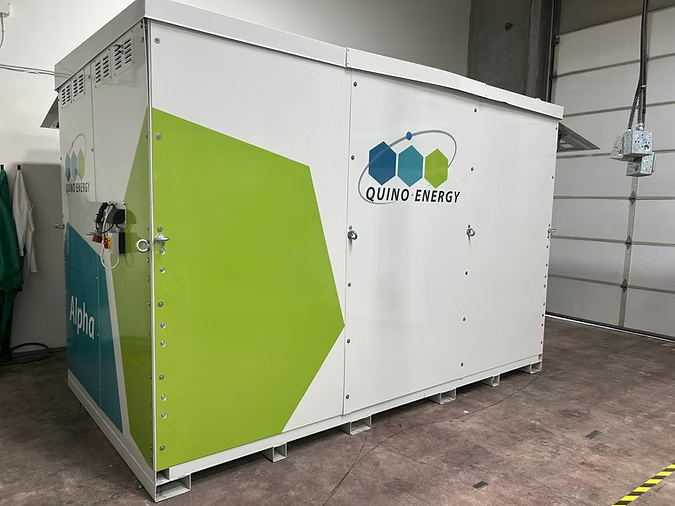
100 KW/h Flow Battery: Photo Provided by Quino Energy

As Beh explained, one outlet for innovation and improvement in the development of the flow battery industry is improving installation. The cost of installation can be reduced by using the carbon steel tanks already available at many shipping ports and refineries. This could also allow the oil industry to enter the flow battery market, as the storage tanks traditionally used for petroleum could be repurposed. 

The uses of flow batteries are varied. They are most commonly considered a grid storage solution, preventing negative pricing during peak renewable energy production while providing on-site storage. If safety is a concern, such as in data centers or hospitals, flow batteries may be a better option than lithium-ion due to their non-flammability. Similarly, flow batteries are a compact option in cases where space is an issue, such as in a densely packed urban area. Stacking the batteries vertically can mean more storage for smaller areas than lithium-ion.

Additional benefits to a flow battery solution include the materials that are found in their production. Flow batteries rely heavily on commonly available materials, and the cost of materials is lessened due to the recyclability of the battery. The need for multiple energy storage solutions is not a zero-sum game. Flow batteries, lithium-ion, sodium-ion, and other storage methods all play a role in this transition. This is backed by European Union Research, which anticipates 20% growth annually until reaching at least 45 GWh by 2030. Simultaneously researching and commercializing various storage options is crucial to meeting decarbonization targets.

  • EVs and Electrification
  • Renewable Energy
Buy JNews
ADVERTISEMENT
From The Energy Pioneer

Meet EP Investing — now live and free through July 15th.

1,300+ companies · 350+ investors · 185+ grants. Capital discovery for the energy transition.

EP Investing is now live
Register Free →
ShareTweetShare
Otto Gunderson

Otto Gunderson

Otto Gunderson has been working in clean energy for the last 7 years, with the last two being spent split between South America, Africa, and Southeast Asia, reporting on the transition to clean energy. After traveling and writing for two years, he founded The Energy Pioneer to create a news outlet with a global approach to clean energy journalism. He particularly enjoys writing about entrepreneurship, investment, and innovations that are contributing to greenhouse gas reduction and clean energy development.

Related Posts

Zimbabwe’s Growing Solar Garbage Problem
Solar

Zimbabwe’s Growing Solar Garbage Problem

June 12, 2026
A Policy Lag in Zimbabwe’s Energy Sector
Features

A Policy Lag in Zimbabwe’s Energy Sector

June 15, 2026
David Energy, Distributed Energy Resources, and the Future of the Grid
Smart Grid

David Energy, Distributed Energy Resources, and the Future of the Grid

June 10, 2026
The Sargassum Paradox: Why the Caribbean’s Clean Energy Hope is a Supply Chain Trap
Clean Tech

The Sargassum Paradox: Why the Caribbean’s Clean Energy Hope is a Supply Chain Trap

June 8, 2026
Advancing Climate Resilience and Energy Equity with the Kresge Foundation
Private Financing

Advancing Climate Resilience and Energy Equity with the Kresge Foundation

June 5, 2026
Who Really Pays When the Lights Go Out?
Public Financing

Who Really Pays When the Lights Go Out?

June 4, 2026
Next Post
New Breakthroughs in Geothermal Energy

New Breakthroughs in Geothermal Energy

Exciting New Green Finance Platforms

Exciting New Green Finance Platforms

Popular Stories

  • The Race to Host AI: Data Centres in Water-Scarce India

    The Race to Host AI: Data Centres in Water-Scarce India

    0 shares
    Share 0 Tweet 0
  • Vietnam’s Oil Buffer Faces Pressure as the Iran War Disrupts Global Oil Flows

    0 shares
    Share 0 Tweet 0
  • Caught Between India’s Military Ambitions and Green Promises: The Future of the Andaman and Nicobar Islands

    0 shares
    Share 0 Tweet 0
  • The Philippines’ Nuclear Gamble

    0 shares
    Share 0 Tweet 0
  • South Sudan’s Missed Opportunity: Untapped Renewables Leave Millions in the Dark

    0 shares
    Share 0 Tweet 0

Actionable Info

From The Energy Pioneer

Meet EP Investing — now live.

1,300+ companies · 350+ investors · 185+ grants

Free through July 15th

Register Free →

The Energy Pioneer

The Energy Pioneer covers the global energy transition — from clean tech and green finance to policy and renewable energy.

Recent Posts

  • Climate Investment and Scaling Decarbonization Solutions
  • The Energy Transition Only Works if Development Works
  • Zimbabwe’s Growing Solar Garbage Problem

Quick Links

  • Home
  • Clean Tech
  • Renewable Energy
  • Green Finance
  • Policy
  • Regions
  • Features
  • Who We Are

© 2026 The Energy Pioneer | All Rights Reserved. |

From The Energy Pioneer

You read about the energy transition. EP Investing is where it happens.

Source deals, raise capital, hire talent, track the market. Free through July 15th.

No thanks
Please enter a valid email.
You're in. We'll be in touch with your access link soon.
No Result
View All Result
  • Home
  • Clean Tech
    • Electric Vehicles
    • Energy Efficiency
    • Green Hydrogen
    • Smart Grid
    • Battery Storage
  • Green Finance
    • Public Financing
    • Private Financing
    • Carbon Markets
  • Policy
  • Renewable Energy
    • Wind
    • Solar
    • Hydropower
    • Nuclear
    • Hydrogen
    • Fossil Fuels
    • Geothermal
  • Regions
    • Africa
    • Asia
    • Europe
    • North America
    • Latin America
    • West Asia
  • Features
  • Who We Are
    • About Us
    • EP Investing
    • Contact Us

© 2026 The Energy Pioneer | All Rights Reserved. |