The Energy Pioneer
No Result
View All Result
  • Home
  • Clean Tech
    • Electric Vehicles
    • Energy Efficiency
    • Green Hydrogen
    • Smart Grid
    • Battery Storage
  • Green Finance
    • Public Financing
    • Private Financing
    • Carbon Markets
  • Policy
  • Renewable Energy
    • Wind
    • Solar
    • Hydropower
    • Nuclear
    • Hydrogen
    • Fossil Fuels
    • Geothermal
  • Regions
    • Africa
    • Asia
    • Europe
    • North America
    • Latin America
    • West Asia
    • Oceania
  • Features
  • Who We Are
    • About Us
    • EP Network
    • Contact Us
No Result
View All Result
The Energy Pioneer
No Result
View All Result
  • Home
  • Clean Tech
  • Green Finance
  • Policy
  • Renewable Energy
  • Regions
  • Features
  • Who We Are
Home North America

Would you trust an emergency alert written by AI?

Human beings struggle with disaster communication. Chatbots can help — if people take them seriously.

Jake BittlebyJake Bittle
November 5, 2026
Reading Time: 7 mins read

This story was originally published by Grist. Sign up for Grist’s weekly newsletter here.

RELATED POSTS

Why Google is Paying to Upgrade Nuclear Power Plants

Rule 9-6 and the Bay Area’s Shift to Cleaner Water Heating

Trump Trade War Could Be a Catalyst to Speed Canada’s Energy Transition, Experts Say

Earlier this month, after Hurricane Isaias made landfall on the Gulf Coast as a Category 3 hurricane, the emergency management expert Laura Myers got a call from a meteorologist in Alabama. Myers is director of the University of Alabama’s Center for Advanced Public Safety, and she talks to state and local emergency managers around her region all the time. The meteorologist told Myers that a local emergency manager had published a graphic showing where Isaias might threaten the Alabama coast with a “sting jet” of high winds.

The problem? The emergency manager had generated the graphic using an artificial intelligence chatbot, and it wasn’t accurate.

“That county emergency manager was trying to get his stakeholders to focus on the risk in that county, and so he had asked AI to help him,” she said. “It did what he wanted it to do, but it was not meteorologically accurate.”

Most emergency management agencies don’t permit employees to use generative AI, but Myers and most other emergency management experts agree that its usage is likely already pervasive at state and local disaster departments. There are hundreds of companies that are marketing AI tools to emergency managers for tasks like flood damage assessment and resource coordination, but public communication is one of the areas where government employees and startups have the most interest.

The reason? Most emergency managers aren’t very good at sending out alerts and quickly communicating about disasters with the public. That’s not because they’re emergency managers, but because they are human beings. They tend to write in jargon that non-experts might not understand, leave out information on the assumption that the public already knows it, and include irrelevant details that could distract people from what they actually do need to know.
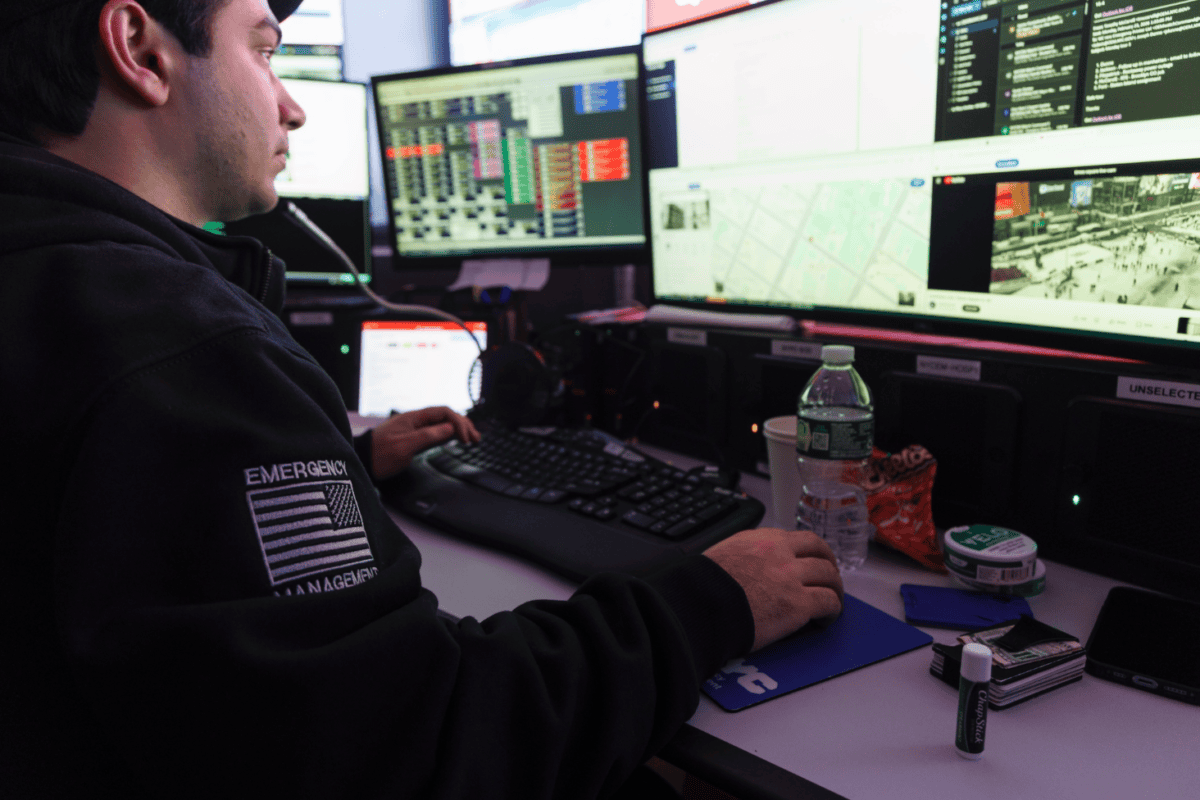
Emergency department personnel with the city of New York monitor the watch-command room in Brooklyn on February 23, 2026, ahead of a winter storm.
Matthew Hoen / NurPhoto via Getty Images via Grist

“A lot of agencies are really limited in resources and the number of people that they have,” said Jeannette Sutton, a disaster researcher at the University of Albany who has created a comprehensive dashboard that provides templates for disaster alerts. “I think they recognize it as a priority, but they don’t prioritize it until they realize they should have. They’re just trying to get their job done without screwing something up.”

Buy JNews
ADVERTISEMENT

Emergency managers are the government officials who are in charge of disaster response and recovery. At the state and local level, It is these officials and their agencies, not the Federal Emergency Management Agency, that make up the first line of defense after an extreme weather event. As such, emergency managers often like to say that “trust is our currency,” and it’s in their communication with the public that they build and lose this trust.

As climate disasters become more frequent and widespread, there have been numerous examples of flawed human communication scrambling an emergency response. In 2016, for instance, adjacent counties in California issued a “voluntary evacuation” and a “mandatory evacuation” for the same wildfire. In Australia in 2019, officials warned about wildfires by using the phrase “Watch and Act,” which the government later said caused “significant confusion” because no one knew what it meant.

In some cases, inadequate communication can mean the difference between life and death. This happened in Montecito, California, after the 2017 Thomas Fire. A few weeks after the fire, a heavy rainstorm produced a deadly mudslide. The government of Santa Barbara County struggled to communicate the risk to residents still traumatized from the blaze and  experiencing a phenomenon that Sutton calls “warning fatigue.” The county sent alerts to everyone in the “voluntary evacuation zone” for wildfires, telling residents to “stay alert to changing conditions and be prepared to leave immediately.” Most of those residents should have left immediately, but to many the evacuation notice was optional; others just didn’t want to evacuate for a second time in a month. The mudslide killed 23 people and injured more than 160 others.

Governments that put out bad warnings are apt to lose the public’s trust said Sutton. “They’re losing the opportunity to be that voice to help people to be safe.”

In theory, alerts are a perfect use case for artificial intelligence, and in particular for the generative AI systems that have developed at a dramatic pace over the past few years. FEMA provides training sessions for emergency managers to learn best practices for synthesizing and sending alerts, but many officials don’t remember all their training when an emergency arrives. A large language model is different. It can read hundreds of thousands of alerts in mere minutes, digest all the research on what works in similar scenarios, and then apply that to edit a human alert in seconds.

“If you’ve only sent one [alert] in your life, and that was 15 years ago, and you need to remember all your training, and you’re thinking ‘Hey, there’s a chemical plume coming my way, the phone’s ringing, the radio’s blaring, I need help,’ the AI is probably gonna do a better job than you are,” said Rob Dale, a former meteorologist who now runs the emergency management department in Ingham County, Michigan.

Dale has already used AI to draft a few practice alerts behind the scenes, but he’s never had to send one out. Ingham County is a small county in central Michigan, and it’s immune from major weather events like hurricanes and fires. If such an event did happen, Dale said he would have no issue allowing a chatbot to draft his incident communication, but he’d still want control over sending the alert out.

Some experts believe the technology is already good enough to deploy. EM1, a startup that produces AI software for emergency managers, has used Sutton’s research to train a model that its executives say is already better than almost any human emergency manager. The company has tested this in-house model on a number of scenarios including wildfires and tsunamis. It can already match or exceed human capabilities on most benchmark tests.

Sutton gave Grist an example of how the software works: Grist provided her with a recent alert sent by a New Mexico county that was trying to warn residents about flooding on the San Juan River.


The original alert

“Breeched banks. The water is rising. EVACUATE NOW. McGee Park open for people and pets, RV.”


Sutton asked the EM1 model to evaluate and revise the alert. In a few seconds, it produced what she said is a far better alert, one that checks all the main boxes of disaster communication.


The new alert

“San Juan County: Floodwater is rising near [location]. People in [evacuation area]: LEAVE NOW for higher ground. Do not walk or drive through floodwater. McGee Park is open for people and pets. Check [official update source] for updates.”


The model identified and fixed several problems with the original text, which does not say who is sending the alert, name the specific location where flooding is happening, or clarify who needs to evacuate and give advice on how to do so safely. It misspells the word “breached,” and it doesn’t provide any guidance on where residents can seek further information.

EM1 has contracts with around a hundred government agencies and school districts, but none are using it to automate their extreme weather alerts just yet. For the moment, they’re only using it to workshop plans and internal preparations. Even so, all the experts interviewed for this story said they are certain that many emergency managers are already using chatbots to write messages, even if they won’t admit it. Sutton said that the emergency managers who take her alert training sessions often present her with high-quality alerts they have drafted in seconds using ChatGPT or Gemini.

“Official adoption is pretty low, but people are unofficially using it, absolutely,” said Sarah Miller, a professor of emergency management at Pierce College in Washington and a longtime instructor at the National Disaster Preparedness Training Center. “They’re using their own personal accounts, or they’re using free ones.”

It sounds like an easy trade-off: if AI is better and faster than humans, and the difference between a good alert and a bad alert can be life and death, we should be using AI for every heat wave and wildfire. Yet even researchers who are bullish on chatbot technology say that making the switch could backfire. Members of the public who are skeptical of AI or who don’t trust the government in the first place may spurn agencies that publish AI-generated graphics or social media posts. In Syracuse, New York, for instance, a union of public employees sued the local government for using an AI service to answer non-emergency 911 calls.

“We trust things that we perceive [are] authentic and care about us,” said Ginny Katz, the founder of HazAdapt, a consultancy that helps disaster officials figure out how to use technology. “AI-generated content does not feel authentic.” There’s also a risk that chatbots could allow emergency managers to send out more alerts, and faster, which could increase the risk of warning fatigue.

As is the case in other areas where AI is being deployed, disaster experts say that for the moment the software is only as capable as the person using it. A seasoned emergency manager might be able to speed up their communication with the public by having a chatbot draft a series of alerts, but an inexperienced one rushing to create an urgent alert won’t know how to evaluate the output of a model like ChatGPT or Claude.

Even though the technology is a ways off from being able to perform without a human expert in the loop, that hasn’t stopped many understaffed emergency management departments from using it. As for how the proliferation of AI-generated content is affecting public trust in government, experts say it’s too early to tell.

“If you had a human sending you a text message versus a computer sending you a text message, which one would you believe is being more accurate?” said Justin Snair, the founder of Preppr, another company that offers AI software to emergency managers.

The answer, he said, depends on the person receiving it.

Tags: AIAI climate forecastingartificial intelligenceFloodingNatural disastersWildfires
ShareTweetShare
Jake Bittle

Jake Bittle

Jake Bittle is a staff writer at Grist, covering climate change, energy, and natural disasters. He is the author of The Great Displacement: Climate Change and the Next American Migration.

Related Posts

Why Google is Paying to Upgrade Nuclear Power Plants
Nuclear

Why Google is Paying to Upgrade Nuclear Power Plants

October 30, 2026
Rule 9-6 and the Bay Area’s Shift to Cleaner Water Heating
Features

Rule 9-6 and the Bay Area’s Shift to Cleaner Water Heating

September 24, 2026
Trump Trade War Could Be a Catalyst to Speed Canada’s Energy Transition, Experts Say
Renewable Energy

Trump Trade War Could Be a Catalyst to Speed Canada’s Energy Transition, Experts Say

September 3, 2026
‘Recipe for Catastrophe’: Trump Moves to Weaken Arctic Drilling Safeguards
Fossil Fuels

‘Recipe for Catastrophe’: Trump Moves to Weaken Arctic Drilling Safeguards

August 25, 2026
Staying Cool as Jamaica Heats Up
Fossil Fuels

Staying Cool as Jamaica Heats Up

August 20, 2026
They’re making record profits, but oil companies still won’t ‘drill, baby, drill’
Fossil Fuels

They’re making record profits, but oil companies still won’t ‘drill, baby, drill’

August 19, 2026

Popular Stories

  • AI Can Scale Regenerative Agriculture – If Farmers Trust It

    AI Can Scale Regenerative Agriculture – If Farmers Trust It

    0 shares
    Share 0 Tweet 0
  • The Race to Host AI: Data Centres in Water-Scarce India

    0 shares
    Share 0 Tweet 0
  • The Sargassum Paradox: Why the Caribbean’s Clean Energy Hope is a Supply Chain Trap

    0 shares
    Share 0 Tweet 0
  • The Philippines’ Nuclear Gamble

    0 shares
    Share 0 Tweet 0
  • Vietnam’s Oil Buffer Faces Pressure as the Iran War Disrupts Global Oil Flows

    0 shares
    Share 0 Tweet 0

Actionable Info

From The Energy Pioneer

Where the energy transition connects.

Journalists, investors, companies, and clean energy leaders — all in one network.

Explore EP Network →

The Energy Pioneer

The Energy Pioneer covers the global energy transition — from clean tech and green finance to policy and renewable energy.

Recent Posts

  • Would you trust an emergency alert written by AI?
  • Steel: A Strategic Industry Built on Coal
  • Architecture for a Hotter World: Thailand’s Community-Led Housing Adaptations

Quick Links

  • Home
  • Clean Tech
  • Renewable Energy
  • Green Finance
  • Policy
  • Regions
  • Features
  • Who We Are

© 2026 The Energy Pioneer | All Rights Reserved. |

From The Energy Pioneer

Meet EP Network.

Enter your email and our team will reach out — or sign up directly.

Please enable JavaScript in your browser to complete this form.
Loading
or sign up directly →
From The Energy Pioneer

You read about the energy transition. EP Network connects you to it.

Leave your email and our team will reach out.

Please enable JavaScript in your browser to complete this form.
Loading
or
Sign up now →
No Result
View All Result
  • Home
  • Clean Tech
    • Electric Vehicles
    • Energy Efficiency
    • Green Hydrogen
    • Smart Grid
    • Battery Storage
  • Green Finance
    • Public Financing
    • Private Financing
    • Carbon Markets
  • Policy
  • Renewable Energy
    • Wind
    • Solar
    • Hydropower
    • Nuclear
    • Hydrogen
    • Fossil Fuels
    • Geothermal
  • Regions
    • Africa
    • Asia
    • Europe
    • North America
    • Latin America
    • West Asia
    • Oceania
  • Features
  • Who We Are
    • About Us
    • EP Network
    • Contact Us

© 2026 The Energy Pioneer | All Rights Reserved. |