
This story was originally published by Grist. Sign up for Grist’s weekly newsletter here.
Earlier this month, after Hurricane Isaias made landfall on the Gulf Coast as a Category 3 hurricane, the emergency management expert Laura Myers got a call from a meteorologist in Alabama. Myers is director of the University of Alabama’s Center for Advanced Public Safety, and she talks to state and local emergency managers around her region all the time. The meteorologist told Myers that a local emergency manager had published a graphic showing where Isaias might threaten the Alabama coast with a “sting jet” of high winds.
The problem? The emergency manager had generated the graphic using an artificial intelligence chatbot, and it wasn’t accurate.
“That county emergency manager was trying to get his stakeholders to focus on the risk in that county, and so he had asked AI to help him,” she said. “It did what he wanted it to do, but it was not meteorologically accurate.”
Most emergency management agencies don’t permit employees to use generative AI, but Myers and most other emergency management experts agree that its usage is likely already pervasive at state and local disaster departments. There are hundreds of companies that are marketing AI tools to emergency managers for tasks like flood damage assessment and resource coordination, but public communication is one of the areas where government employees and startups have the most interest.
The reason? Most emergency managers aren’t very good at sending out alerts and quickly communicating about disasters with the public. That’s not because they’re emergency managers, but because they are human beings. They tend to write in jargon that non-experts might not understand, leave out information on the assumption that the public already knows it, and include irrelevant details that could distract people from what they actually do need to know.
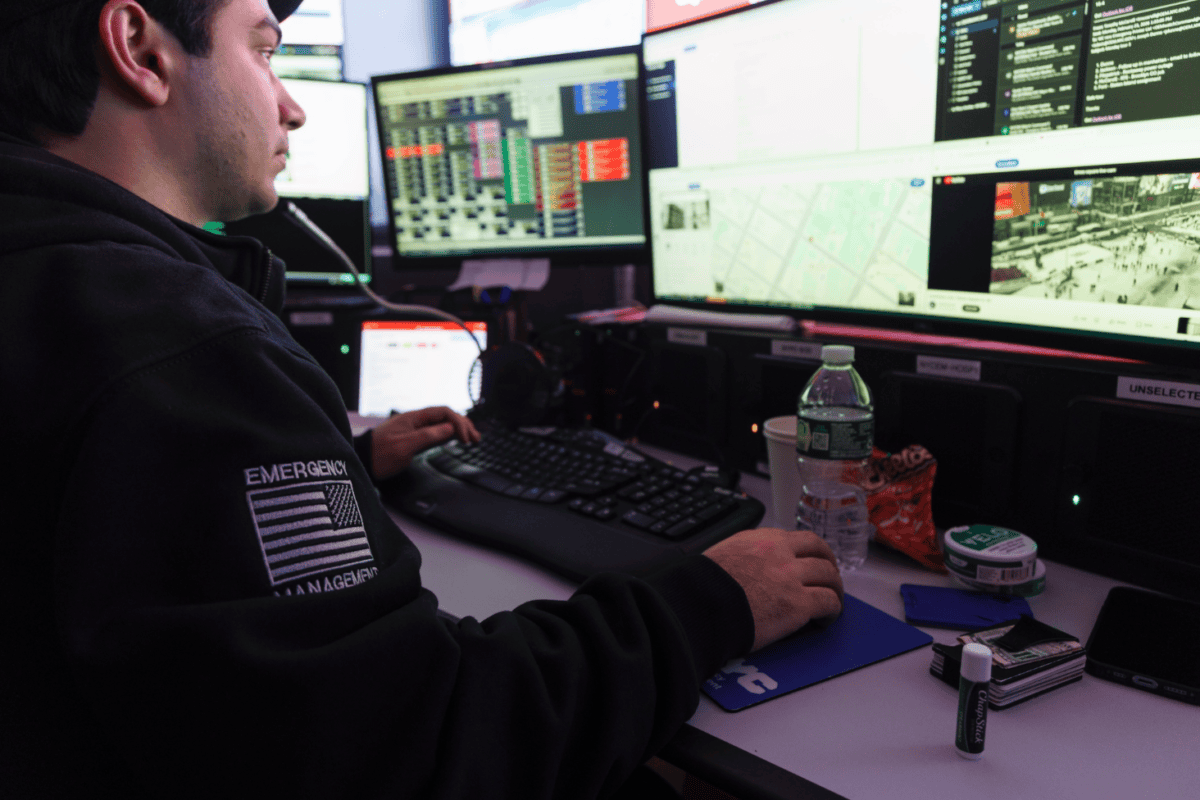
Matthew Hoen / NurPhoto via Getty Images via Grist
“A lot of agencies are really limited in resources and the number of people that they have,” said Jeannette Sutton, a disaster researcher at the University of Albany who has created a comprehensive dashboard that provides templates for disaster alerts. “I think they recognize it as a priority, but they don’t prioritize it until they realize they should have. They’re just trying to get their job done without screwing something up.”

Emergency managers are the government officials who are in charge of disaster response and recovery. At the state and local level, It is these officials and their agencies, not the Federal Emergency Management Agency, that make up the first line of defense after an extreme weather event. As such, emergency managers often like to say that “trust is our currency,” and it’s in their communication with the public that they build and lose this trust.
As climate disasters become more frequent and widespread, there have been numerous examples of flawed human communication scrambling an emergency response. In 2016, for instance, adjacent counties in California issued a “voluntary evacuation” and a “mandatory evacuation” for the same wildfire. In Australia in 2019, officials warned about wildfires by using the phrase “Watch and Act,” which the government later said caused “significant confusion” because no one knew what it meant.
In some cases, inadequate communication can mean the difference between life and death. This happened in Montecito, California, after the 2017 Thomas Fire. A few weeks after the fire, a heavy rainstorm produced a deadly mudslide. The government of Santa Barbara County struggled to communicate the risk to residents still traumatized from the blaze and experiencing a phenomenon that Sutton calls “warning fatigue.” The county sent alerts to everyone in the “voluntary evacuation zone” for wildfires, telling residents to “stay alert to changing conditions and be prepared to leave immediately.” Most of those residents should have left immediately, but to many the evacuation notice was optional; others just didn’t want to evacuate for a second time in a month. The mudslide killed 23 people and injured more than 160 others.
Governments that put out bad warnings are apt to lose the public’s trust said Sutton. “They’re losing the opportunity to be that voice to help people to be safe.”
In theory, alerts are a perfect use case for artificial intelligence, and in particular for the generative AI systems that have developed at a dramatic pace over the past few years. FEMA provides training sessions for emergency managers to learn best practices for synthesizing and sending alerts, but many officials don’t remember all their training when an emergency arrives. A large language model is different. It can read hundreds of thousands of alerts in mere minutes, digest all the research on what works in similar scenarios, and then apply that to edit a human alert in seconds.
“If you’ve only sent one [alert] in your life, and that was 15 years ago, and you need to remember all your training, and you’re thinking ‘Hey, there’s a chemical plume coming my way, the phone’s ringing, the radio’s blaring, I need help,’ the AI is probably gonna do a better job than you are,” said Rob Dale, a former meteorologist who now runs the emergency management department in Ingham County, Michigan.
Dale has already used AI to draft a few practice alerts behind the scenes, but he’s never had to send one out. Ingham County is a small county in central Michigan, and it’s immune from major weather events like hurricanes and fires. If such an event did happen, Dale said he would have no issue allowing a chatbot to draft his incident communication, but he’d still want control over sending the alert out.
Some experts believe the technology is already good enough to deploy. EM1, a startup that produces AI software for emergency managers, has used Sutton’s research to train a model that its executives say is already better than almost any human emergency manager. The company has tested this in-house model on a number of scenarios including wildfires and tsunamis. It can already match or exceed human capabilities on most benchmark tests.
Sutton gave Grist an example of how the software works: Grist provided her with a recent alert sent by a New Mexico county that was trying to warn residents about flooding on the San Juan River.