
When the waters of the Kholpetua River begin to rise, fear settles over Bhamia village. The advancing tide pushes salt water into the village’s canals and ponds, slowly turning familiar sources of water into threats. At times, the waves breach the broken embankment and spill into the village, flooding homes, fields, and pathways.
Bhamia and the neighbouring villages of Porakatla and Durgabhati lie within Shyamnagar Upazila of Satkhira district, in southwestern Bangladesh, on the edge of the Sundarbans, the world’s largest mangrove forest and a UNESCO World Heritage site. The upazila stretches across 1,968.23 square kilometres and is home to around 366,000 people, many of whom live in close proximity to the rivers and waterways that shape this fragile coastal landscape.
For communities like Bhamia, the arrival of the monsoon season brings renewed uncertainty. For many families, the greatest worry is not the loss of land or possessions, but the disappearance of safe drinking water. Each surge of salt water risks destroying the fragile freshwater reserves they depend on, leaving behind a struggle for the most basic necessity of life.
In 2009, Cyclone Aila turned that fear into a devastating reality for thousands of people in Bhamia and nearby villages. The cyclone swept through the region, washing away homes and allowing salt water to inundate drinking water reservoirs. Freshwater sources became contaminated and unusable, forcing many women to walk several kilometres each day in search of safe drinking water for their families.
After Cyclone Aila, the hand-operated Pond Sand Filter (PSF) in Datinakhali village, which was installed in 2007, became one of the few remaining sources of safe drinking water for nearby communities. A PSF is a simple filtration system that uses layers of sand and gravel to remove impurities from pond water, making it safer for drinking. Located about three kilometres from Bhamia village, the PSF drew a daily crowd of women who walked there each morning and afternoon to collect water.
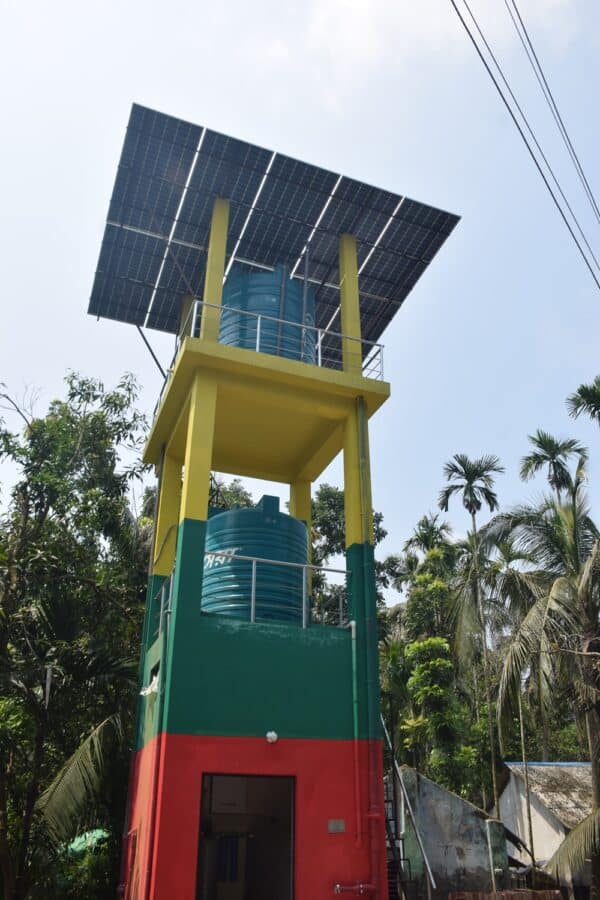
For nearly four years, collecting water from Datinakhali remained part of daily life for many women in Bhamia and surrounding villages. In 2013, a solar-powered saline water purification plant was installed in Bhamia, providing a more reliable source of safe drinking water closer to home.
For Probha Rani Biswas, 46, of Bhamia village, the change was significant. “After Cyclone Aila, we used to collect water far away and with great difficulty. A large part of the day was spent collecting drinking water. We faced extreme hardships at that time. Many times we had to go to collect water early in the morning or late in the evening,” she explained.

“But in 2013, the installation of a solar-powered salt water purification plant near our house has eased our difficulty in collecting water. We get water near our house whenever we need it,” Rani added.
Today, women like Probha, along with Alo Rani, 38, of Porakatla village, and Snigdha Rani Sarkar, 42, of Durgabhati village, no longer have to make the same daily journey for drinking water. Now, even when cyclone warnings echo across the coast or the waters of the Kholpetua River begin to swell, families in Bhamia have a more reliable source of safe drinking water close to home.
Solar-Powered Water Pumps
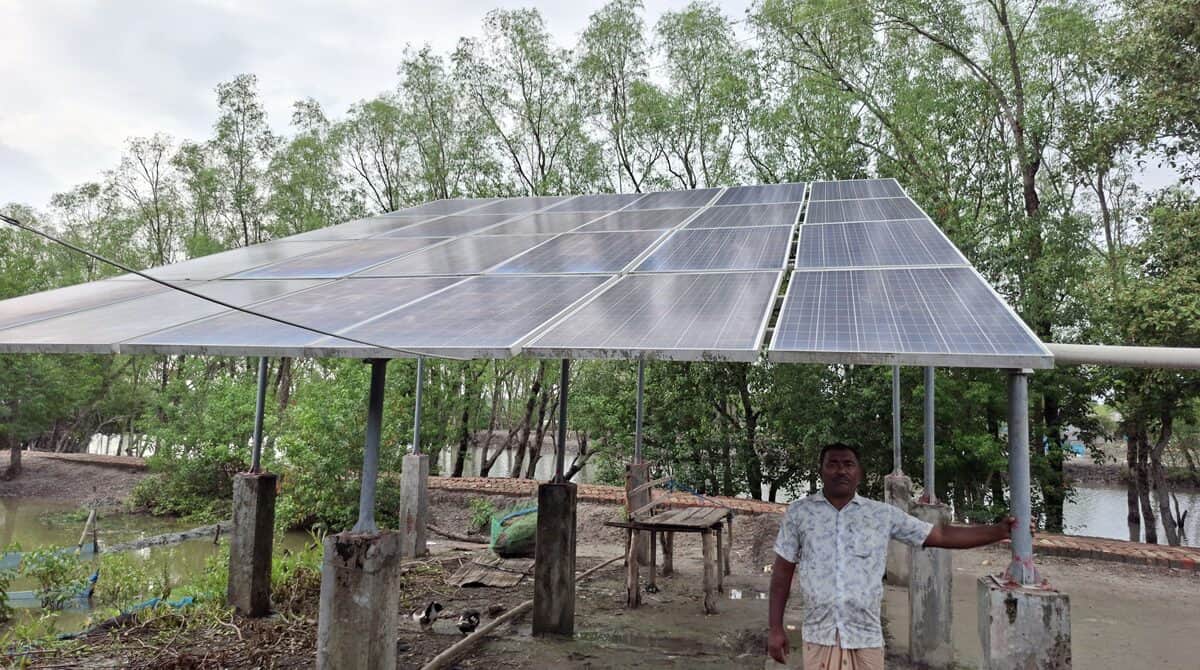
Bhamia’s solar-powered salt water purification plant was installed by constructing a 5-foot-high structure in the salt water. It essentially acts as a reverse osmosis machine, a desalination plant.
The Christian Commission for Development in Bangladesh (CCDB), through its Lighthouse Project, and Haridas Biswas, a member of the local community who donated land for the project helped establish solar-powered desalination pumps/plants to provide safe drinking water in saline-affected coastal areas of Bangladesh.
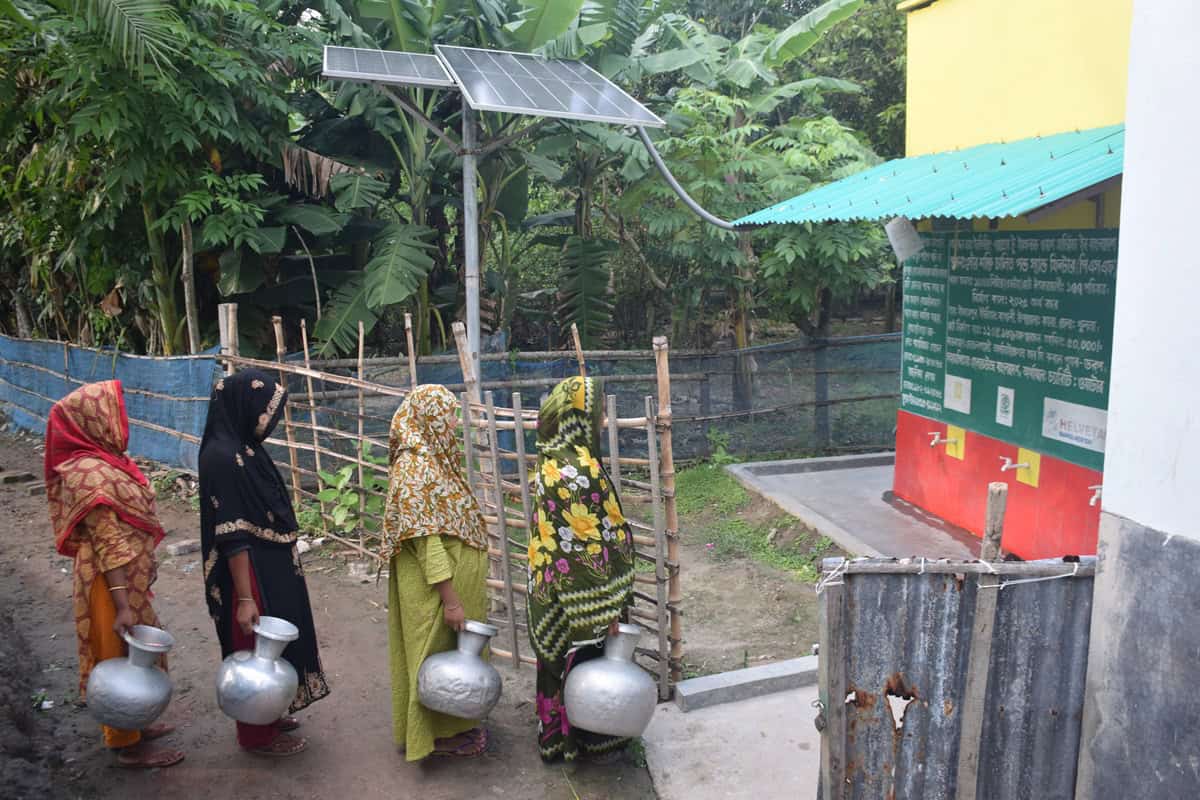
A solar-powered PS was also installed in Islampur village in 2025. This filter was previously operated through a hand-operated tube well where water is automatically drawn from the pond into a tank where people are able to collect it. PSFs are now running on solar power in many villages.
“Earlier, it was a lot of trouble to collect water. Now it is much easier. Solar power has reduced our troubles,” said Hosne Ara, 45, a woman who collects water from the Islampur well.
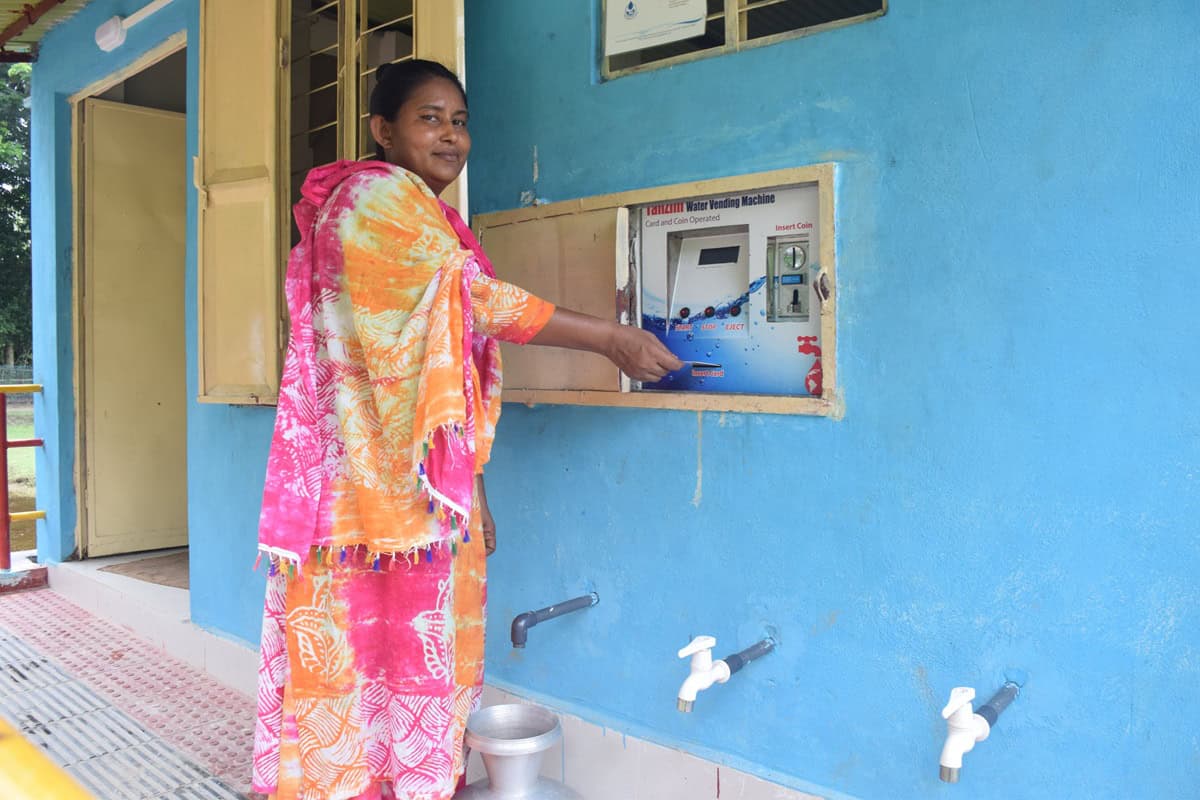
Archana Sarkar of Malgazi village of Mongla upazila of Bagerhat district went to collect water at noon from the water plant set up in her village. Like Archana, about 200 families in the area get their required water daily through ATM cards. “Earlier, we drank polluted water from the pond. Now we get pure water from the solar-powered plant.” said Archana Sarkar.
Apart from Bangladesh, several countries in the world have achieved significant success in providing water through solar power plants. Among these, India, Morocco, Egypt, Ethiopia, South Africa, Kenya, Jordan are notable.
For communities living on the front lines of climate-related disasters, solar-powered water plants are offering a new measure of resilience. Introduced in many water-stressed areas through the work of non-governmental development organizations, these systems provide a dependable source of safe drinking water when traditional supplies fail. Even during disasters, when electricity networks are damaged or shut down, solar power can continue to operate, keeping water flowing when communities need it most.
Helvetas Bangladesh, is the Bangladesh branch of a Swiss NGO that supports sustainable development and climate resilience, and has taken various initiatives to solve the water crisis in southwestern Bangladesh. Mohammad Mahmodul Hasan, Head of Program, Water, Food & Climate at Helvetas Bangladesh, said, “Solar-powered water plants have made clean water easily available to the marginalized. Women no longer have to walk long distances to collect water. The marginalized and repeatedly affected people are benefiting more from the provision of water through solar power in disaster-prone areas.”
Bangladesh Bondhu Foundation, a Bangladeshi NGO focused on environmental protection, provides clean drinking water to approximately 500,000 people across five coastal districts through solar-powered water treatment plants. The organization operates 124 plants, including 33 that treat groundwater and 91 that treat pond water, with purified water distributed to communities through pipeline networks.
“We supply water from different points through pipelines. As a result, it is easy to collect. It saves their time and reduces their hardship. Our initiative has brought a huge change in the lives of marginalized people.” said Obaydul Islam Sujan, Drinking water supply Project Manager, Bangladesh Bondhu Foundation (BONDHU).
Rising Sea Levels
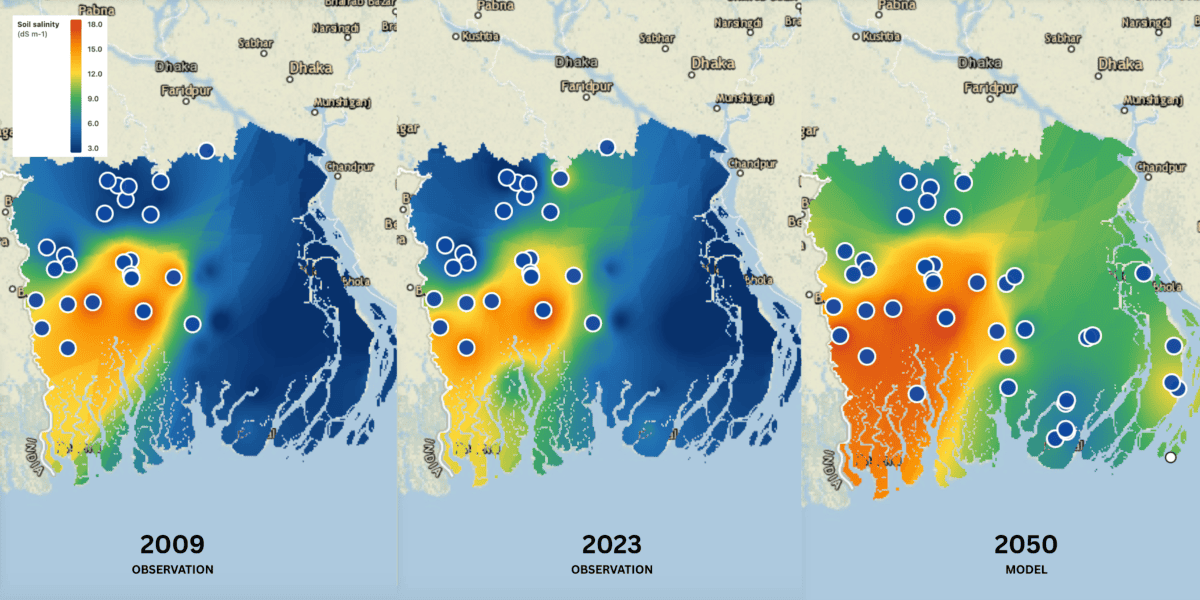
The Ganges is the primary source of freshwater for the southwestern districts of Bangladesh. During the dry season, river flows decline significantly, while saline tidal water from the Bay of Bengal intrudes further inland through the river system. This challenge is being exacerbated by sea-level rise driven by climate change.
Research indicates that tidal water levels in the Ganges tidal floodplain of southwestern Bangladesh are rising due to sea-level rise, land subsidence, and changes in river and tidal dynamics. Studies have recorded increases of approximately 7-8 millimeters per year in some coastal areas of southwestern Bangladesh. In addition, the expansion of shrimp farming has contributed to increasing salinity levels in inland water bodies across the region. And the practice has further intensified saline water intrusion..
Atiq Rahman, Executive Director of the Bangladesh Center for Advanced Studies (BCAS), said, “It is no longer a secret that due to global warming and climate change, the temperature of the ocean is increasing and the sea level is rising. As a direct result of rising sea levels and flooding of coastal villages, the amount of salinity in water sources and soil in coastal areas of Bangladesh has increased alarmingly.”
Possibilities and Prabha Rani’s hopes
In a study on solar power solving the drinking water crisis, Sabrina Rashid Sheonty, Water Resources Engineer and CEO of TETRA said, “Solar-powered saline water purification offers a sustainable solution, which uses solar energy to purify saline water without relying heavily on diesel fuel or an unreliable electricity grid. It is especially suitable for off-grid coastal communities, where fresh water is scarce but solar radiation is abundant.”
“With appropriate policy support and community participation, solar-powered desalination has great potential to become an important component of a climate-resilient drinking water system in the coastal regions of Bangladesh,” added Rashid Sheonty.
The Limits of a Solar Fix
In a study on the failures of solar energy supplied pipe water, WaterAid Bangladesh’s Country Director, Hasin Jahan, noted that “Suitable technology to solve the water problem in southwestern Bangladesh is not yet readily available… WaterAid tested a low-tech solar-powered device. [While] it was capable of extracting groundwater from remote sources and distributing it through pipelines…it was abandoned after a year when the community moved away due to the collapse of the dam.”
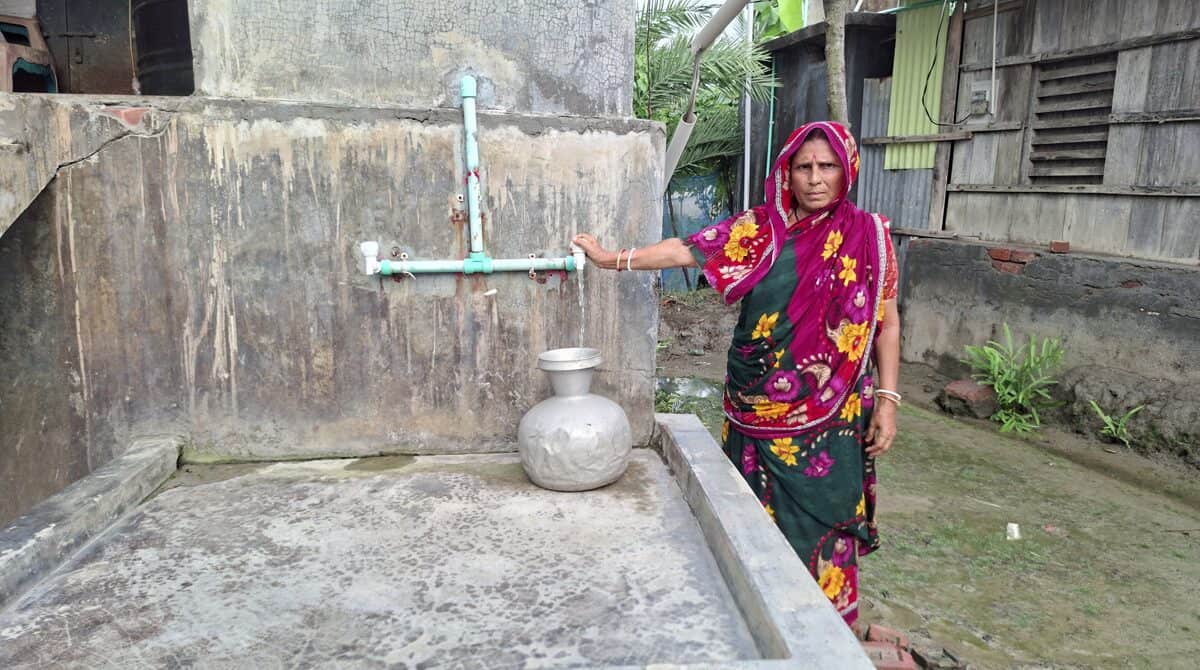
The case highlights how the impacts of climate change, including cyclones and other extreme weather events, can disrupt water infrastructure and complicate efforts to ensure reliable access to clean water in southwestern Bangladesh.
For Probha Rani Biswas of Bhamia village, the need is simple, “Give us a sustainable and permanent solution to the water crisis. Make our fight for survival easier”.
To understand the impact of solar-powered saline water purification plants, this reporter observed some centers in Shyamnagar Upazila (Sub-District) of Satkhira district, Koyra and Paikgachha Upazila (Sub-District) of Khulna district, and Mongla Upazila (Sub-District) of Bagerhat district. International Center for Diarrhoeal Disease Research, Bangladesh (ICDDR, B), Development Organisation of the Rural Poor (DORP), CARE-Bangladesh, Helvetas Bangladesh, Fendship Bangladesh, Bangladesh Bondhu Foundation (BONDHU) and many other non-governmental development organizations are supplying water through solar-powered plants in these areas.