
The Energy Pioneer
No Result
View All Result
  • Home
  • Clean Tech
    • Electric Vehicles
    • Battery Storage
    • Energy Efficiency
    • Green Hydrogen
    • Smart Grid
  • Renewable Energy
    • Solar
    • Fossil Fuels
    • Hydrogen
    • Hydropower
    • Nuclear
    • Wind
  • Green Finance
    • Crash Course
    • Private Financing
    • Public Financing
    • Carbon Markets
  • Policy
  • Regions
    • Africa
    • Asia
    • West Asia
    • Latin America
    • North America
    • Europe
  • Features
  • Who We Are
    • About Us
    • Contact Us
    • EP Investing
  • Home
  • Clean Tech
    • Electric Vehicles
    • Battery Storage
    • Energy Efficiency
    • Green Hydrogen
    • Smart Grid
  • Renewable Energy
    • Solar
    • Fossil Fuels
    • Hydrogen
    • Hydropower
    • Nuclear
    • Wind
  • Green Finance
    • Crash Course
    • Private Financing
    • Public Financing
    • Carbon Markets
  • Policy
  • Regions
    • Africa
    • Asia
    • West Asia
    • Latin America
    • North America
    • Europe
  • Features
  • Who We Are
    • About Us
    • Contact Us
    • EP Investing
No Result
View All Result
The Energy Pioneer
No Result
View All Result
  • Home
  • Clean Tech
  • Green Finance
  • Policy
  • Renewable Energy
  • Regions
  • Features
  • Who We Are
Home Africa

The Grand Egyptian Museum: A Sustainable Gateway to Egypt’s Ancient Wonders

byRahma Diaa
November 14, 2025
Reading Time: 6 mins read

Just steps away from the Pyramids of Giza stands the Grand Egyptian Museum (GEM) — the largest archaeological museum in the world dedicated to a single civilization. Beyond preserving ancient history, the museum also offers a modern model of sustainability in museum design and management. It has become the first green museum in Africa and the Middle East, after receiving the EDGE Advanced Certificate for Green Buildings in 2024.

RELATED POSTS

Decarbonizing Africa’s Road Passenger Transport

The Financiers and Startups Decarbonizing Africa’s ‘Anti-Fossil’ Fuel Nation

Green Hydrogen in Tunisia: Ambitious Energy Strategy amidst Implementation Challenges

The idea for the museum began in the 1990s, and the foundation stone was laid in 2002. The construction project underwent several phases until the museum was officially inaugurated in November 2025. Built on a 500,000 m² site and housing more than 100,000 artifacts, the project’s total cost exceeded one billion USD.

Eco-Friendly Architectural Design

From The Energy Pioneer New memberships opening April 15, 2026

Meet EP Investing — capital discovery for the energy transition.

Visit EP Investing →

Major General Atef Meftah, General Supervisor of the Grand Egyptian Museum and its surrounding area, stated that since his appointment in 2016, his vision was to make the museum an environmentally adaptive, green, and sustainable building that produces no polluting emissions and conserves both energy and water.

“We used locally sourced, eco-friendly construction materials and an environmentally conscious design that maximizes natural lighting and ventilation, significantly reducing electricity consumption for lighting and air conditioning,” Meftah explained.

He added that a solar power station with a capacity of 1 megawatt — currently covering about one-tenth of the museum’s full energy demand — has been installed, with plans to expand generation to 10 megawatts to achieve complete self-sufficiency in the near future.
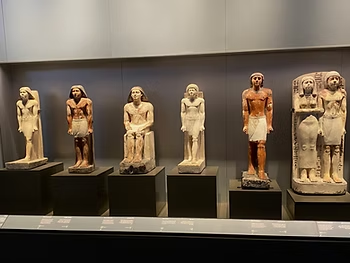
More than 100,000 artifacts reside in the Grand Egyptian Museum. Photo provided by Samira Hamza.

The construction of the solar plant, he noted, cost around 6 to 7 million Egyptian pounds, funded mainly by international grants from partners such as CIF.

Buy JNews
ADVERTISEMENT

Regarding water conservation, Meftah explained that a large reservoir was built to collect, store, and filter rainwater for irrigating the museum’s green landscapes. These measures have resulted in a 34% reduction in electricity use, a 46% decrease in water consumption, and a 48% decrease in emissions, with the museum aiming to achieve carbon neutrality within a few months. Thanks to these achievements, the museum earned the EDGE Green Building Certificate for energy efficiency and resource management.

He emphasized that the construction of the museum aligns with the global trend toward environmental sustainability, improving visitor comfort and engagement. Visitors can also learn about the museum’s sustainability efforts through informational signs and guided ecological tours.

Since its opening, the museum has averaged 15,000–20,000 visitors per day.

Waste Recycling and Social Sustainability

Dr. Islam El-Bestawi, expert in sustainable and environmental tourism under the Green Hurghada Project, noted that the Grand Egyptian Museum applies both environmental and social sustainability principles.

 Women from local communities have been employed in eco-friendly initiatives, such as fabric recycling and the production of handmade bags and crafts, which are sold in the museum’s gift shops — fostering community sustainability.

The museum also conserves electricity and water through recycling systems that reuse water for irrigation and features electric vehicle charging stations. According to El-Bestawi, renewable energy has significantly reduced the operational costs of running such a massive complex with its large daily visitor numbers. Plans are underway to expand renewable energy use toward complete reliance in the near future.

He added that global surveys show that tourists increasingly prefer destinations that meet sustainability standards — a trend expected to attract even more visitors to the museum. He noted that GEM has earned eight ISO certifications covering energy management, occupational health and safety, environment, and quality.

A Vision Rooted in Global Collaboration

In 2002, Egypt, under the auspices of UNESCO and the International Union of Architects, launched an international architectural competition for the design of the museum. The winning proposal came from Heneghan Peng Architects of Ireland, whose concept envisioned the museum as a geometric extension of sunlight rays emanating from the three pyramids, converging into the conical mass of the Grand Egyptian Museum.

Construction began in May 2005, with site preparation and infrastructure works. In 2006, the largest conservation center in the Middle East was established to restore, preserve, and prepare artifacts for display.

This center officially opened in 2010.

The museum’s main building was completed in 2021, becoming the largest museum in the world dedicated to telling the story of ancient Egyptian civilization. Among its most notable treasures are the complete collection of King Tutankhamun, displayed together for the first time since the tomb’s discovery in 1922, as well as the collection of Queen Hetepheres, mother of Pharaoh Khufu, builder of the Great Pyramid, and the reconstructed Solar Boat of Khufu. Exhibits span from Pre-Dynastic Egypt to the Greek and Roman periods.

Inside, the museum features dedicated spaces for cultural and educational activities, including a Children’s Museum, an education center, temporary exhibition halls, a cinema, a conference center, and commercial areas with shops, cafés, and restaurants, all set within landscaped gardens.

The Grand Egyptian Museum now joins a growing global movement of sustainable cultural institutions.

With its scale, innovation, and environmental ambition, the Grand Egyptian Museum positions itself not only as a guardian of Egypt’s past but also as a beacon for sustainable cultural development in the Middle East and Africa.
From The Energy Pioneer New memberships opening April 15, 2026

Meet EP Investing — the platform behind the stories.

1,300+ companies · 350+ investors · 47+ grants

Visit EP Investing →
ShareTweetShare
Rahma Diaa

Rahma Diaa

Rahma is a multi-awarded freelance journalist, media trainer, and the founder of Climate School. She is based in Egypt and is particularly interested in covering the Climate Crisis and sustainability in the MENA region and North Africa. She collaborated with Arab and foreign media, including IJNET, Scientific American (Arabic version), Climate Tracker, VICE, CFI, and ARIJ websites and networks. She won ten local, regional, and international press awards, including the Covering Climate Now Award for 2021. She built out her platform, “Climate School,” which offers climate journalism training to Arabic-speaking journalists.

Related Posts

Decarbonizing Africa’s Road Passenger Transport
Africa

Decarbonizing Africa’s Road Passenger Transport

March 3, 2026
The Financiers and Startups Decarbonizing Africa’s ‘Anti-Fossil’ Fuel Nation
Africa

The Financiers and Startups Decarbonizing Africa’s ‘Anti-Fossil’ Fuel Nation

February 16, 2026
Green Hydrogen in Tunisia: Ambitious Energy Strategy amidst Implementation Challenges
Africa

Green Hydrogen in Tunisia: Ambitious Energy Strategy amidst Implementation Challenges

February 13, 2026
The Race to Host AI: Data Centres in Water-Scarce India
Asia

The Race to Host AI: Data Centres in Water-Scarce India

February 9, 2026
From Access to Sovereignty: Africa’s Renewable Energy Vision
Africa

From Access to Sovereignty: Africa’s Renewable Energy Vision

February 4, 2026
The Players Driving Africa’s Decentralized Energy Revolution
Africa

The Players Driving Africa’s Decentralized Energy Revolution

February 2, 2026
Next Post
Energy Security in the Age of China’s Rare Earth Dominance

Energy Security in the Age of China's Rare Earth Dominance

Zambia Powers Up: Renewable Energy Revolution Takes Center Stage

Zambia Powers Up: Renewable Energy Revolution Takes Center Stage

Popular Stories

  • The Financiers and Startups Decarbonizing Africa’s ‘Anti-Fossil’ Fuel Nation

    The Financiers and Startups Decarbonizing Africa’s ‘Anti-Fossil’ Fuel Nation

    0 shares
    Share 0 Tweet 0
  • Decarbonizing Africa’s Road Passenger Transport

    0 shares
    Share 0 Tweet 0
  • Green Hydrogen in Tunisia: Ambitious Energy Strategy amidst Implementation Challenges

    0 shares
    Share 0 Tweet 0
  • South African Pension Funds Outshine $13 Billion Green Transition Funds

    0 shares
    Share 0 Tweet 0
  • Unlocking Africa’s Renewable Potential with Battery Storage

    0 shares
    Share 0 Tweet 0

Actionable Info

🔒 NEW MEMBERSHIPS OPEN APRIL 15
EP
EP Investing Climate Finance Intelligence

Our journalism is made possible by readers like you.

The founders, investors, and professionals reading The Energy Pioneer use EP Investing to find capital, partners, and opportunities.

1300+Companies
350+Investors
45+Grants
Explore EP Investing →

The Energy Pioneer

The Energy Pioneer covers the global energy transition — from clean tech and green finance to policy and renewable energy.

Recent Posts

  • Decarbonizing Africa’s Road Passenger Transport
  • Unlocking Africa’s Renewable Potential with Battery Storage
  • The Financiers and Startups Decarbonizing Africa’s ‘Anti-Fossil’ Fuel Nation

Categories

  • Africa
  • Asia
  • Battery Storage
  • Carbon Markets
  • Clean Tech
  • Crash Course
  • Electric Vehicles
  • Energy Efficiency
  • Features
  • Fossil Fuels
  • Green Finance
  • Green Hydrogen
  • Hydrogen
  • Hydropower
  • Latin America
  • North America
  • Nuclear
  • Policy
  • Private Financing
  • Public Financing
  • Renewable Energy
  • Smart Grid
  • Solar
  • West Asia

Quick Links

  • Home

© 2026 The Energy Pioneer | All Rights Reserved. |

No Result
View All Result
  • Home
  • Clean Tech
    • Electric Vehicles
    • Energy Efficiency
    • Green Hydrogen
    • Smart Grid
    • Battery Storage
  • Green Finance
    • Public Financing
    • Private Financing
    • Carbon Markets
  • Policy
  • Renewable Energy
    • Wind
    • Solar
    • Hydropower
    • Nuclear
    • Hydrogen
    • Fossil Fuels
    • Geothermal
  • Regions
    • Africa
    • Asia
    • Europe
    • North America
    • Latin America
    • West Asia
  • Features
  • Who We Are
    • About Us
    • EP Investing
    • Contact Us

© 2026 The Energy Pioneer | All Rights Reserved. |