
Africa has powered the world’s clean energy revolution from below. It is only now learning to demand something in return.
In January 2026, a Congolese delegation arrived in Washington with a shortlist of state-owned mining assets in the Democratic Republic of Congo that were open to American investment. Rather than seeking aid or diplomatic concessions, Kinshasa came with a proposal that offered access to some of the world’s most valuable mineral reserves in exchange for capital, partnerships, and political support.
The DRC produces more than 70 percent of global cobalt supply, a mineral central to the battery technologies underpinning the energy transition. For years, that dominance generated surprisingly little geopolitical leverage for Kinshasa. But as governments and companies scramble to secure critical mineral supply chains, the balance is beginning to shift.
Chinese Investment
While Europe and the United States grappled with the costs and pace of the energy transition, China used the moment to expand its position across the supply chains that would define the new energy economy. Even as it continued relying heavily on fossil fuels at home, Beijing invested aggressively in the mines, refineries, and supply chains required for a more electrified future.
Chinese state-backed firms moved into the DRC, Zambia, Zimbabwe, and across the continent as part of a broader industrial strategy. Through the Belt and Road Initiative and related investments, Chinese companies financed mines, built roads and railways, expanded ports, signed long-term extraction agreements, and developed the infrastructure needed to move African commodities eastward to Chinese processing facilities. By the time Western governments recognized the strategic importance of these supply chains, much of the foundation had already been built.
China now controls approximately 91 percent of global critical mineral refining capacity and holds majority stakes in more than 60 percent of the DRC’s mining projects. Today, China receives 72 percent of DRC cobalt, 58 percent of Africa’s manganese, and 28 percent of its graphite.

China’s rise has been shaped by a global supply chain in which Africa provides the raw material, China processes it, the world buys the finished product, and the value, jobs, industrial capacity, and technological expertise largely remain in China. The TAZARA railway, now being revitalised under a USD 1.4 billion programme led by China Civil Engineering Co., runs from Zambia’s Copperbelt east to the port of Dar es Salaam in Tanzania, toward Chinese markets. The ore goes east and the money follows it.
In 2025, China imposed export controls on germanium, gallium, and rare earth elements, in retaliation for US chip restrictions. Entire industries in the United States, Europe, and Japan were forced to reckon with their dependence on supply chains that ran through a single chokepoint. At the G7 summit in Kananaskis, leaders formally acknowledged the strategic threat. Although China was not explicitly named, the source of concern was obvious.
Washington’s scramble
The Trump administration took office in January 2025 with critical minerals at the top of its economic security agenda. The Development Finance Corporation, armed by Congress with an expanded financing capacity of over USD 140 billion, has made Africa its second-largest regional portfolio, with cumulative exposure surpassing USD 10 billion.
Its flagship initiative is the Lobito Corridor, a transcontinental infrastructure project designed to connect the mineral-rich Copperbelt region of the DRC and Zambia to global markets through Angola’s Atlantic coast. Beyond the railway itself, the project includes plans for agricultural value chains, renewable energy installations, special economic zones, logistics hubs, and vocational training programmes across the three countries.
At its core is a 1,300-kilometre rail route linking the DRC and Zambia’s mining regions to the Atlantic port of Lobito in Angola, supported by a USD 553 million loan from the US International Development Finance Corporation (DFC). The corridor is intended to reduce export transit times from roughly thirty days to eight and provide an alternative route for critical mineral exports that currently rely heavily on eastward links through Tanzania and South Africa. Angola is expected to generate more than USD 2 billion in concession revenues over the life of the project.
Two railways now point in opposite directions. The TAZARA railway, built to connect Zambia’s Copperbelt to the Indian Ocean, a route that over decades became increasingly connected to China’s dominant position in global mineral supply chains. The Lobito Corridor offers a competing path westward through Angola to the Atlantic, creating a new supply route for minerals destined for global markets.
In December 2025 Washington signed a Strategic Partnership Agreement with the DRC establishing a Strategic Asset Reserve, designated priority mining zones where American companies receive preferential treatment, placed in direct competition with Chinese operators who currently control 72 percent of Congolese copper and cobalt mines. Project VAULT followed in February 2026: a USD 12 billion critical mineral strategic reserve, America’s attempt to insulate itself from the kind of supply shock China demonstrated it could engineer.
Europe’s Rules, China’s Reality
The EU Critical Raw Materials Act sets binding targets to reduce European dependence on any single country for critical mineral imports. The Act has unlocked 60 Strategic Projects targeting lithium, graphite, cobalt, nickel, and rare earths, with 13 of those projects in partner countries including Zambia. Buyers who can prove their minerals are sourced from certified, traceable supply chains get access to European markets on better terms. Buyers who cannot, struggle.
Yet diversification at the mining stage does not necessarily translate into independence from China. China remains dominant in the processing and refining of many critical minerals, meaning that even minerals extracted from new projects in partner countries may still pass through Chinese-controlled supply chains before reaching European markets.
Morocco has taken advantage of this. Sitting at the intersection of Africa and Europe, with modern ports, generous trade agreements, and a government that had the foresight to position itself as a manufacturing partner rather than a raw material supplier, Morocco has built itself into the continent’s most advanced battery hub. In June 2025, it inaugurated its first lithium-ion battery materials manufacturing plant at Jorf Lasfar. Managem, Morocco’s largest mining and hydrometallurgy company, is supplying Renault with 5,000 tonnes of low-carbon cobalt sulphate annually under a seven-year agreement, enough to support 15 GWh of battery production per year.
But the emerging supply chain is not a clean break from China. A gigafactory in Kenitra is expected to come online later in 2026 with an initial 20 GWh capacity. The Kenitra gigafactory is being built by Gotion High Tech, a Chinese company.
Morocco is simultaneously becoming an alternative source of critical minerals for Europe and a platform for Chinese manufacturers seeking access to European markets. The country is not replacing one dependency with another; it is attempting to capture value from both sides of the competition.
African Governments Are Rewriting the Terms
Zimbabwe was the first to move forcefully. In 2022, it banned the export of unprocessed lithium, the mineral that powers the batteries in smartphones and electric vehicles around the world. The message was simple: if companies wanted access to Zimbabwean lithium, they would have to process it inside Zimbabwe.
The policy did not drive away Chinese investors; it changed the terms of their involvement. Chinese companies moved downstream instead, building processing capacity within Zimbabwe’s borders. Sinomine Resource Group, which acquired the Bikita lithium mine for USD 200 million in 2022, is investing around USD 500 million in a lithium sulphate plant, while Zhejiang Huayou Cobalt has committed hundreds of millions of dollars to expand processing at the Arcadia lithium project.
Zimbabwe is now Africa’s leading lithium producer, and its government has made clear that exporting raw minerals is no longer enough. The ambition is not simply to supply the global battery industry, but to capture more of the value generated along the way.
Namibia has taken a similar approach toward capturing more value from its mineral resources. In June 2023, its Cabinet banned exports of unprocessed lithium, cobalt, manganese, graphite, and rare earth elements, while a new Minerals Bill under review considers stronger local ownership requirements, including a proposed 51 percent Namibian ownership threshold for new mining ventures.
The DRC used temporary export bans in 2025 to stabilise global cobalt prices, after a period of oversupply and falling global demand. The 2025 G20 Johannesburg Summit produced a Critical Minerals Framework that formally recognised producing nations’ sovereignty over their resources, a shift from frameworks that had previously treated mineral access as primarily a consumer-country concern.
In Guinea, the USD 24 billion Simandou project shipped its first iron ore in November 2025. The integrated mining and infrastructure development is the largest of its kind in Africa’s history and was built around a model that links extraction with infrastructure, community benefits, and domestic industrial development. It is being cited across the continent as a template for what large-scale mineral development can look like.
The Limits of Mineral Wealth
South Africa holds 80 percent of the world’s known platinum group metal reserves and 37 percent of its manganese. It should be one of the world’s great mineral processing economies. Instead, it is watching its domestic smelting capacity collapse not because of politics or policy failure in the minerals sector, but because the electricity needed to run the smelters is unreliable and expensive. The “manganese paradox,” as analysts have taken to calling it, is a warning: you can own the resource and still miss the opportunity if you cannot power the industries needed to process it.
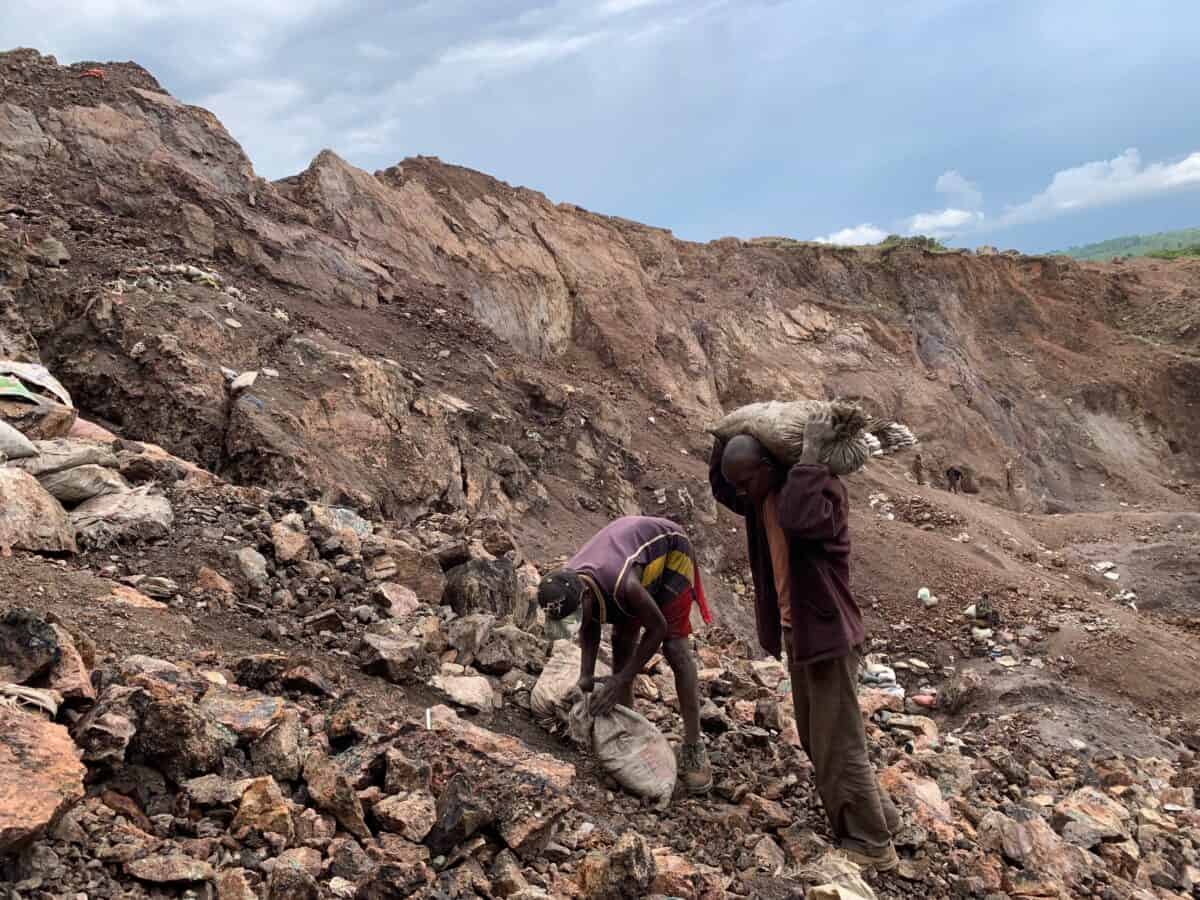
In the DRC, artisanal cobalt mining carried out by hand, in unregulated and dangerous conditions, often by children, continues to shadow the supply chains feeding the world’s clean energy industries. Western automakers and battery manufacturers have spent years developing traceability systems to separate artisanally mined cobalt from responsibly sourced material. Yet the industry has not solved the challenge of ensuring cobalt is responsibly sourced.
Across the continent, the broader challenge is value capture. Africa currently retains only around 10 percent of the value generated from its mineral exports.
What the competition changes
The critical minerals race has the potential to provide Africa with a valuable bargaining chip.
The African Continental Free Trade Area (AfCFTA), the African Union’s Green Minerals Strategy, and Afreximbank’s investments in processing infrastructure reflect a growing effort to move beyond the export of raw materials. The goal is to build more refining, manufacturing, and industrial capacity within Africa rather than simply shipping minerals abroad.
That future is not inevitable. Africa has seen resource booms before. Oil, diamonds, and gold brought wealth, but much of the value left with the cargo. The resource curse is not a law of nature; it is the result of how resources are governed, negotiated, and developed.
What is different this time is that the buyers need Africa more than they have ever admitted, and African governments are increasingly using that leverage to demand more from the deals they sign.