
Editor’s note: The author of this piece is writing under a pseudonym due to safety concerns related to their reporting.
The view from the backseat of the taxi is blurred by rain. Outside, entire neighbourhoods lie in darkness, while brightly lit streets appear intermittently – a visible legacy of the load shedding zones. The taxi was ordered through Grab, a ride-hailing service run by one of the few foreign companies still operating in Yangon.
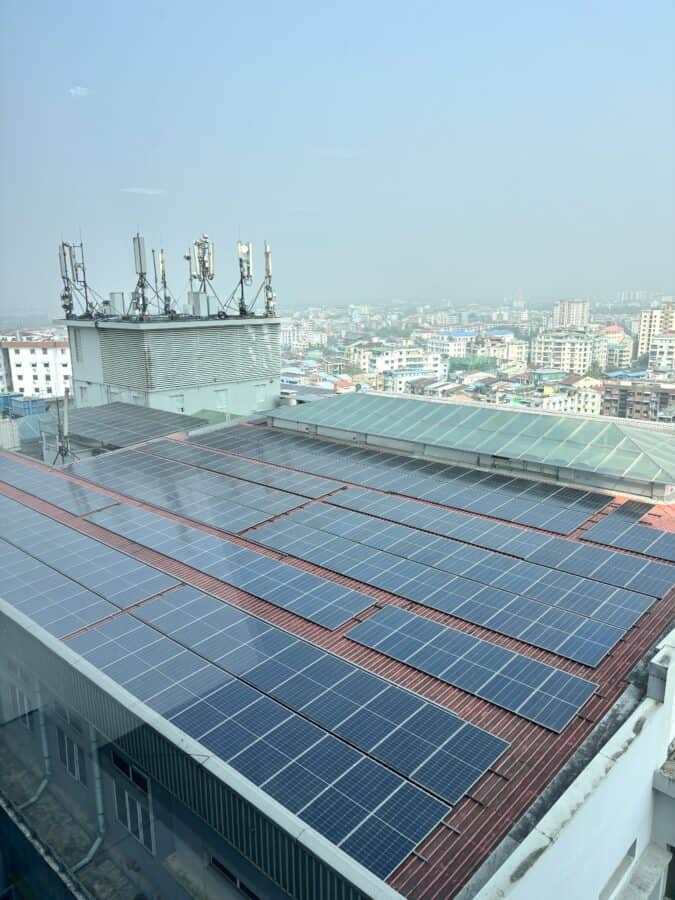
The city’s limited electricity supply is rationed by area, with different neighbourhoods receiving power at different times to keep the strained grid running. Yet, a few lights flicker from houses amid the dark street. These are homes with standalone systems: either inverters and batteries that charge when the grid is on, or, for the more affluent, rooftop solar.
Grid electricity prices in Yangon have risen in the past few years without any visible improvements in reliability. The load-shedding schedule is broadly followed, but power cuts still occur during designated ‘online’ periods, making electricity access unpredictable. This gap creates an alternative energy market, from imported diesel for backup generators – for those who can afford the cost and administrative burden of registering them for now-rationed fuel supply – to more common standalone battery and solar systems that require hefty upfront payments.
The roots of Myanmar’s power crisis
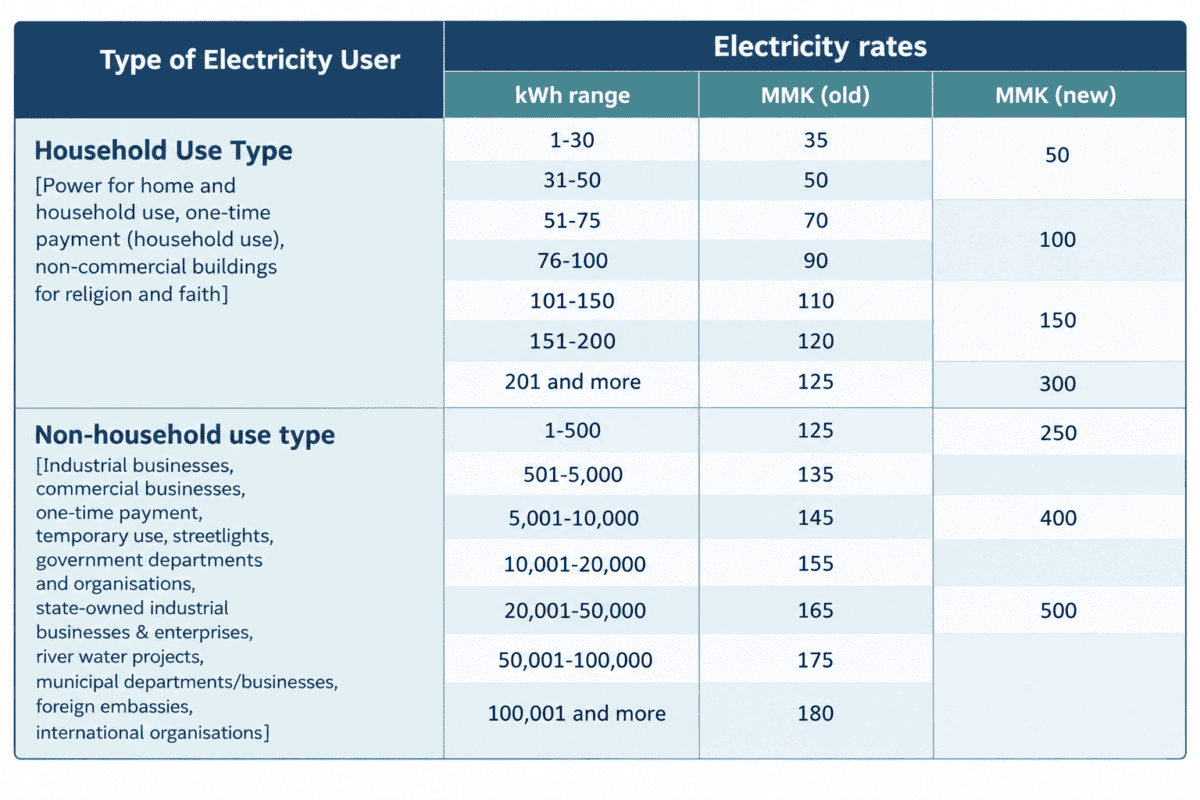
From 2016 to 2021, it was almost impossible to convince homeowners and businesses to install solar systems. At the time, grid electricity was exceptionally cheap. In early 2019, Myanmar had one of the lowest electricity tariffs in the world: MMK 35-50/kWh (USD 0.03-0.037) for residential customers and MMK 75-150+/kWh (USD 0.06-0.11) for commercial customers. On July 1, 2019, the Ministry of Electricity and Energy (MOEE) implemented a significant tariff hike, replacing flat-rate pricing with a consumption-based tariff, introducing multi-tiered structures to reflect the real cost of electricity production. The new household tariffs capped residential use between MMK 35 and 125 and commercial use between MMK 125 and 180.
During those years, Myanmar followed the National Electrification Plan, supported by a USD 400 million World Bank Group loan, which prioritised grid expansion in five phases and aimed to provide universal access by 2030, including in remote areas. Mini-grids and solar home systems were considered temporary solutions, with the expectation that stable grid connections would eventually reach these communities. Nevertheless, progress was significant: over the five years, public-private partnerships flourished, grid connections grew by an average of 6% a year between 2017 and 2020, and the nationwide household electrification rate jumped from 34% in 2016 to 57% at the end of 2020. Off-grid energy access improved, with renewable mini-grids electrifying remote villages and islands.

The World Bank project officially concluded in September 2021. Since then, Myanmar has grappled with a steady decline in electricity access.
Load shedding as a way to manage electricity
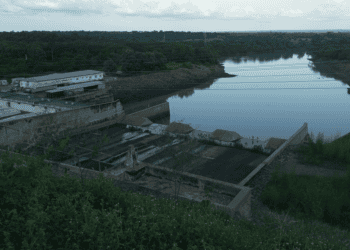
Starting in 2022, Yangon and the rest of the country adopted a rotational load-shedding schedule, dividing townships into alternating groups that receive limited hours of electricity to manage stress on the existing power distribution system. During periods of sufficient hydropower generation, typically from November to February, households received electricity for four hours, followed by four hours without power. In contrast, during the dry season from March to May, when hydropower generation declines, the rotation becomes more restrictive, with four hours followed by eight hours without electricity.
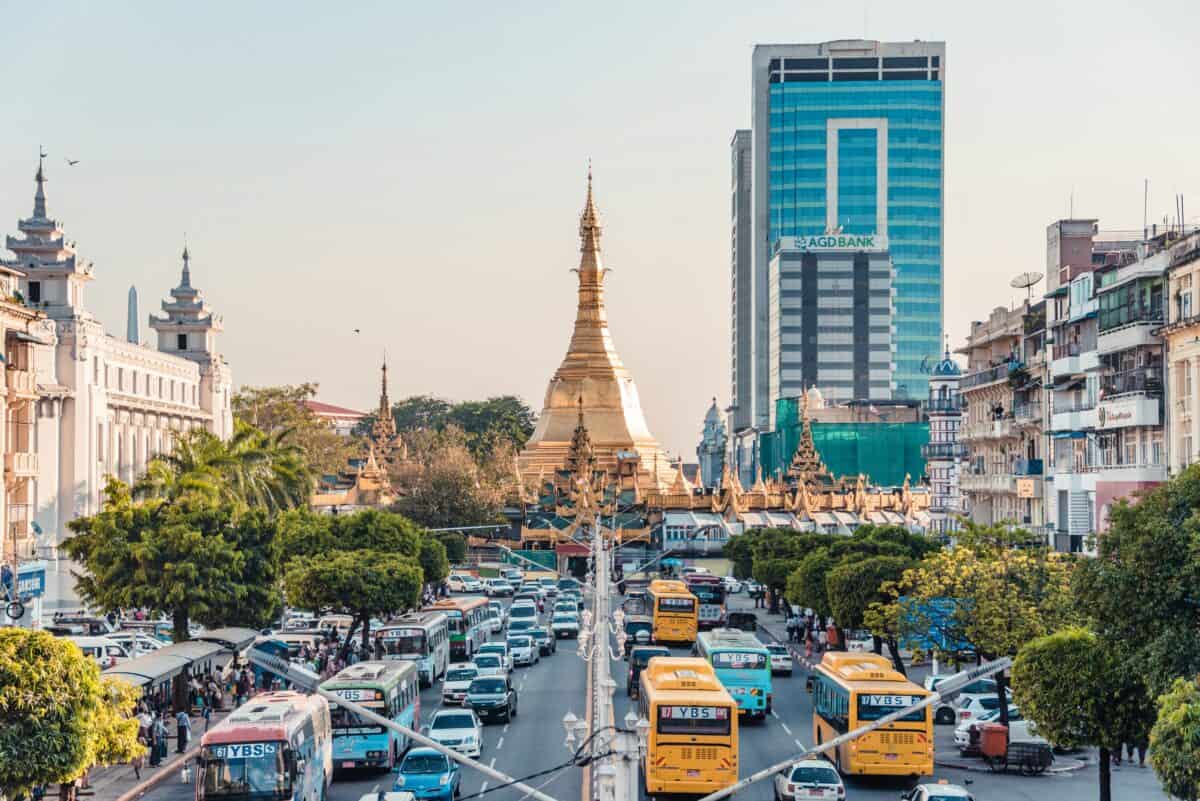
However, the schedule depends on township electricity authorities, and localised disruptions and power cuts remain a regular occurrence. On any given day, residents might see their electricity come on as scheduled, only for it to be cut off a few hours later due to system overload, with power not returning until the next scheduled supply window. In those instances, the steady hum of the backup generators would take over, signalling the entire neighbourhood had lost power. Starting on October 4, 2026, as the rainy season ended, Yangon’s Electricity Supply Corporation, which operates the electricity distribution network in Yangon, announced a renewed schedule of 4-hour on and 4-hour off load-shedding across the city.
Even with load shedding, Myanmar’s electricity generation is in a notorious deficit. In 2021, a nationwide boycott in which users refused to pay their electricity bills led to drastic measures, including disconnecting households that did not pay their due monthly bills. MOEE was also forced to implement two major price increases in recent years. Effective September 1, 2024, the ministry doubled the previous maximum tariffs for household, industrial, and commercial use from 2019.
Several tariff revisions for commercial and industrial use have followed. A revision, effective February 1, 2026, introduced a fixed rate of MMK 900/kWh for 24-hour uninterrupted electricity supply using Liquefied Natural Gas (LNG) to non-domestic consumers within industrial zones and special economic zones. MOEE subsequently extended this special tariff to industrial and business enterprises outside industrial and special economic zones.
Additionally, in its announcement on August 17, 2026, MOEE introduced a nighttime tariff of MMK 600/kWh for large power-consuming industries operating from 11 pm to 5 am. This initiative is intended to pilot time-of-use tariff pricing to support the development of Myanmar’s electricity system, according to the ministry’s announcements.
The impacts of the global energy crisis on Myanmar’s energy security
In response to the war in Iran and subsequent disruptions to the global energy supply chain, as well as the country’s currency depreciation affecting foreign trade, Myanmar’s government implemented measures to curb the impacts within the country and regulate fuel consumption. One was adopting an ‘even-odd’ licensing system, allowing vehicles to drive based on their licence plate numbers: even numbers on even dates and odd plates on odd dates. The other was rationing gas for private vehicles, capping it at a maximum of 30-35 litres of gasoline (half a tank per car) at MMK 4,450-4,600/litre for Octane and 4,800-5,800 for Diesel, USD 1.2-1.3 and USD 1.3-1.6, respectively, according to the authorised exchange rate for banks and corporate customers/importers of 1 USD = ~MMK 3,600.(Read note below for further information about the exchange rate).
Due to these measures, Yangon taxi drivers spent 12 hours at a time every other day in winding queues along the main roads to refuel. Even though the official city-wide curfew was lifted in December 2025, drivers would park their cars in the queues and leave between midnight and 3am, returning in the early morning to resume waiting. The frustration was palpable in the sweltering heat of April days, as drivers who had queued since midnight often only reached their turn around midday.
Launched on March 7, the ‘even-odd’ system was cancelled on September 11, reportedly after daily average fuel consumption fell from 13.4 million litres to 9.5 million litres. Fuel rationing has remained in place for vehicles and industrial users.
Solar as a new backup for businesses and households
Given the load-shedding, electricity disruptions, tariff hikes and fuel shortages, businesses that need to operate 24/7 require alternative solutions. A private school owner, a commercial user charged at MMK 900/kWh under the MOEE’s definition, installed a solar system in April 2026, becoming self-sufficient and independent in managing their electricity consumption. A 24 kW grid-connected system with 100 kWh of installed battery storage can now fully cover the school’s electricity needs; on cloudy or rainy days, the batteries charge from the grid.
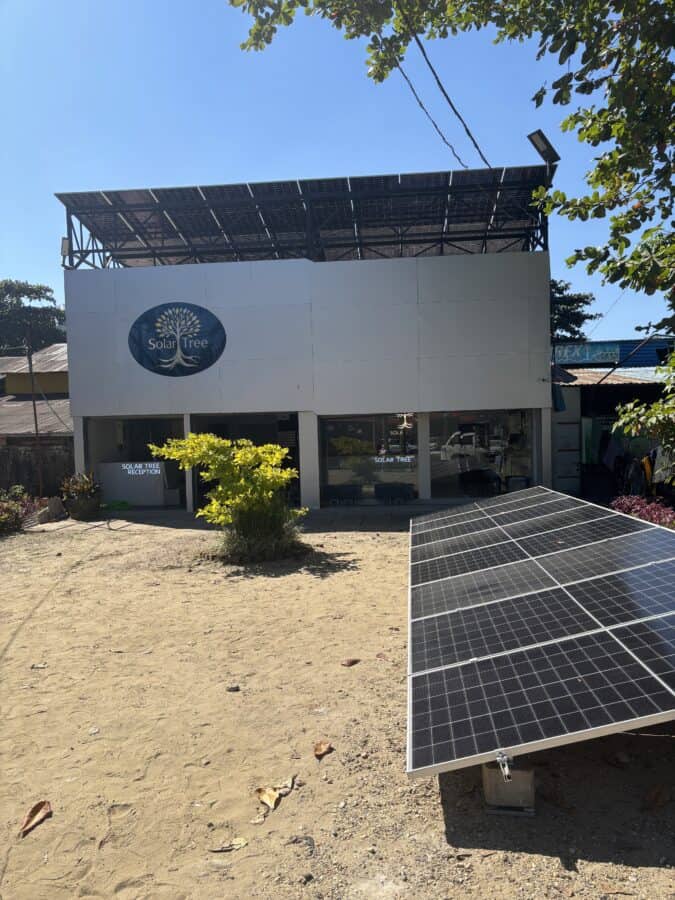
The school’s last electricity bills before switching to solar were around MMK 350-400,000/month; now they have been reduced three- to fourfold to MMK 90-100k – an equivalent of a household electricity bill. However, with an upfront investment of MMK 60 million (~USD 15k), the system’s payback period based on electricity-bill savings alone is still around 20 years. Financing such systems is also challenging, with banks typically offering loans at 13 per cent interest over a two-year term. A homeowner with a 12 kW solar system, including 30 kWh of battery storage, similarly reduced their electricity bills by three times, spending around MMK 50,000/month.
In Myanmar, people install solar out of necessity to have uninterrupted electricity, not for sustainability or other environment-related reasons. With high demand, companies sell, install, design, and service these systems at different price points. Independent electricians and contractors are starting to enter this alternative market, where price, lead time and convenience are the main deciding factors. Solar and battery suppliers have developed a steady distribution network, offering after-service care and a two-year warranty.
Big picture: Generation capacity, distribution bottlenecks & missing financing
While the Myanmar government may intend to increase the profitability and reliability of the electricity grid, without significant investment in generation, transmission, and distribution, it remains a Sisyphean task. There have been no significant additions to the country’s power generation besides a small 15 MW solar project coming online in July 2026 and a temporary boost from LNG-fired power plants in Yangon Region, which added 500 MW of generation during the dry season to supply industrial and special economic zones. In 2025, electricity generation declined by around 1,500 MW due to destroyed national grid transmission lines, natural disasters, and reduced gas supply from the Yadana offshore field, leaving installed capacity at 6,725 MW. According to MOEE’s official published statistics, Myanmar can generate around 70% of the required daily electricity demand of 4,664 MW, producing 3,600MW through a mix of 32 hydropower plants, 24 natural gas plants, two coal-fired power plants, and 12 solar power plants.
Needless to say, the country urgently needs a solid plan for electricity generation. The World Bank report, Myanmar Economic Monitor published in June 2026, cited electricity – price and reliability – as the main hurdle to doing business in Myanmar. MOEE plans to develop a new electricity generation model under its New Energy Development Programme for 2026-2045; however, the question remains: with what money and whose expertise, given mounting international pressure over internal politics and ongoing conflict, and economic support limited to China, Russia, and ASEAN countries?
Note: According to the Official Reference Rate set by the Central Bank of Myanmar, 1 USD = MMK 2,100. However, this exchange rate is heavily overvalued, and the country’s economy is driven by two other valuation tiers for the USD-to-MMK exchange rate system: the authorised online market/platform rate for authorised banks and corporate customers/importers (1 USD = MMK 3,600), and the remittance/black-market rate of 1 USD = MMK 4,300 used by exchange counters in Yangon, remittance channels and black-market street trades.