
Efforts to reduce emissions through the adoption of renewable energy have revealed new vulnerabilities in energy security. As countries shift away from oil-driven conflicts, they are becoming enmeshed in the geopolitics of critical minerals, trading one form of dependence for another.
Critical minerals are “as strategically important as oil was and probably more important going forward than oil will be because the supply of these things is so much more in the control of one country, ” says James Kynge, a senior research fellow for China and the World with the Asia-Pacific Programme at Chatham House.
The People’s Daily Online, a Chinese state-run media outlet, reported that China will ease restrictions and tariffs starting November 10, 2025. This temporary relaxation on the export of critical minerals and rare earth elements (REEs) to the US includes gallium, germanium, antimony, synthetic diamonds, and boron nitrides, materials with both civilian and defense applications. They have also stopped the extra verification for graphite, another dual-use product.
While there’s no new treaty or binding bilateral agreement, China has formally agreed to and is implementing parts of the consensus. However, Kynge cautions that this is a pause, not a resolution: “There’s a huge latitude for a continuation of the controls.” He added, “It’s quite likely that they will continue with export controls in one form or another,” since “a lot of these rare earths are used in defense equipment and weapons.”
Kynge also warned that this represents “leverage on a completely different scale,” going “right to the heart of national security,” and that China is proving it “can really turn the screws on the most important element of American power.”
Even with this pause in restrictions, Australia, Canada, the US, and Europe remain committed to diversifying their REE supply chain not just in terms of sourcing the raw materials, but also in processing them and developing technologies that rely less on rare earths overall. Philip Andrews-Speed, a Senior Research Fellow at the Oxford Institute for Energy Studies’ within the China Energy Programme, highlighted the difficulty of this diversification, noting that these countries “certainly can and are building capacity to process rare earths and manufacture permanent magnets,…[but] they are unlikely to be cost-competitive without substantial and sustained government support. Likewise, any growth in Western production is likely to be offset, at least in part, by growing demand and by growing Chinese production.”
China makes up 82% of wind turbine production and 70% of the world’s electric vehicle manufacturing, with both sectors relying heavily on REE permanent magnets. Typically, wind turbines require a gearbox to increase the speed of the slow-turning blades, allowing the generator to spin at a sufficient rate to produce electricity efficiently.

Gavin Harper, a critical materials research fellow at the University of Birmingham, explains “offshore wind turbines tend to favor generators that have rare earth magnets … because rare earth permanent magnet generators allow you to create a generator that can turn much more slowly, [allowing you] to omit the gearbox completely.” This avoids unnecessary servicing and maintenance, which, as he points out, “is particularly difficult [ to do] out at sea.”
As for electric vehicles, Harper notes that “permanent magnet motors…are much more efficient than other types of electric motors, which means they can deliver a better range from the same battery capacity.”
As outlined by Anders Hove, a Senior Research Fellow at the Oxford Institute for Energy Studies’ China Energy Programme, the reason behind China’s dominance in the clean energy sector is that they “juiced the market for these technologies domestically” through “intense competition [between] domestic players to not just reduce prices, but to…scale up manufacturing.”
Assessing the potential strategic implications of this dominance, Kynge said “there is a possibility that in the future, China could use its control of its supply of rare critical minerals to disadvantage foreign competitors of Chinese renewable energy companies.”
He then outlined potential outcomes, “if they want to raise the cost to foreign users of critical minerals. There could well be a system of dual pricing so that you have REEs in China selling for considerably lower than what is sold abroad.”
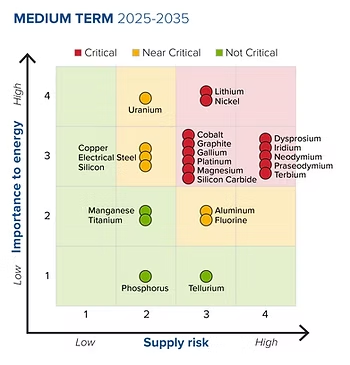
Investing in research and innovation is key. As Hove describes it, moving away from clean energy dependence on China “does not require breakthrough technology.” The focus should be on minor technological alterations. He describes this low-level innovation as a simple “change [in] the recipe” done through adjusting “the proportions [of rare earths]”.
This approach has been done before, when “the price for one [rare earth] went up and the price for the other went down.” Improving energy security and independence for countries outside of China will require governments to “reward projects that rely less on Chinese imports”, says Hove.
Looking forward, Kynge predicts “China has a five-year window in which its position in trade disputes will become much stronger and in some cases, almost unassailable.”
China’s growing dominance of the supply of rare earth and critical minerals creates a fragile foundation for the green transition. Without diversified and secure access to these materials, the global drive toward wind, solar, and electric vehicle production could be significantly delayed. Countries may hesitate to invest in clean technologies that leave them vulnerable to supply chain disruptions, thereby putting decarbonization targets at risk.