
President Ferdinand Marcos Jr. approved the Philippines Geothermal Resource De-Risking Facility (PGRDF) in July of this year, marking the largest development in geothermal energy in the country since 2001.
The Electric Power Industry Reform Act, better known as EPIRA, was passed in 2001, restructuring the power sector by opening electricity generation to competition, privatizing state-owned assets, and shifting the government’s role towards regulation. But the reforms also marked a turning point for geothermal development: large-scale projects stalled as public support for geothermal resource exploration declined.
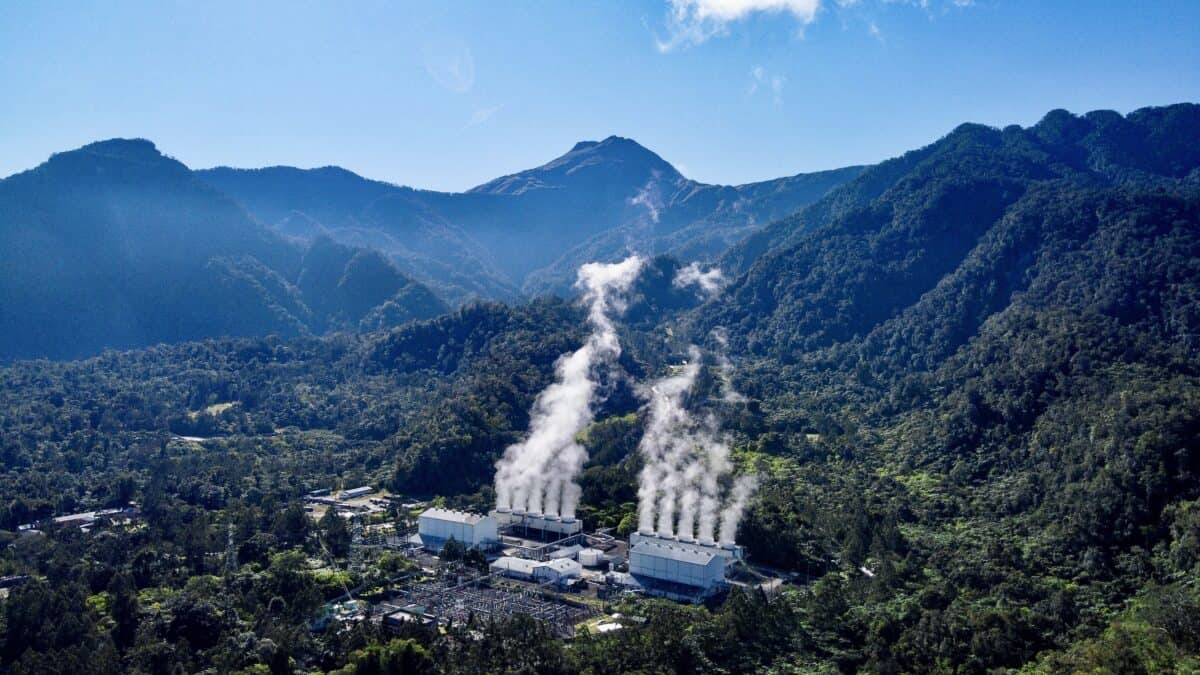
The Philippines currently has 2,057 MW of installed geothermal capacity, compared with approximately 1,850 MW in 2001, when EPIRA was passed. That means the country has added only around 207 MW of net geothermal capacity in the last twenty-five years.
As Rainier Halcon, Chief Science Research Specialist in geothermal energy at the Philippine Department of Energy, explained, most of the country’s geothermal development had been “built on existing areas” and amounted to an “expansion of the original plants.”
The History of Geothermal in the Philippines
The Philippines emerged as a pioneer in geothermal power, drawing on its abundant geothermal resources. Initial experiments in Tiwi, Albay, successfully generated electricity in 1967, laying the groundwork for commercial development. Following the oil crises of the 1970s, the government accelerated efforts to develop domestic energy sources and reduce reliance on imported fuel. By 1983, the Philippines had become the world’s second-largest producer of geothermal power.
Unlike solar and wind, geothermal power can provide a continuous source of renewable electricity, largely independent of weather conditions.

The war on Iran has renewed concerns about the Philippines’ reliance on imported fuels, echoing the energy-security challenges of the 1970s oil crisis. In response, the government has renewed its focus on reducing exposure to global fuel-price shocks and investing in indigenous sources of energy.
“I see geothermal as part of the foundation of a diversified power system, and there is a broader energy security argument alongside it. The Philippines is highly exposed to international fuel prices because imported coal and gas supply a large share of our generation,” said Alnie Demoral, Asia energy analyst at Ember.
Global Lessons in Geothermal Development
The Philippines is the world’s third largest producer of geothermal behind the United States and Indonesia. The US has advanced its industry through private investment, technological innovation and government support, while Indonesia has expanded capacity through state-owned energy companies, government policy and international financing.
Indonesia offers an example of how governments can reduce geothermal exploration risks. Approved by the Green Climate Fund in 2018 and developed with the World Bank and Indonesian government, the Geothermal Resource Risk Mitigation (GREM) Facility helps finance early-stage exploration and drilling, sharing the financial risk of developing new geothermal resources. It became operational in 2021.
Both the Philippines and Indonesia sit on the Pacific Ring of Fire, giving them significant geothermal resources. Indonesia has a larger estimated geothermal potential and has invested heavily in developing its sector, including through government-backed exploration financing.
The Philippines is now pursuing a similar approach through the PGRDF. As Demoral explained, “power sector restructuring under EPIRA shifted more of that risk to developers.” With private developers bearing more of the upfront exploration risk, geothermal development in the Philippines has stagnated. The PGRDF aims to address this barrier by helping de-risk exploration and encourage new investment.
How the PGRDF Works
The Philippines Geothermal Resource De-Risking Facility (PGRDF) is financed through a US$170 million sovereign loan from the Asian Development Bank (ADB), channelled through the state-owned Land Bank of the Philippines. It aims to stimulate greenfield geothermal development by offering developers loans covering up to 50% of eligible project costs.
“While there are also projects that have moved forward without multilateral development bank (MDB) support, sharing these risks can materially improve the investment equation because exploration and drilling are among the biggest barriers to geothermal development,” says Demoral.
Greenfield geothermal development is particularly risky because of the high upfront costs and uncertainty of exploration. “As with geothermal projects elsewhere, I think exploration and drilling remain the main bottlenecks in the Philippines. They can make or break the economics of a project because you have to commit significant capital before you know whether the resource is actually viable,” explained Demoral.
According to Energy Secretary Sharon Garin, developing each megawatt of geothermal capacity requires an estimated US$6 million in investment. Halcon highlighted the uncertainty facing developers: “Even if you drill, let’s say, three wells, there is still no guarantee that the resource that you will encounter is in commercial quantity. Drilling alone will cost you around 10 million US dollars per well.”
The Philippines has an estimated 2,100 MW of untapped geothermal potential, requiring approximately US$12.6 billion in investment to develop.
The PGRDF’s loans are expected to support around 300 MW of capacity over its initial six-year period, from 2028 to 2033. But Halcon sees this as a first step: “The success of this first phase in the first six years will pave the way for additional future extension of this risk mitigation facility. So the second phase hopefully will be informed by this first phase.”
A further 1,800 MW of geothermal capacity could potentially be unlocked beyond the facility’s initial phase. If fully developed, the Philippines’ geothermal resources could account for 14% of the country’s installed electricity capacity, marking a significant milestone in its energy transition.
Incentivizing Policy
Beyond reducing the financial risks of geothermal development, the government is introducing measures to improve investment prospects by providing long-term revenue certainty, greater flexibility in project timelines and targeted research support.
Halcon outlined several of these measures, including the Green Energy Auction Program, which offers winning bidders 20-year power supply agreements at fixed prices, as well as a three-year extension for geothermal service contracts. The government is also exploring the use of a trust fund to support research into highly acidic geothermal fluids and emerging technologies.
These measures seek to address gaps in the Renewable Energy Act of 2008, which Halcon argues has not adequately accounted for geothermal’s high upfront cost. While the law has supported the development of other renewable energy sources, such as solar, wind, hydro and biomass, its existing mechanisms have been less effective in encouraging new geothermal projects. The government hopes that the introduction of the de-risking facility will help bridge this gap and unlock new greenfield development.
Not a Competitor, but a Partner
Despite its high upfront costs and drilling risks, geothermal offers a reliable source of renewable energy once developed. Unlike hydropower, which can be affected by droughts, or biomass, which requires a steady supply of organic material, geothermal can provide consistent power regardless of weather conditions.
Asked why the Philippines should continue investing in geothermal despite its high drilling risks and initial costs, Demoral argued that it should not be viewed as competing with other renewables.
“I wouldn’t frame geothermal as competing with solar and wind. We should build solar and wind where they are most economical and fastest to deploy and continue to develop geothermal where the resource is viable. That diversification has value in its own right.”