

As one of the largest coal-dependent economies, Indonesia is under increasing pressure to balance continued economic expansion and growing electricity demand with reducing its emissions. In this Q&A, Dr. Ramanan C J, international lecturer in Energy Engineering at Curtin University Malaysia, discusses how floating solar photovoltaics could help power Indonesia’s islands while supporting its long-term energy security and decarbonisation goals.
Q: What is floating solar photovoltaics (PV) and what makes it well suited to Indonesia compared with rooftop solar or land based solar farms?
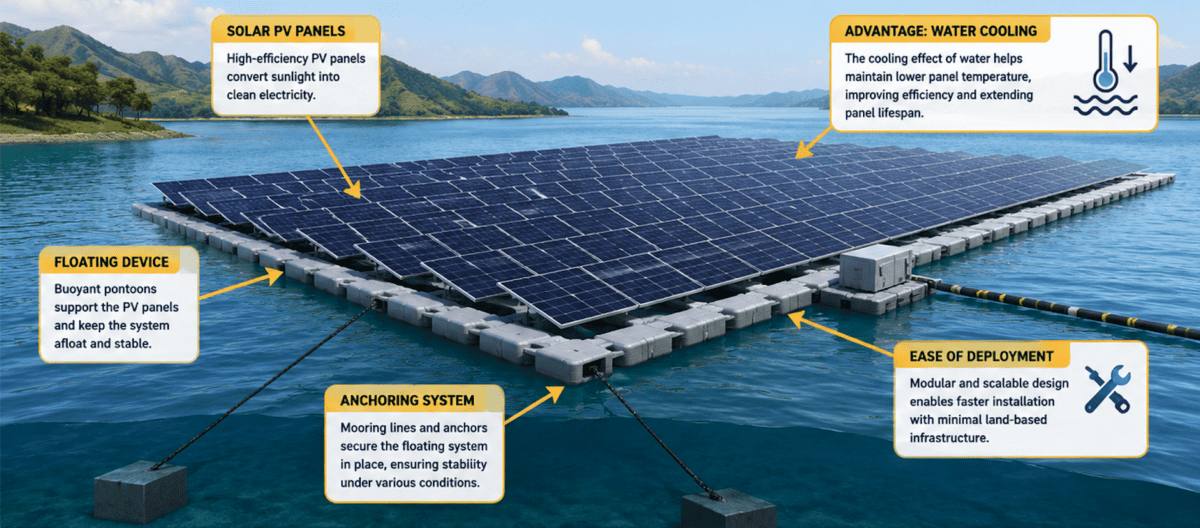
A: Floating photovoltaic systems refer to the deployment of solar PV panels on water surfaces. They are not a new energy conversion technology, but rather an adaptation of conventional solar PV systems installed on bodies of water. In this system, floaters are used to keep the solar panels afloat, while moorings and anchors are used to stabilize them on the water surface.
Indonesia faces serious challenges, including dense population growth, land constraints, water scarcity, and harmful emissions, all of which are contributing to rising energy demand. Meeting this demand is essential to provide services such as cooling, lighting, electricity, and transportation that support quality of life.
Floating solar is more suitable than rooftop PV or land-based solar farms because it utilizes unused water surfaces instead of limited rooftop space. It operates more efficiently due to the natural cooling effect of water, supports much larger installation capacities, reduces water evaporation and avoids land acquisition issues in densely populated areas. In contrast, rooftop PV systems are generally limited to residential or commercial building applications due to roof size and structural constraints.
Q: For an archipelagic country like Indonesia, what is the most realistic model for distributing power generated from floating solar (subsea cables, decentralized microgrids, or some hybrid of both)? Especially for remote islands?

A: In addition to its basic advantages, floating photovoltaics is a viable solution for the electrification of island regions especially in archipelagic countries like Indonesia. This is because it reduces dependence on fuel imports and the transportation of fuels between islands. It also improves energy access for remote islands and lowers transmission losses by generating power close to where it is consumed.
In contrast, subsea cables are expensive and difficult to implement across multiple islands and make them less practical for remote regions. While floating platforms for ocean environments are still in the development stage, these systems can currently be installed in inland water bodies or nearshore regions with calm conditions and minimal waves. In this context, decentralized micro-grids should be deployed together with battery backup systems and smart controls to ensure an optimal and reliable energy supply.
Q:What are the main regulatory or policy barriers currently slowing renewable investment in Indonesia and what can be done to accelerate it?
To understand the policy barriers, I refer to a recent article published on Indonesia’s stalled energy transition. It finds that renewable investment is slowed by policy and institutional constraints. For example, the government has delayed its renewable energy target from 2025 to 2030 and continues to approve new coal plants for industrial estates, despite commitments to gradually reduce coal dependency.
Decision makers prioritize affordability and economic growth, reflected in policies such as capping coal prices, which keeps coal artificially cheap and reduces the competitiveness of renewables. The utility PLN (Perusahaan Listrik Negara), Indonesia’s state-owned electricity company, remains heavily tied to coal through long-term supply contracts. Within PLN, internal divisions favour fossil fuel operations over renewables, as renewable units have comparatively limited influence.
Government planning is also inconsistent, as renewable energy targets in electricity plans are frequently revised when projects fail to materialize, creating uncertainty for investors. Political and business interests are deeply intertwined, illustrated by the appointment of ministers with ties to the coal industry, which can influence the approval of new coal projects.
Even when green policies exist, they are often largely symbolic in practice. For instance, carbon trading is limited to small internal transactions and the carbon tax has been delayed, showing weak enforcement. On top of that, investors face bureaucratic hurdles because ministries can block each other and no single agency has clear authority to drive the transition. Altogether, these examples show a system where coal is still actively supported, policies are inconsistent and decision making is fragmented which makes renewable investment risky and slow.
Q: You’ve argued Indonesia should conserve its natural gas and coal for strategic domestic use while shifting electricity generation toward solar PV. What would a realistic pathway for that transition look like, particularly given Indonesia’s continued reliance on coal, fossil fuel subsidies, rising energy demand, and an aging grid connected to coal power plants?
A: Indonesia is attempting to achieve its net-zero emissions target by 2060 and the nation’s energy portfolio includes renewable energy projects such as floating solar photovoltaics. My argument is mainly based on the characteristics of solar PV, as it primarily generates electricity. It cannot directly replace fossil fuels in all sectors. Transportation still relies heavily on fossil fuels and while hydrogen is an alternative fuel, it is still in its early stages. Biofuels could also be a solution but they come with the challenges of high feedstock, processing and land-use costs.
Therefore, I suggest that the primary focus should be on electrification, which directly supports the net-zero transition such as the adoption of electric vehicles and the increased use of electric appliances. According to the 2023 BP Statistical Review data, Indonesia generated 67.6 TWh of electricity from oil and natural gas, and 216.8 TWh from coal. Although the country has abundant coal resources, it can focus on reducing the use of oil and natural gas to lower dependence on imports while conserving its domestic oil and natural gas reserves for strategic needs.
A realistic transition pathway would involve gradually reducing fuel-based vehicles and promoting electric vehicles for domestic transportation, while reserving fossil fuels for critical sectors such as military operations, healthcare and heavy transportation, where electrification remains difficult. To support this transition, the government can implement policies that encourage EV adoption including subsidies, low interest loans and reduced taxes.
Indonesia should also gradually modernize its aging electricity grid to better integrate renewable energy sources such as solar PV. Since coal still dominates the power system and energy demand continues to rise, the transition cannot happen immediately. Instead, Indonesia can adopt a phased approach by slowly investing in grid upgrades and battery storage systems, and expanding renewable energy capacity while maintaining energy affordability and reliability.
Q: Beyond electricity generation, how do you see Indonesia balancing decarbonization with broader energy security and economic development goals, especially in areas like transport (EVs), industrial growth, and reducing dependence on imported fuels?
Indonesia is one of the world’s top carbon emitting countries, which highlights the urgency of balancing decarbonization with energy security and economic development goals. Although the country has introduced policies to accelerate the energy transition, progress remains relatively slow and shows that Indonesia still faces barriers in achieving its renewable energy targets.
Rising energy insecurity and fuel price volatility, has become a major driver pushing Indonesia to accelerate its energy transition. One important strategy is the rapid adoption of electric vehicles, which can reduce dependence on imported fossil fuels while supporting cleaner transportation.
Electric vehicle adoption in Indonesia has shown significant growth in recent years. However, the success of EV adoption depends on whether the electricity used is generated from renewable energy rather than coal. If coal continues to dominate the power sector, the environmental benefits of EVs will be limited. At the same time, Indonesia is promoting domestic EV and battery manufacturing industries.
Hybrid electric and fuel vehicles can be an intermediate transition solution to bridge the shift from conventional fossil-fuel vehicles to full electrification. This can contribute to industrial growth, create jobs and strengthen the country’s position in the global clean energy transition, while also supporting the United Nations Sustainable Development Goals particularly SDG 7 (Affordable and Clean Energy), SDG 8 (Decent Work and Economic Growth) and SDG 13 (Climate Action).
In the long term, expanding renewable energy sources such as solar power and adopting biofuels, hydrogen energy, and EVs can help Indonesia improve energy security by reducing reliance on imported fuels and stabilizing energy costs. Therefore, Indonesia’s challenge is not only to decarbonize but also to ensure that the transition supports economic growth, industrial competitiveness and long-term national energy independence.
Q: Indonesia has responded to rising oil prices from the Iran war with fuel subsidies, but these can strain public finances and delay long-term energy investment. How can Indonesia balance short term affordability with accelerating renewables as part of a broader energy security strategy?
A: When global problems arise, they should not be handled solely by the government, and citizens should also share the responsibility. For example, individuals can reduce their dependence on fossil fuels by using more sustainable alternatives.
At the same time, while people make up a country, the government is responsible for managing it. The government can continue providing targeted fuel subsidies to support short-term affordability. Indonesia should also prioritise and invest in renewable energy development to strengthen long-term energy security. By combining public cooperation with strong government policies, Indonesia can reduce its reliance on imported oil and improve its energy security for the future.