


The Energy Pioneer
No Result
View All Result
  • Home
  • Clean Tech
  • Renewable Energy
  • Green Finance
    • Crash Course
    • Private Financing
    • Public Financing
    • Carbon Markets
  • Policy
  • Regions
    • Africa
    • Asia
    • West Asia
    • Latin America
    • North America
    • Europe
  • Features
  • Who We Are
    • About Us
    • Contact Us
    • EP Investing
  • Home
  • Clean Tech
  • Renewable Energy
  • Green Finance
    • Crash Course
    • Private Financing
    • Public Financing
    • Carbon Markets
  • Policy
  • Regions
    • Africa
    • Asia
    • West Asia
    • Latin America
    • North America
    • Europe
  • Features
  • Who We Are
    • About Us
    • Contact Us
    • EP Investing
No Result
View All Result
The Energy Pioneer
No Result
View All Result
  • Home
  • Clean Tech
  • Green Finance
  • Policy
  • Renewable Energy
  • Regions
  • Features
  • Who We Are
Home Clean Tech

A Canadian Model for Tech-Agnostic Direct Air Capture

Q&A with Guillaume Devaux VP of Strategic Partnerships at Deep Sky

Otto GundersonbyOtto GundersonandFeatured Expert: Guillaume Devaux
May 11, 2026
Reading Time: 4 mins read

Deep Sky is a Canadian carbon removal project developer building infrastructure for Direct Air Capture (DAC) and permanent carbon storage. The company works with DAC technologies that remove CO₂ directly from the atmosphere, generating carbon removal credits that companies can purchase to help address their emissions.

RELATED POSTS

Rising Fuel Prices Push Jamaicans Toward Electric Vehicles

India’s Energy Trilemma

Building a Resilient Planet: A Conversation with the United Nations Environment Programme

Demand for carbon removal credits is growing as companies look for technologies that can reliably remove and store CO₂ to help offset their emissions. In this Q&A, Otto Gunderson speaks with Guillaume Devaux, VP of Strategic Partnerships at Deep Sky, about the company’s tech-agnostic approach to Direct Air Capture (DAC), which involves operating and comparing multiple carbon capture technologies at the same facility rather than backing a single system. They discuss why Deep Sky chose this model and how the approach could shape the future of carbon removal commercialization.

Q: What is the tech-agnostic approach, and how has Deep Sky adopted it?

From The Energy Pioneer

Meet EP Investing — now live and free through July 15th.

1,300+ companies · 350+ investors · 185+ grants. Capital discovery for the energy transition.

EP Investing is now live
Register Free →

A: At Deep Sky Alpha in Alberta, Canada, multiple Direct Air Capture (DAC) technologies are already operating side by side under the same conditions. That gives us real performance data and informs future projects. 
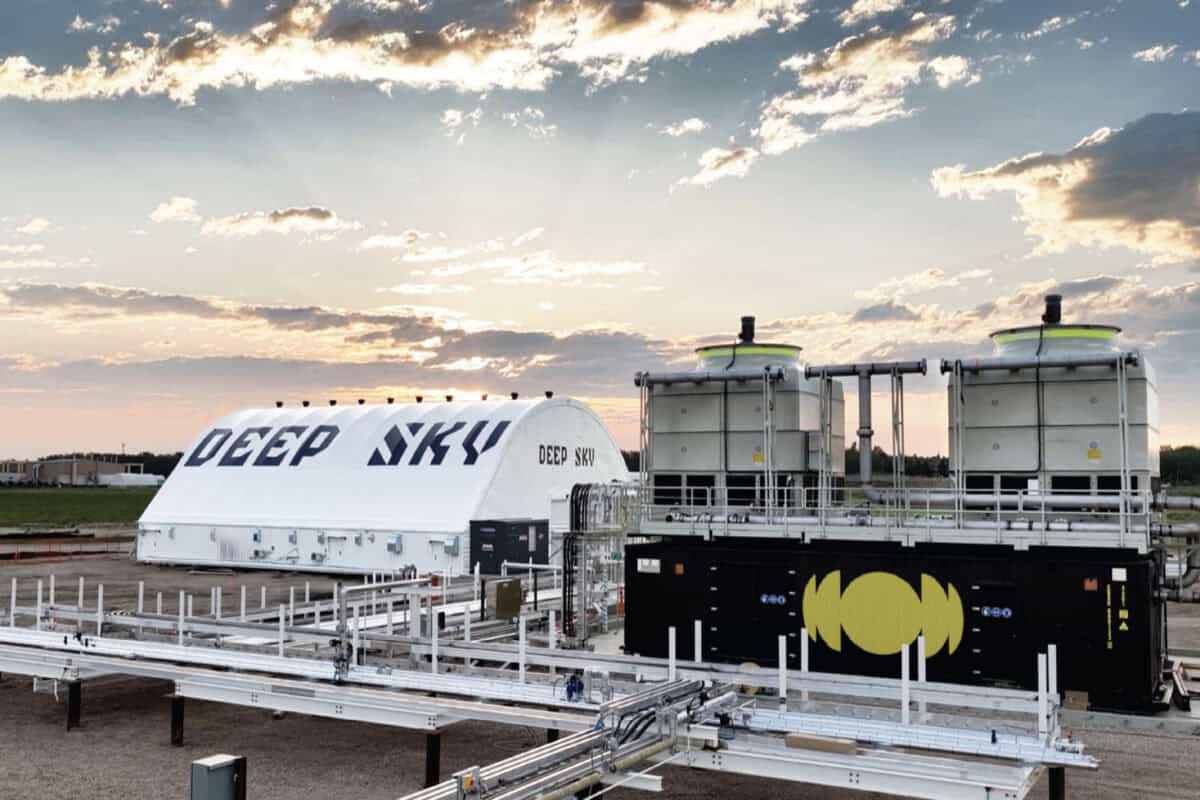
Deepsky Alpha facility

That operating model reflects how we’ve adopted a tech-agnostic approach in practice. Rather than developing a single capture technology, we build, finance, and operate the infrastructure, and deploy leading technologies onto it. This allows us to evaluate performance under real-world conditions and continuously select the most effective systems as we scale.

The reason for this approach is how the market has evolved. Buyers and partners are looking for ways to feel confident in delivery and long-term value. With a large and rapidly evolving set of DAC technologies, committing to a single pathway can be difficult to justify. A tech-agnostic model allows us to adapt as technologies improve while maintaining consistent project execution.

 

Buy JNews
ADVERTISEMENT

Q: What are some concrete benefits Deep Sky has seen through this approach?

A: Three benefits stand out. First, better data. Running multiple technologies under identical conditions allows us to benchmark performance based on how systems behave at scale, not in controlled environments.

Second, more reliable delivery. Buyers are increasingly focused on whether contracted tonnes will be delivered. A portfolio approach allows us to manage performance at the technology level without impacting overall project delivery.

Third, a stronger commercial proposition. Buyers are not tied to a single technology outcome. Instead, they participate in the evolution of the technology landscape over time, which aligns better with long-term procurement strategies.


Q: What impact has this had on developing the technology and the modular commercialization approach?

A: The impact is most visible in how quickly we can move from validation to deployment. By operating multiple technologies at Alpha and selecting based on real performance, we can move into scaled deployment with greater confidence in system design and integration. That shortens development cycles and allows us to standardize earlier in the process.

This has led to a modular approach to commercialization. Core elements like site design, energy integration, CO₂ handling, and storage are developed as repeatable systems, while capture technologies are integrated onto that platform. Each new project builds on the last, rather than starting from zero.

More broadly, this positions Deep Sky as an infrastructure platform for DAC deployment. We’re focused on building the systems that allow leading technologies to scale, and on creating a pathway for continuous improvement as those technologies evolve.


Q: How has working side-by-side with other climate tech companies helped Deep Sky?

A: Operating multiple technologies in one place accelerates learning. From an operational standpoint, we can identify patterns across systems and feed those insights back to technology partners. That improves performance over time and helps technologies mature faster under real-world conditions.

There are also commercial advantages. Buyers and partners can evaluate multiple approaches through a single process, which improves efficiency and confidence in decision-making.

For infrastructure partners, engineering firms, and investors, the model is also clearer. They are working with a platform focused on deployment, rather than taking direct exposure to technology risk, which makes those partnerships easier to structure.


Q: Would you encourage other climate tech companies to adopt the tech-agnostic approach?

A: It depends on where they sit in the value chain.cFor technology developers, the priority should remain advancing performance. The industry still needs improvements in materials, energy use, and system design.

For project developers and infrastructure platforms, a tech-agnostic approach reflects where the market is today. The main challenge is not the number of technologies, but the ability to deploy them reliably at scale and connect them to the infrastructure required for durable storage.

More broadly, what we’re seeing is a clearer structure emerging across the ecosystem, with different players contributing across technology, infrastructure, storage, and capital. Deep Sky’s model is designed to integrate these elements at the project level, so that technologies can be deployed, financed, and scaled more efficiently.

From The Energy Pioneer

Meet EP Investing — now live and free through July 15th.

1,300+ companies · 350+ investors · 185+ grants. Capital discovery for the energy transition.

EP Investing is now live
Register Free →
Tags: AlbertsCanadaCarbon CreditsDeepSkyDirect Air CaptureOffset Emissions
ShareTweetShare
Otto Gunderson

Otto Gunderson

Otto Gunderson has been working in clean energy for the last 7 years, with the last two being spent split between South America, Africa, and Southeast Asia, reporting on the transition to clean energy. After traveling and writing for two years, he founded The Energy Pioneer to create a news outlet with a global approach to clean energy journalism. He particularly enjoys writing about entrepreneurship, investment, and innovations that are contributing to greenhouse gas reduction and clean energy development.

Featured Expert: Guillaume Devaux

Featured Expert: Guillaume Devaux

Guillaume Devaux is the VP of Strategic Partnerships at Deep Sky, a carbon removal company developing Direct Air Capture (DAC) and CO₂ storage infrastructure. Guillaume drives global partnerships with enterprises aiming to remain competitive and derisk their decarbonization journey in a climate-driven future.

Related Posts

Rising Fuel Prices Push Jamaicans Toward Electric Vehicles
Electric Vehicles

Rising Fuel Prices Push Jamaicans Toward Electric Vehicles

May 7, 2026
India’s Energy Trilemma
Fossil Fuels

India’s Energy Trilemma

May 1, 2026
Building a Resilient Planet: A Conversation with the United Nations Environment Programme
Policy

Building a Resilient Planet: A Conversation with the United Nations Environment Programme

April 27, 2026
When the Lights Came On: Zimbabwe’s Rural Electrification and the Return of Local Wildlife
Clean Tech

When the Lights Came On: Zimbabwe’s Rural Electrification and the Return of Local Wildlife

April 23, 2026
The Nexus We Ignore: How Water Connects Energy, Health, and the Environment
Features

The Nexus We Ignore: How Water Connects Energy, Health, and the Environment

April 17, 2026
South Sudan’s Missed Opportunity: Untapped Renewables Leave Millions in the Dark
Renewable Energy

South Sudan’s Missed Opportunity: Untapped Renewables Leave Millions in the Dark

April 14, 2026

Popular Stories

  • Caught Between India’s Military Ambitions and Green Promises: The Future of the Andaman and Nicobar Islands

    Caught Between India’s Military Ambitions and Green Promises: The Future of the Andaman and Nicobar Islands

    0 shares
    Share 0 Tweet 0
  • The Race to Host AI: Data Centres in Water-Scarce India

    0 shares
    Share 0 Tweet 0
  • Vietnam’s Oil Buffer Faces Pressure as the Iran War Disrupts Global Oil Flows

    0 shares
    Share 0 Tweet 0
  • South Sudan’s Missed Opportunity: Untapped Renewables Leave Millions in the Dark

    0 shares
    Share 0 Tweet 0
  • Two Paths Forward: How The Iran Conflict Is Reshaping the Energy Sector

    0 shares
    Share 0 Tweet 0

Actionable Info

From The Energy Pioneer

Meet EP Investing — now live.

1,300+ companies · 350+ investors · 185+ grants

Free through July 15th

Register Free →

The Energy Pioneer

The Energy Pioneer covers the global energy transition — from clean tech and green finance to policy and renewable energy.

Recent Posts

  • A Canadian Model for Tech-Agnostic Direct Air Capture
  • Rising Fuel Prices Push Jamaicans Toward Electric Vehicles
  • Nigeria’s Energy Transition: Who Decides, Who Benefits and Who Pays?

Quick Links

  • Home
  • Clean Tech
  • Renewable Energy
  • Green Finance
  • Policy
  • Regions
  • Features
  • Who We Are

© 2026 The Energy Pioneer | All Rights Reserved. |

From The Energy Pioneer

You read about the energy transition. EP Investing is where it happens.

Source deals, raise capital, hire talent, track the market. Free through July 15th.

No thanks
Please enter a valid email.
You're in. We'll be in touch with your access link soon.
No Result
View All Result
  • Home
  • Clean Tech
    • Electric Vehicles
    • Energy Efficiency
    • Green Hydrogen
    • Smart Grid
    • Battery Storage
  • Green Finance
    • Public Financing
    • Private Financing
    • Carbon Markets
  • Policy
  • Renewable Energy
    • Wind
    • Solar
    • Hydropower
    • Nuclear
    • Hydrogen
    • Fossil Fuels
    • Geothermal
  • Regions
    • Africa
    • Asia
    • Europe
    • North America
    • Latin America
    • West Asia
  • Features
  • Who We Are
    • About Us
    • EP Investing
    • Contact Us

© 2026 The Energy Pioneer | All Rights Reserved. |