
Ilorin, Nigeria — When graphic designer Adekola Ibrahim opened his laptop to start the day’s work, a sudden power outage left him unable to switch it on.
This time, however, the outage did not disrupt his work. His fully charged portable power station, commonly known as a “power tank,” automatically switched on as programmed.
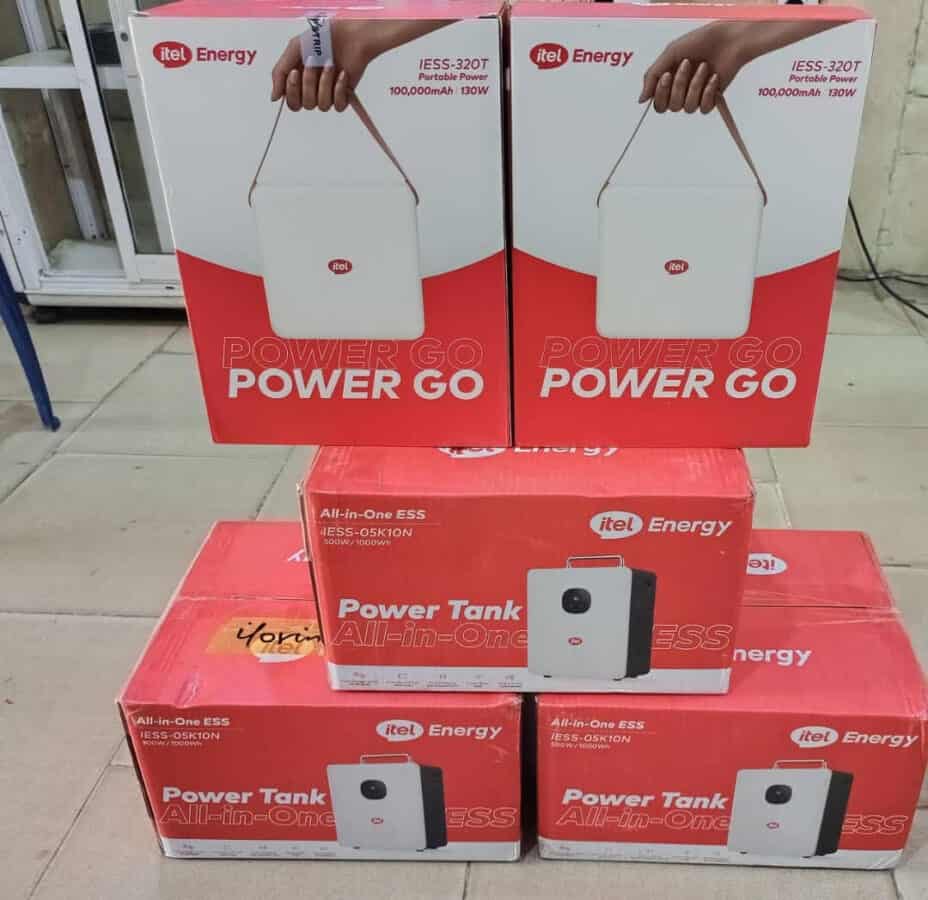
But electrifying his home to ensure reliable electricity supply came at an additional cost. Ibrahim spent 600,000 naira (USD450) to purchase the portable power station and pay an electrician to install and connect it to his home’s electrical system. Ibrahim has been using it for the past two years as a backup when grid electricity is unavailable, and says it has transformed the way he works. His monthly income has improved significantly from 100,000 naira (USD 74) to 300,000 naira since he transitioned to power tanks.
“It has made me more productive. I use it as an alternative when there’s no electricity to power my laptop and router, or even charge my phone” he said.
Nigeria’s History of Unreliable Electricity
For many Nigerians, reliable electricity can feel like something that’s always just out of reach. Ibrahim’s experience is not an isolated one, but reflects the difficulties that households and businesses face in securing a consistent power supply.
Nigeria’s electricity sector has undergone several major reforms, but efforts to improve access have yet to resolve the country’s longstanding electricity crisis.

In 1972, the government established the National Electric Power Authority (NEPA) as the country’s state-owned electricity utility. After decades of inadequate investment and persistent problems with electricity generation and supply, the government embarked on reforms that eventually led to NEPA being replaced by the Power Holding Company of Nigeria (PHCN) in 2005.
PHCN was later unbundled as part of a broader electricity-sector reform programme, creating separate companies responsible for generation, transmission and distribution.
Private companies took over the operation of most power-generation plants and distribution networks, while the government retained control of electricity transmission. The reforms were intended to attract private investment into a sector that had suffered from years of underinvestment and ageing infrastructure.
But the reforms have not brought the reliable electricity supply many Nigerians had hoped for. The national grid has continued to suffer from repeated collapses. In 2025 alone, the grid collapsed four times between February and December, with available generation reportedly falling from 3,825 megawatts to just 39 megawatts within minutes during one of the incidents.
Since 2010, Nigeria has recorded about 222 total or partial national-grid collapses. Despite having Africa’s largest gas reserves, the country continues to struggle to turn its energy resources into reliable electricity.
The grid can carry roughly 12,000 to 13,500 megawatts, but far less is typically delivered. In 2023, generation averaged about 4,500 megawatts for a population of more than 200 million, compared with roughly 6,000 megawatts in Ethiopia, which has a population of about 132 million.
“Nigeria’s electricity problem is not simply a shortage of generating capacity the deeper problem is a combination of weak infrastructure, inadequate investment, financial instability in the power sector, gas-supply constraints, electricity theft, and governance and regulatory challenges.”, says Ridwan Ajibola, Engineer and Technical Instructor and team leader at Skillyard consulting limited in Lagos.
He went on to explain that “If consumers do not pay, distribution companies cannot adequately pay other participants; generators struggle to recover costs; gas suppliers are affected; and investment in maintenance becomes difficult.”
The country loses an estimated USD 29 billion a year because of unreliable electricity, with power outages disrupting businesses and economic activity. Even the government-owned Transmission Company of Nigeria (TCN) loses about 7.79 megawatts for every 100 megawatts injected into the grid, due to aging transmission infrastructure and vandalism of power lines and towers. According to Reuters, in the past two years the company recorded 108 attacks on its transmission infrastructure.
Power Tanks and Generators
These long-standing challenges have created opportunities for various generator brands to capitalize on growing demand from local businesses that depend heavily on reliable electricity. However, the safety and environmental concerns associated with these generators remain a major challenge, as fossil fuel powered generators emit harmful fumes that pose risks to both human health and the environment.
According to reports, between 2008 and 2014, approximately 10,000 Nigerians died as a result of exposure to fumes emitted by generators. In 2015, the government banned imports of small, Chinese-made generating sets because of the risks they posed. Locally known as ‘I Better Pass My Neighbour’, these generators had become widely adopted by households seeking an affordable alternative to the country’s unreliable electricity supply. More recently, research has continued to highlight the health risks associated with generator use in Nigeria. A 2024 study examining emissions from different generator brands found elevated levels of toxic compounds in their exhaust, with the researchers identifying a high potential cancer risk from prolonged exposure.
A Solar Powered Solution
Power Tanks were introduced by Itel in 2024 as an alternative solution to Nigeria’s persistent and unreliable electricity supply. The AIO Power Tanks are rechargeable and portable power systems that can be charged using either conventional electricity or solar power, offering an alternative to petrol-powered generators.
Solar-powered systems, inverters, and rechargeable power stations have increasingly gained popularity as safer and more environmentally friendly solutions for meeting household and business electricity needs.
Nigeria has emerged as one of Africa’s largest small-scale solar markets, driven largely by rising energy costs and persistent power outages. The sector reportedly attracted about USD 2.5 billion in investment in 2025, while the country’s broader renewable energy market is estimated to have attracted USD 13.5 billion in investment.
Ogunronbi Olalekan, a solar entrepreneur in Ibadan, said his solar business is experiencing significant growth as more households and businesses turn to solar energy and other alternative power solutions to meet their electricity needs.
Olalekan admitted that continuous power failures in the country are responsible for the increased demand for his products.
“I set up my business for as low as 1,000,000 naira (USD 740) in 2025. I learned this business from my elder sister and now I have my own brand. We sell different kinds of solar items, inverters, photovoltaic panels, rechargeable power tanks, and other tech accessories.”
Overcoming Power Failure
Ridwan said that for the country to overcome power failures, it needs to stop measuring the success of the electricity sector primarily by the amount of installed and generated capacity.
“The more meaningful measure is how many megawatt-hours of reliable and affordable electricity actually reach homes, businesses and industries. Nigeria has significant natural gas, hydro and solar resources; the priority is to convert these resources into reliable electricity and deliver it efficiently through a technically strong and financially sustainable power system.”