
With more than a quarter of US greenhouse gas emissions coming from transportation, meeting carbon reduction targets will require adoption of not only passenger EVs, but also fleets across trucking, heavy industry, and buses. Companies across the United States are developing both hardware and software solutions to electrify fleets. The industry must find locations where electricity offtake is possible, create optimized schedules to keep charging costs down and vehicles on the road, and build the physical infrastructure required to reshape the industry.
Building the Infrastructure
One of the most immediate challenges in building out an electric fleet is physically constructing a charging location. EV Fleet charging pioneer Terawatt has developed a comprehensive solution for both trucking and autonomous/rideshare fleets. Terawatt develops charging depots for fleet operators, allowing them to focus on each customer’s unique requirements. During an August call with Terawatt Chief Product and Strategy Officer Titiaan Palazzi, he explained that operating charging depots allows Terawatt to optimize them for energy management. Palazzi gave the example of working with a utility to determine available power at a location before installing chargers, then using energy management software to throttle total charging.
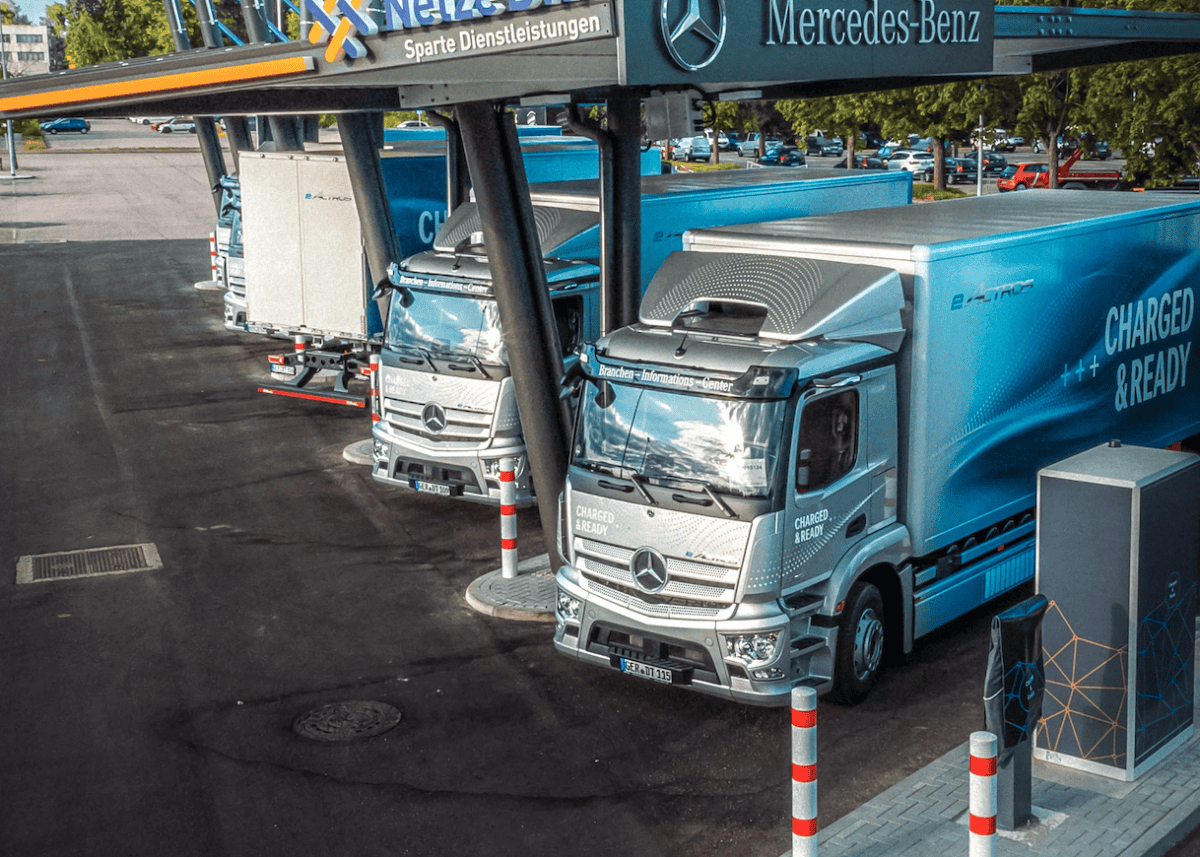
Palazzi outlined how oftentimes fleet vehicles do not need to charge their entire battery at the most rapid rate possible. Rather, they can charge at optimized times to reduce energy costs. This allows Terawatt to add more chargers to a site and use peak power when a vehicle is first plugged in, then taper down as the battery continues to charge. Palazzi concluded by explaining that this lets the same amount of utility power support more chargers.
Building the Platform
The challenges of fleet electrification extend beyond infrastructure buildout and into how charging is orchestrated. Max Brandt, Co-Founder and CEO of European energy management company FLEXECHARGE, explained in a September call with The Energy Pioneer that electrifying fleets requires connecting systems that were never designed to work together. Determining which vehicle will charge when, where and at what power level requires highly reactive software. FLEXECHARGE’s HARMON-E platform does this by integrating grid operators, charging station manufacturers, fleet management teams, a company’s back-end software and electricity market information. The platform already manages charging load across Circle K’s rollout of 1,000 charge points.
With an energy grid already under strain, finding locations where sufficient energy is available and grid interconnection is possible has proven challenging. WeaveGrid, a California-based software and machine learning company, works with utilities to create optimized offtake. In a conversation with Cynthia Leung, Director of Strategic Partnerships at WeaveGrid, she explained that WeaveGrid was created in response to what massive EV adoption would do to the grid. Leung outlined how working alongside the grid allows EV charging to happen at the opportune time, whether when renewable energy is at peak availability or when the operator has flexibility to avoid peak times. Leung concluded by emphasizing how reducing peak demand can help prevent transformers from becoming overloaded.

As the number of chargers grows, a unified platform where fleet operators can find charging locations and prices is important to prevent charging anxiety. ChargeLab has been developing the backend software required for fleet charging since the company entered the industry in 2016. As Founder and CEO Zak Lefevre explained, when the company entered the market, there was a need for the software solution for charging optimization on top of the hardware solutions being developed at the time.
Lefevre then outlined how different fleet types will require different solutions. Certain fleet types may need Direct Current (DC) fast charging, which requires charging locations with sufficient grid capacity to supply high levels of power. Alternatively, fleets that do not require fast charging can use Alternating Current (AC) charging, which typically requires less grid capacity. By creating a software platform that can work across different hardware, ChargeLab can optimize charging times and energy consumption while providing an easy interface for fleet users.
Vehicle Adoption
California-based Forum Mobility, founded in 2021, has expanded from charging hubs to leasing electric trucks. An August conversation with Forum Mobility Co-Founder and CEO Matt LeDucq explored the challenge of working across both the charging and the vehicle industries. LeDucq described how fleets choosing to lease new vehicles are demonstrating a “crawl before you walk” approach to adopting electric trucks, leasing two or three before scaling up as comfort and familiarity with the technology grow.
LeDucq explained how the value proposition for switching to electric vehicles has shifted from environmental benefits to economic benefits in recent years. This has been evident in both lower cost per mile and reduced downtime. LeDucq then pointed to two major factors driving industry development: the established viability of the technology and improved capital market conditions. This has created momentum for scaling, as Forum currently operates 10 MW of charging infrastructure and a fleet of approximately 100 trucks.
Off-Grid Solutions
Many of the conditions driving truck electrification have also contributed to bus electrification. Sean Burke, CEO & Co-Founder of Enteligent, a California-based company focusing on DC/DC power solutions, explained how a pilot project to electrify buses in the San Jose School District, funded by the California Energy Commission and administered by Lawrence Berkeley National Labs, uses a combined solar, battery, and DC-to-DC charger installation. This allows the bus fleet to be charged completely off-grid. As Burke explained, the lengthy process of utility infrastructure upgrades, including the multi-year lead times for transformers, could be mitigated in certain instances through the combination of solar canopies, battery storage, and DC chargers.
Developing technologies for EV fleet charging that does not require interconnection can be accomplished with a number of different technologies. Texas-based Kaizen Clean Energy has developed a modular charging system which uses methanol as a feedstock and can be installed in a day. When asked what allows for such a short time to power, Co-Founder and CTO Craig Klaasmeyer described how the entire system is above ground. The system, which consists of a methanol tank, clean generator, a separate battery, and a skid-mounted charger, allows for fleets coming online to access power without waiting for grid connection.
Managing the Grid Strain
While off-grid charging is suitable in certain situations, most EV fleet charging will still need grid access. New York-based Ampcontrol has developed a solution to manage EV fleet charging integration with the grid. During a September conversation with Joachim Lohse, CEO of Ampcontrol, he outlined how Ampcontrol has created a vertically integrated cloud software platform. This enables asset monitoring and integration with fleet operators’ Transport Management Systems. Ampcontrol is then able to use specific vehicle data, such as energy requirements or departure times, to optimize on-site charging.
Lohse then described how energy management requirements differ significantly by industry. In outbound logistics operations, they rely heavily on vehicle and route data because they use depot-based charging. Transit bus operators use more fixed routes; however, Lohse added that the industry is increasingly interested in integrating day-ahead and spot pricing to optimize charging costs. Lastly, he explained that electrifying port operations is an entirely different challenge because of the massive energy loads and the difficulty of electrifying cranes and terminal tractors. To address the variety of challenges, Ampcontrol’s technology distinguishes between the instant responses used for micro-grid stability or load fluctuations, and predictive optimization for fleets to charge at times of maximum profitability.
Electrifying fleets, whether trucks, buses, machinery, or passenger vehicles could significantly reduce the emissions from the transportation sector. However, as industry leaders have repeatedly emphasized, the reasons for electrification are no longer just environmental. Whether to reduce vehicle downtime, avoid fluctuating fuel costs, or take advantage of available renewable energy, the economic case for electrifying fleets has never been stronger.
Readers can join our climate and clean energy network for updates and developments from companies across the trucking and EV sector, including FLEXECHARGE, WeaveGrid, Terawatt, ChargeLab, Forum Mobility, Enteligent, Kaizen Clean Energy, and Ampcontrol.