

Singapore has introduced Sustainable Aviation Fuel (SAF) mandate, with flights departing from the country required to use a 1% SAF blend from 2026. This requirement is expected to increase gradually over the coming years. Similar policies are being introduced in the European Union, placing growing pressure on the aviation industry to transition towards more sustainable fuels. However, some industry players have pushed back against these mandates, arguing that the costs and pressures of adoption could threaten the industry’s viability. Despite this resistance, aviation has seen relatively little technological progress in reducing its reliance on conventional fuels compared with the automotive industry.
Although aviation is not the largest contributor to emissions within the transport sector, it remains one of the most carbon-intensive forms of travel on a per-passenger, per-kilometre basis. Identifying effective ways to reduce these emissions is therefore essential to ensuring the industry’s long-term sustainability and development.
The Energy Pioneer interviewed Conor Madigan, founder and CEO of Aether Fuels, a climate technology company that converts waste carbon into sustainable fuels for aviation, shipping and heavy industry. The interview explores the complexities of the sector, covering investment, scaling operations and government regulation.
Q: How does Aether’s technology differ from existing SAF production methods, and what advantages does using waste carbon feedstocks offer in terms of cost and scalability?
A: Aether’s Aurora technology is designed around three key advantages: higher yields, lower capital costs, and greater feedstock flexibility. Through process intensification and novel catalysts, we can produce a higher yield of fuel with a variety of different waste carbon feedstocks improving the economics and scalability of SAF production.
Today, most SAF is produced through the Hydroprocessed Esters and Fatty Acids (HEFA) pathway, which relies on limited supplies of used oils and fats. With HEFA’s feedstock nearing capacity, we need more economical technologies that can utilize a broader range of abundant feedstocks. Our technology can process waste carbon from biogas, agricultural and forestry residues, municipal solid waste, industrial waste gases, and captured CO₂ with hydrogen. These feedstocks are abundant and are available in quantities around the world, allowing us to adapt projects to regional feedstock availability and deploy our technology globally.
Q: Scaling SAF requires significant investment. Having raised more than US$60 million, what does the funding landscape look like for next-generation fuel technologies, and what investors and partners are needed to bring projects like Aether’s to commercial scale?

A: Scaling next-generation SAF requires different types of capital at different stages. Venture capital is essential for developing and demonstrating new technologies, but moving from demonstration to first-of-a-kind commercial facilities requires a different level of investment. That capital can come from private investors, public funding, or partnerships that bring together multiple stakeholders.
Ultimately, successful commercialization requires an ecosystem including proven technology, investment, infrastructure, supportive policies, and customers willing to purchase the fuel. Our work in Singapore is a good example of how bringing those pieces together can help move innovative technologies toward commercial deployment.
Q: Following the Singapore Airlines deal, what interest are you seeing from other airlines, and how many could realistically become customers in the coming years?
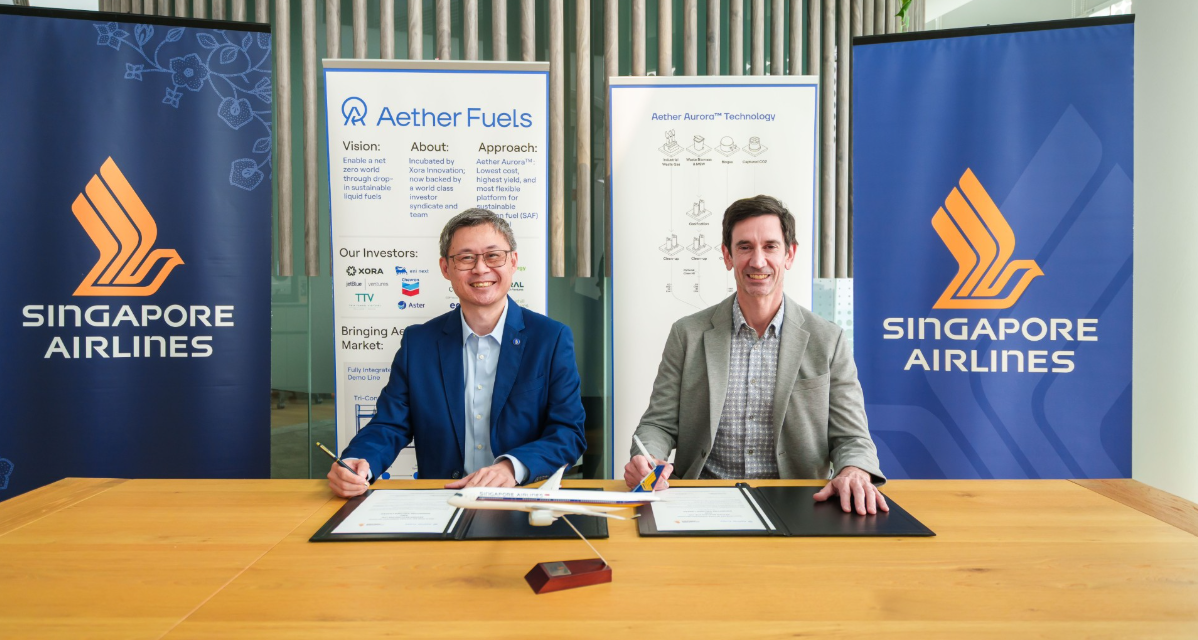
A: Most airlines are interested in SAF as they prepare for increasing requirements. With CORSIA’s mandatory phase beginning in 2027, growing regional mandates and targets, and corporate demand for lower-carbon aviation, airlines are looking for reliable and economical SAF supply.
Q: What role do government incentives, regulation and policy need to play in accelerating SAF production and making it commercially competitive with conventional jet fuel?
A: SAF needs support from across the industry to reach meaningful scale. In the near term, government incentives help bridge the cost gap with conventional jet fuel and support investment in new production technologies. At the same time, mandates and targets provide important demand signals that give developers and investors greater confidence to move projects forward.
Over time, we expect the price of next-generation SAF to be reduced as technologies improve, production becomes more efficient, and more facilities are built, however this requires consistent policy, investment, and collaboration across the entire value chain.