
Bui Power Authority has proven the model on a small reservoir. The question is whether it can survive contact with Volta Lake, the world’s largest man-made lake.
Ghana’s clean energy conversation keeps returning to the same body of water: Volta Lake.
Held back by the Akosombo Dam, this vast reservoir helped build Ghana’s power grid, and has repeatedly threatened to destabilize it. Too little water during droughts. Too much during floods. And a hydro fleet caught in between.
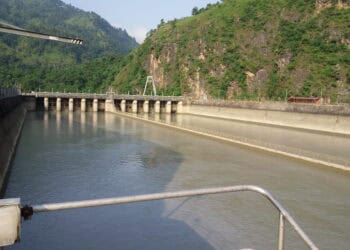
Two hundred kilometres to the northwest, Ghana has been testing floating solar on the Bui reservoir, the country’s second-largest hydropower project. The panels are installed on the water alongside the dam’s turbines.
If floating solar works on the Bui reservoir, could the model work on Volta Lake, a reservoir roughly sixteen times the size?
Lessons from Bui
An engineer at Bui Power Authority (BPA), the state-owned company that operates the Bui hydropower project, has worked on the floating installation since it began. The engineer asked not to be named and described a project that grew cautiously.

The first phase was designed as a pilot to test whether floating solar could operate on an existing hydro reservoir.
“We started with one megawatt and then scaled it up to five megawatts,” explained the engineer.
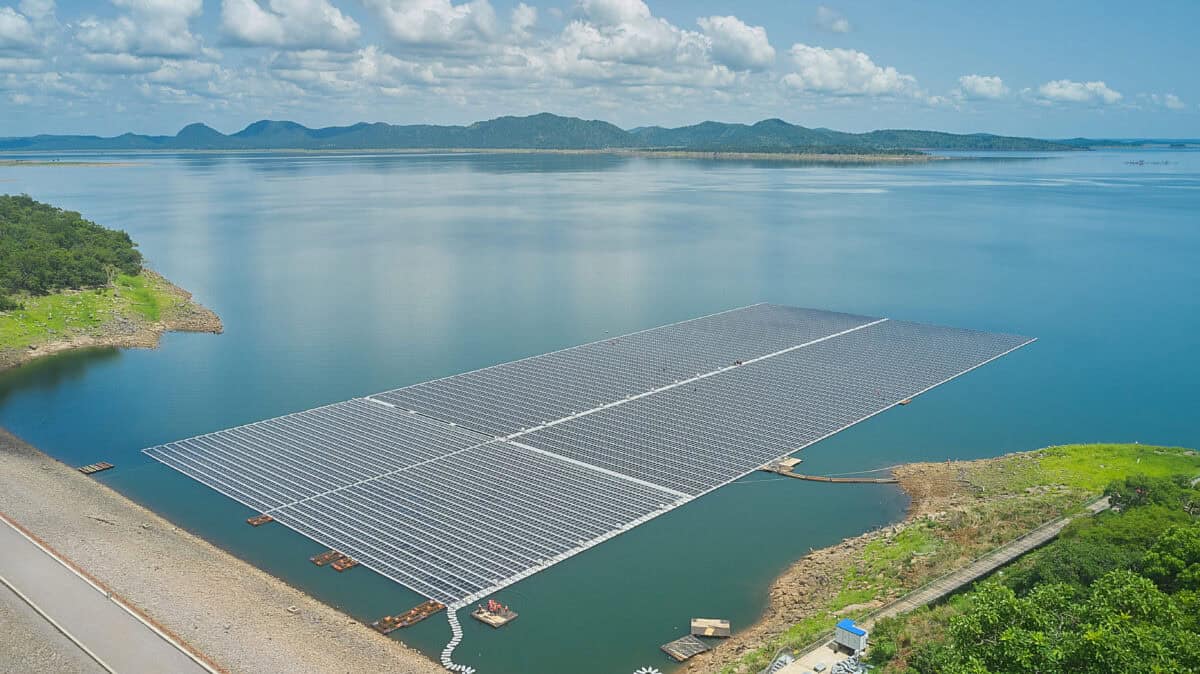
Because the project was built during the COVID-19 pandemic, when the original equipment manufacturer could not travel to Ghana, local engineers at BPA developed and integrated the floating solar installation with the existing Bui hydropower facility.
The experiment has since grown. A 25-megawatt expansion is currently under construction, forming part of a broader plan to develop 250 megawatts of floating and land-based solar within the Bui enclave, alongside roughly 50 megawatts of battery storage.
“The battery storage only comes in when there is an intermittency, like cloud cover,” said the engineer.
The system is currently designed to smooth out fluctuations in solar generation rather than shift daytime power into the evening.
“This hybridisation is manual. It’s not automatic yet,” said the engineer.
Operators have to manage how the solar plant and hydroelectric generators work together, rather than relying on an automated system to balance the two sources.
That experience matters because Bui has exposed practical challenges that feasibility studies cannot anticipate. The recurring challenge is cable management. Strong waves, particularly after rainfall, can knock the cables carrying electricity from the solar panels into the water, damaging connectors and forcing crews to make repairs.
For a much larger installation on Volta Lake, those seemingly mundane engineering problems could become significant.
Why Akosombo is different
The case for floating solar at Akosombo, however, is not simply about putting more panels on water.
Raphael Adjapong Amankwah, an energy sector analyst at Vivo Energy Ghana, familiar with Ghana’s power market said the country’s core electricity problem has not historically been a shortage of generation capacity. He linked persistent power-sector debts largely to revenue collection failures at the distribution level.
But Ghana’s future electricity system will face a different challenge.
Demand is expected to grow as new loads, including electric vehicles, come onto the grid, while climate change and weather events such as El Niño make hydro generation less predictable.
That makes the combination of solar and hydro particularly valuable.
Akosombo’s turbines are dispatchable. Operators can reduce hydro generation when solar is produced during the day and increase it again as solar output falls.
The result would not be solar replacing hydropower, but the two resources complementing each other.
The additional generation might also put pressure on Ghana’s transmission system. A large floating solar array would add a significant volume of electricity to the grid during daylight hours. The lines and substations downstream of Akosombo would need to be capable of carrying that power to consumers.
The challenge is not simply whether solar panels can float on Volta Lake. It is whether Ghana can operate the resevoir, the dam and the grid as one system.
The Economics of Scaling Up
Ghana has an existing benchmark for what floating solar can cost. Bui’s floating plant was built at a levelised cost of roughly USD 0.10 per kilowatt-hour. BPA has said that using Ghanaian engineers rather than expatriate contractors saved around USD 2 million on its solar projects to date.
A 2023 peer-reviewed feasibility study modelled a much larger floating solar project on Volta Lake itself. The study examined a 420-megawatt array, estimating annual electricity generation of about 520,000 megawatt-hours, an annual revenue of nearly USD 52 million and a payback period of roughly 12 years.
The panels could also reduce evaporation from the reservoir, with the study estimating annual water savings of about 73,000 cubic metres.
The figures do not make a 420-megawatt project inevitable. But there is both a working project at Bui and a detailed model for what a much larger installation on Volta Lake could deliver.
Political blocks
Before BPA could put solar panels on its reservoir, its leadership had to persuade Parliament to amend the legislation that created the authority in 2007. The law had given BPA responsibility for operating a hydroelectric dam, but did not cover solar generation or a hybrid hydro-solar system. The dam was therefore within BPA’s legal mandate; the solar project was not. Parliament had to expand BPA’s mandate before the authority could develop the floating solar project.
The technology was ready. The mandate was not.
Akosombo could face similar institutional barriers. The Volta River Authority operates the dam under its own legal mandate, meaning a large floating solar project would require clarity over who can develop the resource, who operates the solar installation and how it would be integrated with the existing hydro system.
Those political and regulatory barriers could ultimately prove more important than whether the panels can survive the waves.
From Pilot to Scale
Bui has shown that floating solar can work on a hydro reservoir. Akosombo presents the larger test: whether Ghana can scale that model and integrate it into one of the country’s most important hydroelectric systems. With Ghana targeting 10 percent of its electricity from renewables by 2030, the stakes are becoming more immediate.