
The Energy Pioneer
No Result
View All Result
  • Home
  • Clean Tech
    • Electric Vehicles
    • Energy Efficiency
    • Green Hydrogen
    • Smart Grid
    • Battery Storage
  • Green Finance
    • Public Financing
    • Private Financing
    • Carbon Markets
  • Policy
  • Renewable Energy
    • Wind
    • Solar
    • Hydropower
    • Nuclear
    • Hydrogen
    • Fossil Fuels
    • Geothermal
  • Regions
    • Africa
    • Asia
    • Europe
    • North America
    • Latin America
    • West Asia
    • Oceania
  • Features
  • Who We Are
    • About Us
    • EP Network
    • Contact Us
  • Home
  • Clean Tech
    • Electric Vehicles
    • Energy Efficiency
    • Green Hydrogen
    • Smart Grid
    • Battery Storage
  • Green Finance
    • Public Financing
    • Private Financing
    • Carbon Markets
  • Policy
  • Renewable Energy
    • Wind
    • Solar
    • Hydropower
    • Nuclear
    • Hydrogen
    • Fossil Fuels
    • Geothermal
  • Regions
    • Africa
    • Asia
    • Europe
    • North America
    • Latin America
    • West Asia
    • Oceania
  • Features
  • Who We Are
    • About Us
    • EP Network
    • Contact Us
No Result
View All Result
The Energy Pioneer
No Result
View All Result
  • Home
  • Clean Tech
  • Green Finance
  • Policy
  • Renewable Energy
  • Regions
  • Features
  • Who We Are
Home Geothermal

Kenya’s Geothermal Energy and the Displacement of the Maasai

byCatherine Suttah
September 14, 2026
Reading Time: 5 mins read

By the end of 2025, Kenya’s installed geothermal capacity had reached 980 MW, making it the world’s seventh-largest geothermal producer — more than Iceland and Italy combined. Nearly all of this capacity comes from a single field: Olkaria, in the Rift Valley, 120 kilometres northwest of Nairobi.

RELATED POSTS

‘Synthetic Rwanda’ Reveals the Unexpected Emissions Cost of Electrification

How Power Tanks Are Keeping Nigeria’s Small Businesses Running Amid Persistent Grid Failures

Ghana Already Knows How to Float Solar on a Dam. Can It Scale?

Olkaria is a point of national pride for Kenya. The country harnessed its own volcanic rock to produce clean, round-the-clock power four decades before its neighbours drilled a single well. But this is not the same story told by the Maasai families who once lived there.

Geothermal Boom

The East African Rift is one of the world’s most promising untapped geothermal regions. Ethiopia alone is estimated to have up to 10,000 MW of geothermal resources still underground.
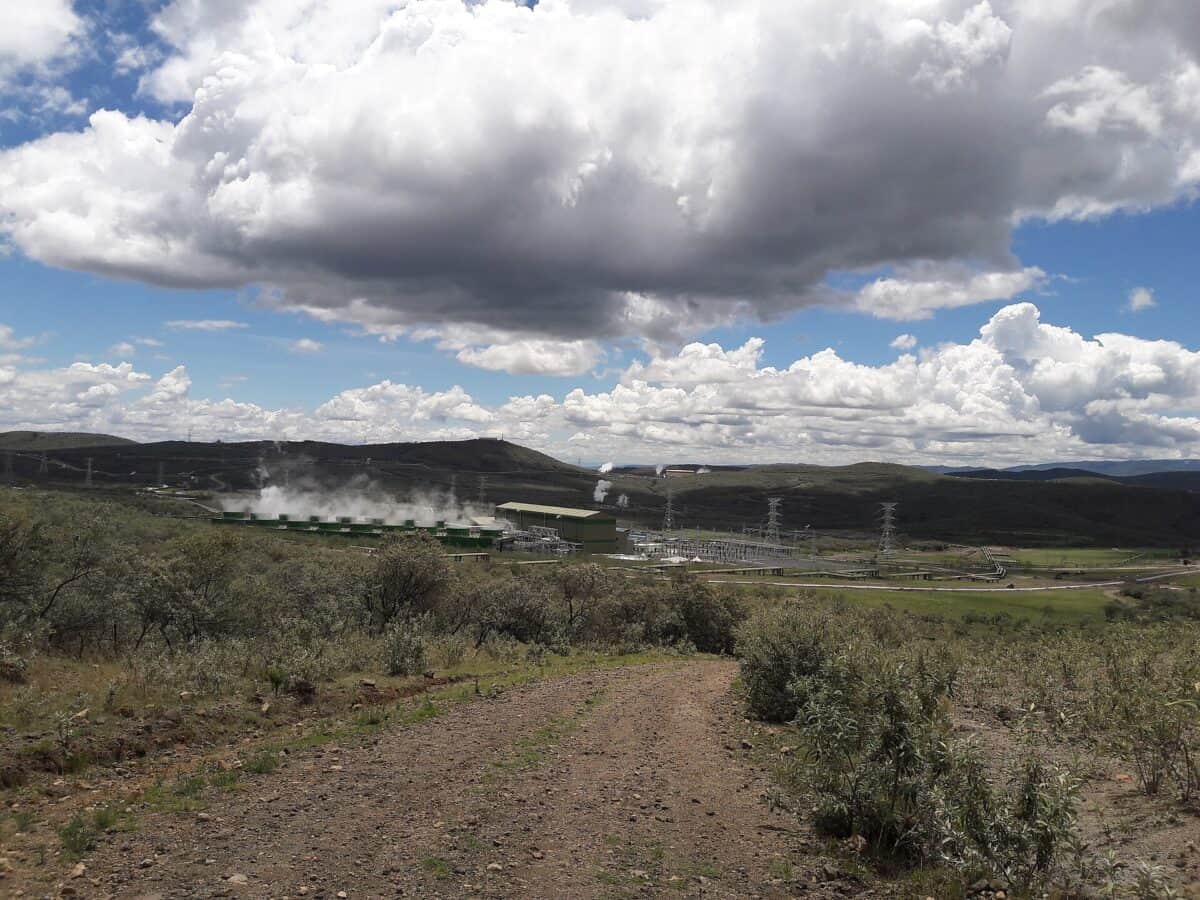
The Olkaria V geothermal power station in Kenya’s Hell’s Gate National Park-Photo by Macabe5387

Kenya’s build-out at Olkaria has been financed with nearly USD 1 billion in public funding from the World Bank, the European Investment Bank, Japan’s JICA, Germany’s KfW, and France’s AFD. Spread across four power stations, that investment now supplies roughly half of the country’s electricity. On paper, this is exactly what a just energy transition is supposed to look like: public institutions absorbing the upfront risks of clean-energy investment, directing capital toward a strategic national resource, and ensuring that the benefits of reliable, affordable electricity extend beyond private investors.

But the benefits have come with a cost. In 2014, Kenya’s state-owned geothermal utility, KenGen, resettled around 1,000 Maasai people, roughly 150 families, from four villages to make way for the Olkaria IV plant. They were moved to a new settlement the community now calls RAPland, after the Resettlement Action Plan that created it, where each family received a two-bedroom house on a 0.41-hectare plot, a fraction of the grazing land a pastoralist household needs to keep livestock as it traditionally has.

The Cost of Olkaria

Buy JNews
ADVERTISEMENT

Daniel Ntanana Ole Shaa, a RAPland resident and human rights activist, has described the costs of resettlement, including lost livelihoods, cultural sites and land ill-suited to pastoralism. In an article for The Elephant, journalist Lotte Hughes quoted him as saying: “We feel that the banks value their business more than our lives and wellbeing.”

Fifty kilometres south, at Mount Suswa, Maasai families who regard the volcano’s crater as a holy place, Oldonyio Lenkai, “God’s dwelling place”, are watching KenGen eye it for expansion and wondering if they will be next.

When the Complaints Began

Formal complaints followed, filed with both the World Bank Inspection Panel and the European Investment Bank’s own Complaints Mechanism. The two bodies conducted a joint compliance review between March and July 2015.

Investigators found that lenders had failed to recognise the impacted persons as indigenous people and failed to trigger the Indigenous Peoples policy, which could have safeguarded the communities from many of the subsequent project failures. The EIB’s own Conclusions Report examined the categorisation of the Maasai as indigenous people and the possible impact of that classification on how the resettlement framework was applied. The community was deprived of the right to free, prior and informed consultation, the right to secure customary land rights, and the right to benefit-sharing for the commercialisation of their natural resources.

The World Bank’s Inspection Panel also identified serious shortcomings in the resettlement process. Subsequent reporting and community complaints documented problems with livelihood restoration, land titling and infrastructure, disputes over who qualified for resettlement benefits, and inadequate consideration of Maasai cultural and traditional practices. Residents also reported that the new settlement was less suitable for grazing and farther from traditional sources of livelihood.

Civil society groups monitoring the project have also documented KenGen filing legal charges against community members who publicly raised concerns, and Maasai informants have described the mediators sent to resolve disputes as, in their words, “KenGen’s spies.” A coalition of international NGOs eventually wrote directly to the World Bank, the EIB, JICA, KfW, and AFD, asking them to intervene and have the charges dropped.

The Consultation Trap

Kenya’s national target is 5,000 MW of geothermal by 2030, more than five times what exists today, almost all of it planned for sites along the same Rift Valley corridor already dotted with Maasai settlements. The Geothermal Risk Mitigation Facility, the African Union-backed fund that de-risks exploratory drilling for fifteen countries from Kenya to Djibouti, has no equivalent mechanism for de-risking displacement. It will pay up to 80% of a surface study. But it will not pay for an independent land audit, or fund a legal aid clinic for a Maasai family fighting a resettlement claim, or require that a community be formally recognised before the drilling begins. The instruments built to make geothermal bankable for investors have no counterpart built to make it survivable for the people who already live there. The problem is that a public utility is moving faster than its consultation obligations. 

Kenya as an Example

Geothermal is, by most measures, about as clean as electricity gets: low emissions, a small land footprint, and power that runs around the clock. But clean energy is not automatically just energy. Across the Rift, countries looking to Kenya as a model are also inheriting its conflicts over land, ownership, and displacement.

In Kenya, that means Maasai families losing grazing land, community leaders dismissed as backward, and Mount Suswa, sacred and steaming, waiting to find out whether it is next.
Tags: East African RiftGeothermalKenyaMaasai displacementOlkaria
ShareTweetShare
Catherine Suttah

Catherine Suttah

Catherine Suttah is a Master of Environmental Management student at Duke University's Nicholas School of the Environment, concentrating in Energy and Environment and Business and Environment. She is the founder and managing director of Africa Climate Futures, a Pan-African platform accelerating sustainable energy transition and climate finance across Africa's 54 nations. Previously, Catherine served as Clean Cooking Officer at ENI Ghana Exploration & Production Ltd, leading initiatives that reached over 3,000 individuals across 10 communities while establishing climate education programs in schools. She holds a Bachelor of Science in Administration with a major in Accounting from the University of Ghana and has served as Conference Coordinator for LCOY Ghana towards COP27 and COP29, contributing to national youth climate statements. Catherine's extensive network includes fellowships with YALI, SheChangesClimate, and Chatham House, and she is particularly passionate about building the next generation of African climate leaders, promoting women's inclusion in climate policy, and scaling community-driven environmental solutions across the African continent.

Related Posts

‘Synthetic Rwanda’ Reveals the Unexpected Emissions Cost of Electrification
Africa

‘Synthetic Rwanda’ Reveals the Unexpected Emissions Cost of Electrification

September 7, 2026
How Power Tanks Are Keeping Nigeria’s Small Businesses Running Amid Persistent Grid Failures
Energy Efficiency

How Power Tanks Are Keeping Nigeria’s Small Businesses Running Amid Persistent Grid Failures

September 2, 2026
Ghana Already Knows How to Float Solar on a Dam. Can It Scale?
Solar

Ghana Already Knows How to Float Solar on a Dam. Can It Scale?

August 31, 2026
EP Deep Dive | Mission Impossible: US Struggles to Cut China out of Critical Mineral Supply Chains
Policy

EP Deep Dive | Mission Impossible: US Struggles to Cut China out of Critical Mineral Supply Chains

August 26, 2026
Uganda Still Cooks Over Firewood. Could Chinese Stoves Change That?
Africa

Uganda Still Cooks Over Firewood. Could Chinese Stoves Change That?

August 24, 2026
Biogas Cuts Firewood Use in Rural Zimbabwe
Renewable Energy

Biogas Cuts Firewood Use in Rural Zimbabwe

August 19, 2026

Popular Stories

  • The Race to Host AI: Data Centres in Water-Scarce India

    The Race to Host AI: Data Centres in Water-Scarce India

    0 shares
    Share 0 Tweet 0
  • Vietnam’s Oil Buffer Faces Pressure as the Iran War Disrupts Global Oil Flows

    0 shares
    Share 0 Tweet 0
  • Caught Between India’s Military Ambitions and Green Promises: The Future of the Andaman and Nicobar Islands

    0 shares
    Share 0 Tweet 0
  • The Philippines’ Nuclear Gamble

    0 shares
    Share 0 Tweet 0
  • The Sargassum Paradox: Why the Caribbean’s Clean Energy Hope is a Supply Chain Trap

    0 shares
    Share 0 Tweet 0

Actionable Info

From The Energy Pioneer

Where the energy transition connects.

Journalists, investors, companies, and clean energy leaders — all in one network.

Explore EP Network →

The Energy Pioneer

The Energy Pioneer covers the global energy transition — from clean tech and green finance to policy and renewable energy.

Recent Posts

  • Kenya’s Geothermal Energy and the Displacement of the Maasai
  • Billion-Dollar Disasters: What the Data Reveals About Extreme Weather Costs
  • The Five Most Important Moments in Virtual Power Plant History

Quick Links

  • Home
  • Clean Tech
  • Renewable Energy
  • Green Finance
  • Policy
  • Regions
  • Features
  • Who We Are

© 2026 The Energy Pioneer | All Rights Reserved. |

From The Energy Pioneer

Meet EP Network.

Enter your email and our team will reach out — or sign up directly.

Please enable JavaScript in your browser to complete this form.
Loading
or sign up directly →
From The Energy Pioneer

You read about the energy transition. EP Network connects you to it.

Leave your email and our team will reach out.

Please enable JavaScript in your browser to complete this form.
Loading
or
Sign up now →
No Result
View All Result
  • Home
  • Clean Tech
    • Electric Vehicles
    • Energy Efficiency
    • Green Hydrogen
    • Smart Grid
    • Battery Storage
  • Green Finance
    • Public Financing
    • Private Financing
    • Carbon Markets
  • Policy
  • Renewable Energy
    • Wind
    • Solar
    • Hydropower
    • Nuclear
    • Hydrogen
    • Fossil Fuels
    • Geothermal
  • Regions
    • Africa
    • Asia
    • Europe
    • North America
    • Latin America
    • West Asia
    • Oceania
  • Features
  • Who We Are
    • About Us
    • EP Network
    • Contact Us

© 2026 The Energy Pioneer | All Rights Reserved. |