
For more than twenty years, Ibiade, a rural community in Nigeria’s Ogun state, has existed without access to electricity.
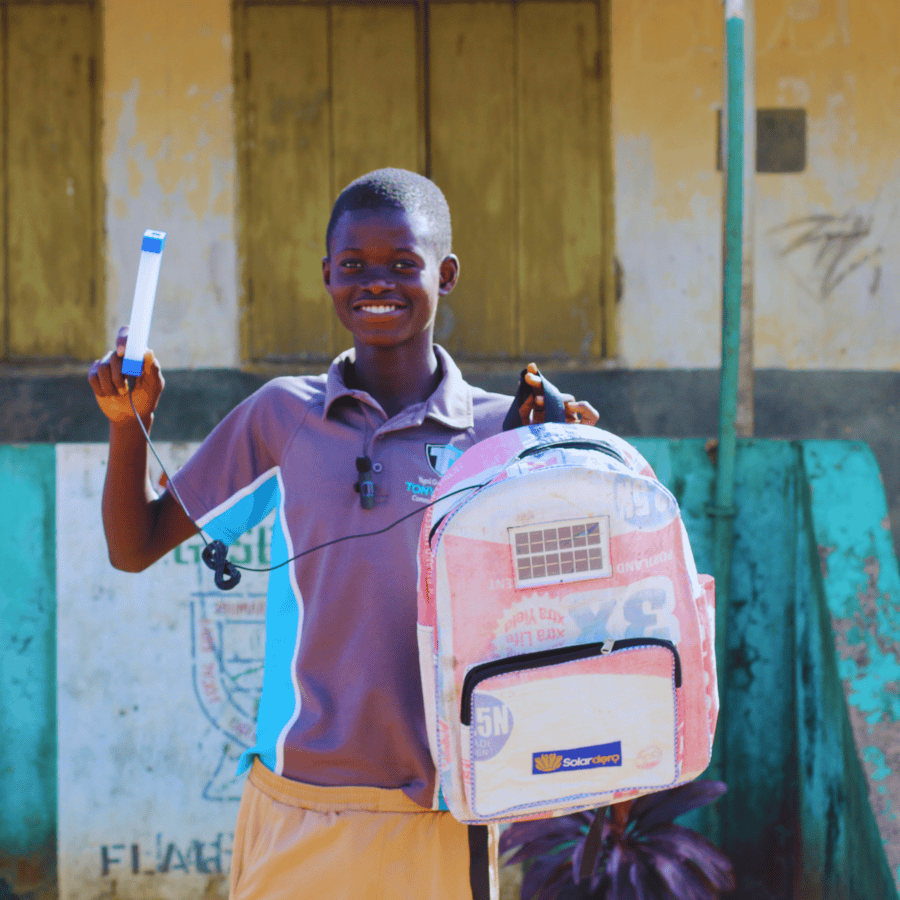
The lack of electricity has become a part of everyday life for high school students like Oluwatoyin Popoola, who attends Community High School. Before he received his solar-powered back pack, Popoola’s ability to study in the evening depended on whatever light source he was able to get his hands on.
An estimated 20,000 rural communities in Nigeria remain without access to electricity, according to the Rural Electrification Agency of Nigeria, (REA). A 2016 study of university students in Lagos found that power irregularities accounted for 99.8 percent of the variation in academic activities. Highlighting the impact of unreliable electricity on education. For many young people in regions like Ibiade, the lack of electricity makes it difficult to read, revise and prepare for examinations outside the classroom.
Receiving a solar-powered school bag has changed that routine. The bag charges during the day using sunlight and provides students like Popoola with a reliable source of light after dark. He can now continue reading and studying in the evening without relying on electricity or temporary lighting. The intervention has effectively turned hours once lost to darkness into additional time for learning.
‘Solar Turned Relief’
In 2024, Sayedero Enitan, an engineer who founded Solardero Foundation, a non-profit organization providing solar bags to students in rural communities. The foundation’s name combines ‘Solar’, an English word, and ‘Dero’, a Yoruba word meaning ‘solar turned relief’.
“I am an engineer and have worked in the renewable energy sector for over a decade. With around 80 million Nigerians still lacking access to electricity, it has become part of my personal mission to contribute towards reducing that number to zero”, said Enitan.

Her goal is to help children living in underserved communities that experience unreliable electricity.
“We wanted to create a practical solution that supports both education and clean-energy access. The solar school bag allows a child to carry school materials during the day while also providing a source of light for studying at night,” she said.
According to Enitan, the foundation works with community leaders and local partners to identify schools in areas with limited access to electricity where the bags would benefit children. The bags are made using a combination of new materials and discarded cement sacks, reflecting the foundation’s commitment to sustainability and waste reduction. Small solar panels attached to the top of each bag absorb sunlight during the day, charging built-in LED lights that provide illumination after dark.
“The initiative is largely self-funded. We have also worked with companies that sponsor the production and distribution of bags to children through their corporate social responsibility and community-impact programmes,” she explained.
Since the inception, approximately 6,000 schoolchildren have benefited through outreach and corporate social responsibility partnership. The benefits extend beyond providing light for studying. In some cases, the solar-powered lights also benefit other members of the household, extending the initiative’s reach beyond the individual child receiving the bag.
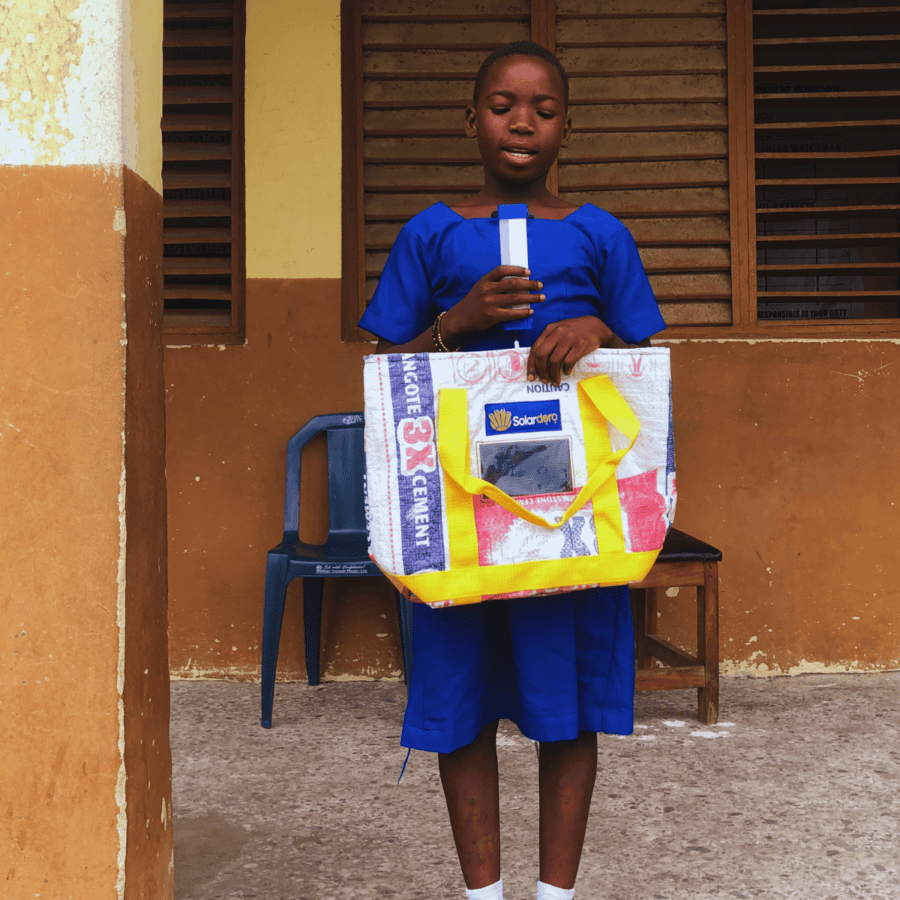
In August, Musediku Fathia, a final year primary school pupil at Roman Catholic Mission Primary School in Idata, Ibeju-Lekki Local Government Area of Lagos State, received a solar-powered bag when the organisation visited her school, just as she was preparing for her entrance examination to high school.
As a final-year primary school pupil, Fathia relies on the extra hours of light to revise lessons, complete assignments and prepare for secondary school. Like Ibiade, Idata has been without electricity for more than three decades, making the solar-powered lamp an important addition to her daily routine.
“Now with a solar bag, I don’t need to stress about looking for a lamp to do my school assignments at night,” Fathia said,
Ridwan Ajibola, a technical instructor and team leader at Skillyard Consulting Limited in Lagos, said: “Solar-powered school bags can be an effective and innovative solution to improving learning outcomes among children in rural communities without reliable access to electricity.”
Ajibola also added that the bags improve children’s safety and health by reducing exposure to smoke and fire hazards associated with kerosene lamps.
Startups across sub-Saharan Africa, such Tanzania and Uganda have also embraced solar powered bags as a solution.
But while access to affordable solar lighting can increase the number of hours children spend studying at home, improved study time does not automatically guarantee better examination results. Learning outcomes also depend on teachers’ quality, availability of learning materials, parental support and school facilities.
According to Enitan, funding remains a significant challenge, as demand far exceeds the foundation’s current capacity to provide bags, limiting its ability to reach more children in other communities. “Reaching remote communities where road access and transportation can be difficult is another barrier. This makes distribution more complicated and requires greater coordination with schools, community leaders and local partners,” he said.
For Popoola, the difference has been significant. “Having a reliable source of light to study at night has greatly improved my academic performance across different subjects,” he said enthusiastically.