
Author: Daria Prokaza
The Russian invasion of Ukraine and the barrage of rocket attacks on Ukraine’s energy infrastructure have forced the country to rebuild what’s been destroyed while reimagining its energy future at the same time. The destruction of over a quarter of Ukraine’s power generation has upped the demand for clean, renewable energy systems, decentralized energy generation, and smarter, more resilient grids. The nation’s push for a just energy transition has become a defining narrative of resilience.
An expert panel hosted by Greencubator, the Ukrainian ecosystem of green startups, brought together policymakers, investors, and entrepreneurs to explore the critical role of small and medium-sized enterprises and startups in this transformative journey.
The Future Economy is Green
Ukraine’s government has committed to climate neutrality by 2050, aligning with EU directives. Achieving this vision requires massive shifts: increasing renewable energy from 6% of total generation in 2020 to 75% by mid-century, scaling wind energy production 90 times over, and achieving zero-emission buildings. These ambitious targets come with hefty financial demands — up to €1.1 trillion in investments by 2050.
Marharyta Zhenchuk, Senior Project Manager on Climate Policy, Reform Support Team of the Ministry of Environmental Protection and Natural Resources of Ukraine, explained:
“Funding is a crucial challenge. It is estimated that from next year till 2027, we need to invest 7 to 10 billion euros, which is an impressive sum. I also wanted to give some glimpse of hope because, according to the latest estimates, in 2024, we were able to invest more than 4 billion euros into our energy system through international financial institutions. We are gradually growing our capacity to invest. Also, we have the support of our international partners, even though we need to increase our capacity to generate the required finances”.

Building on Marharyta’s points, Konstantine Kintsurashvili, Regional Lead for Climate Strategy and Delivery at EBRD, highlighted that Ukraine`s green transition also requires mobilization of private capital on a significant scale, potentially unlocking substantial new business opportunities.
“We need to be mindful that there is no future economy but a green economy. The sooner we understand this and take action, the easier it will be to create a future-proof economy and develop durable business models,” — Konstantine Kintsurashvili, Regional Lead for Climate Strategy and Delivery at EBRD.
SMEs and Startups: Green Innovations at the Core
Climate Tech startups and SMEs are at the heart of this green transition in Ukraine. From developing decentralized energy systems to enhancing energy efficiency and sustainability, these enterprises are driving innovative solutions tailored to Ukraine’s unique challenges.
For instance, Prengi, a Ukrainian facility management platform, is revolutionizing energy efficiency by helping clients reduce energy consumption by up to 18%. Initially focused on operational savings, the company embraced its role in green technology with the support of Greencubator and EBRD/EU project — Climate Innovation Vouchers. Today, Prengi operates internationally, including in the U.S., demonstrating how ideas born in Ukraine can achieve global success.
Sergey Shulga, Founder and CEO of Mondial Solutions and Prengi, highlighted both the challenges and opportunities within Ukraine’s energy landscape: “Ukraine has an energy-inefficient economy. We consume significantly more energy resources to produce goods and services than many other countries. While this poses a challenge for our economy today, it also creates significant opportunities for small businesses and entrepreneurs in Ukraine”.
Sergey also noted that energy-efficient solutions created by Ukrainian companies have already earned the trust of government institutions around the world, and therefore, they can also support Ukraine in overcoming its current challenges.
“For example, we had a meeting with the Ministry of Saudi Arabia. They consider our software to be used to grow efficiency in their facility management and sustainability in the environment. Also, we had a meeting in Kazakhstan with a government company. It’s a large company that builds schools, hospitals, and residential buildings. They also manage these properties and are considering our system for their needs,” explained Sergey Shulga.
The entrepreneur believes that addressing challenges such as energy inefficiency and sustainability requires collective action. By pooling expertise and resources, stakeholders can accelerate innovation, enhance competition, and deliver impactful solutions.
Technology is Ready, Funding Needed
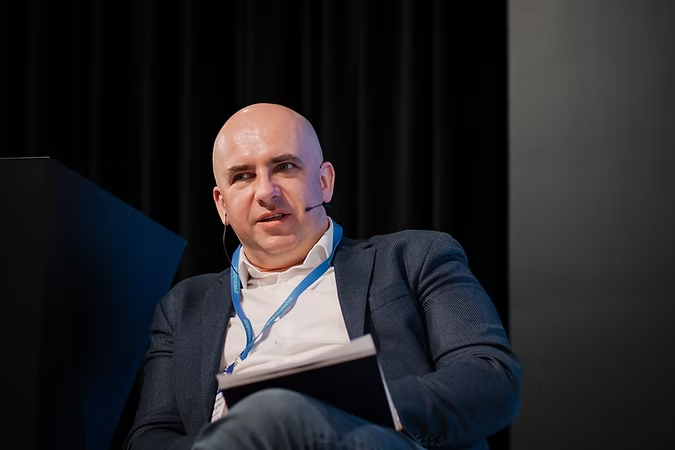
“Globally, we’re seeing a move away from the giant power station that covers an entire region. Instead, we are moving towards distributed energy systems, which are safer from attacks from the air and blackouts, as well as more resilient to environmental challenges posed by climate change”, — shared Ryan Grant Little, a Climate Tech founder, investor, and advocate for sustainable innovation.
Early in his career, Ryan Grant Little founded a renewable energy company in Canada, which he later sold to a joint venture of GE and AES, marking the beginning of his journey in green technology. Today, Ryan is the host of Another ClimateTech Podcast, where he explores insights and trends in the climate technology space.
In the context of Ukraine, he described the rebuilding effort as a unique opportunity to embrace distributed energy systems. This approach not only allows for the modernization of transmission and distribution infrastructure but also creates significant roles for small and medium-sized enterprises. To facilitate this involvement, he stressed the need for government-backed guarantees for offtake agreements with smaller companies.
“It’s important that the transition to green energy is not about technology anymore. The technology is there. It’s more cost-efficient now than building coal or natural gas. We know that now. It’s not about technology risk. It’s about getting the right financing there. To get the funding for expensive capital expenditures like energy projects means someone has to be willing to back it for 20 years or more. And I think that’s the issue that we need to see and solve in order to open up the space for small and medium players,” said Ryan Grant Little.
Empowering Climate Innovators
An example of a project in Ukraine that effectively bridges the gap between green innovation and practical implementation is the Climate Innovation Vouchers project.
Launched in 2017 by the European Bank for Reconstruction and Development (EBRD) with financial backing from the European Union (EU), the program has been implemented by the Ukrainian NGO Greencubator, which plays a critical role in driving its success. Together, these organizations have created a platform that empowers small and medium-sized enterprises to turn climate-focused ideas into actionable solutions by providing grants of up to €50,000, covering 75% of eligible costs.
With Greencubator’s deep understanding of the local ecosystem, EBRD’s financial expertise, and the EU’s commitment to sustainability, the initiative has supported 54 forward-thinking companies to date, including Guinness record-winning e-bikes Delfast; operators of e-mobility solutions TOKA, GO TO-U, a producer of eco-friendly packaging on an industrial scale S.Lab; Frendt — solutions for precision agriculture; Releaf Paper — producer of paper from fallen leaves, and many others.
“I want to say that the Climate Innovation Vouchers are a rather exceptional window of opportunity that the EBRD, as an International Financial Institution, offers to the startup community. In my opinion, the Climate Innovations Vouchers project is a benchmark and something to perhaps replicate with other International Financial Institutions as well,” said Konstantine Kintsurashvili, Regional Lead for Climate Strategy and Delivery at EBRD.
“Greencubator began nurturing the green startup ecosystem 16 years ago, long before this industry became mainstream. Through our acceleration and grant programs, we have supported a generation of entrepreneurs now driving the green transformation of many industries domestically and worldwide. As Russia targets Ukraine’s energy infrastructure, we strengthen our focus on educating businesses for energy-resiliency amidst power outages, while maintaining our programs for energy & climate-focused startups through our Greencubator projects,” — shared Roman Zinchenko, co-founder of Greencubator and coordinator of the Climate Innovation Vouchers project in Ukraine.
A Global Opportunity for Local Innovation
The rebuilding of Ukraine’s energy infrastructure offers a unique opportunity to leapfrog outdated models. As Ryan Grant Little noted, “Distributed energy is secure energy.” By focusing on localized, renewable systems, Ukraine can create a more resilient grid while setting an example for global energy transition efforts.
Ukraine’s just energy transition is more than a policy goal — it’s a testament to resilience, innovation, and the power of collective action. As SMEs and startups drive this transformation, they not only contribute to Ukraine’s recovery but also pave the way for a global shift toward sustainable energy. With the right support, these enterprises can turn a challenging moment into a defining legacy of leadership in the green economy.