
In Zimbabwe, hydroelectricity from the Kariba Dam is no longer reliable due to recurring droughts caused by climate change. Additionally, the equipment at the country’s thermal power station at Hwange is outdated and is constantly breaking down.
In the past few years, Zimbabwe has suffered long hours of electricity cuts, with some areas going for more than 20 hours a day without power. At one point late last year, the Kariba Hydropower Station, which has an installed capacity of up to 1,050 MW, was generating less than 200 MW per day. According to the International Trade Administration, Zimbabwe’s installed capacity is 2,800MW against the national demand of 5,000 MW needed to support industry and households in the country fully.
To ease the electricity crisis, the Intensive Energy User Group—a consortium of mining companies in Zimbabwe—is planning to develop a floating solar power plant at Kariba Dam. Kariba Dam, which lies along the border between Zimbabwe and Zambia, is the largest manmade dam in the world. Constructed in 1959 on the Zambezi River, Kariba Dam extends for 170 miles and can hold up to 180.6 cubic kilometers of water.
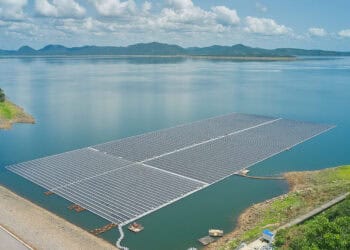
Experts say the global demand for clean energy is increasing against the backdrop of climate change. This rising demand for clean energy has seen the development of floating solar projects, also known as “floatovoltaics,” in various countries across the globe. These floating solar projects are alternatives to land-based solar installations. Some of the notable floating solar projects include Dezhou Dingzhuang Floating Solar Farm, Three Gorges New Energy Floating Solar Farm, and CECEP Floating Solar Farm, all in China; Sembcorp Floating Solar Farm in Singapore; and Sirindhorn Dam Floating Solar Farm in Thailand.
A recent study reveals that “floating solar photovoltaic systems are rapidly gaining traction due to their potential for higher energy yield and efficiency compared to conventional land-based solar photovoltaic systems.” The technology, studies have indicated, generates 0.6 percent to 4.4 percent more energy and exhibits efficiency improvements ranging from 0.1 percent to 4.45 percent over land-based solar power plants.
Eddie Cross, the chairman of the Intensive Energy User Group, said the US$250 million floating solar project in Zimbabwe would be developed in two phases, each of 500 MW. Upon completion, the Kariba floating solar project will be the first major solar energy project in Zimbabwe and one of the largest floating solar installations in the world.
“It is expected to be operated as a hybrid power plant using solar-generated power, power stored in large batteries, and the generation capacity at the dam wall,” Cross said.

Amid fears that the floating solar project could affect Kariba Dam’s rich aquatic life, Cross assured that Phase One of the project would involve 400 hectares of the lake, “which is totally insignificant.”
“Kariba is still the largest manmade lake in the world,” he added.
A recent article by Paula Mazza and Simone Cardoso from the Federal University of Juiz de Fora, Brazil, and Rafael Almeida from Indiana University, U.S.A., revealed that floating photovoltaics offered numerous benefits, and their potential negative impacts on aquatic ecosystems were still under investigation.
“A growing body of research demonstrates that the reduction of sunlight penetration caused by solar panels can reduce water temperature and dissolved oxygen levels, but how does aquatic life respond to such changes in the environment?” the team wrote.
They added that most of the recent studies reported a decrease in phytoplankton and cyanobacteria, microscopic algae and bacteria capable of photosynthesis, especially as the panel coverage increases.
“This seems to support the potential of FPV in reducing algal blooms, but the process appears more complex than initially thought,” they said.
Cross added that a full-scale feasibility study for the Kariba floating solar project was underway and should be completed in 6 months. “Construction [will] start in the second quarter of 2026 with completion in mid-2027.”
He further cited benefits of the floating solar project, including how floating solar panels were cooler because they were on the water and therefore more productive. Additionally, Cross explained how this project “does not use valuable land and is easier to clean. It has the capacity to increase the base load output of the hydropower plant by a third. It will also help make the best use of available water for power generation.”
Ramanan C J, an international researcher affiliated with the Curtin University Malaysia campus (an Australian Public University) who was part of this study, told The Energy Pioneer that, among others, the significant benefits of the floating solar power plants were that they save land, especially in regions with land scarcity.
The floating solar panels, he added, also prevent water evaporation and can be integrated into existing hydropower reservoir dams like the Kariba Dam. “This also provides shared grid transmission,” Ramanan C J added.
He outlined how there was a performance improvement in floating solar panels due to cooling compared to a land-based system. “However, this is still a dilemma and research is ongoing,” he said.
But citing data from the NREL, USA’s 2021 research, Ramanan C J explained how floating solar systems had a higher installation cost of about $0.26/WDC, which is 25 percent more than ground-mounted systems, mainly due to the much higher structural costs, around 300 percent for floats and anchoring.
He added, “I think that we can customize the floating structure with reasonable adjustments according to the local weather conditions.”
He added that there was confusion in the performance of floating photovoltaics compared to land photovoltaics. “Floating solar is still in its early stages, with no established standards and uncertain conclusions. Improved designs and technology could reduce costs over time,” he said.