
The Energy Pioneer
No Result
View All Result
  • Home
  • Clean Tech
  • Renewable Energy
  • Green Finance
    • Crash Course
    • Private Financing
    • Public Financing
    • Carbon Markets
  • Policy
  • Regions
    • Africa
    • Asia
    • West Asia
    • Latin America
    • North America
    • Europe
  • Features
  • Who We Are
    • About Us
    • Contact Us
    • EP Investing
  • Home
  • Clean Tech
  • Renewable Energy
  • Green Finance
    • Crash Course
    • Private Financing
    • Public Financing
    • Carbon Markets
  • Policy
  • Regions
    • Africa
    • Asia
    • West Asia
    • Latin America
    • North America
    • Europe
  • Features
  • Who We Are
    • About Us
    • Contact Us
    • EP Investing
No Result
View All Result
The Energy Pioneer
No Result
View All Result
  • Home
  • Clean Tech
  • Green Finance
  • Policy
  • Renewable Energy
  • Regions
  • Features
  • Who We Are
Home Africa

In East Africa, Solar Energy Can Save Vaccines

byWinile Ximba
April 1, 2026
Reading Time: 5 mins read

Extreme weather is menacing Tanzania and Kenya, the two ‘tiger economies’ of East Africa. Kenya and Tanzania are neighboring nations with a combined GDP of $250 billion, yet their economies remain vulnerable. As floods and droughts intensify, the damage to coal and hydroelectric power grids is immense. 

RELATED POSTS

RE100: Corporate Demand for Renewable Energy Is Outpacing Market Readiness

Zimbabwe Civil Society Groups Rally Behind Buhera Residents Amid Lithium Mining Dispute

Closing the Circle: How Morocco Is Building a Wind Energy Supply Chain

“Each time extreme drought or flooding arrives, the hit to electricity generation, transmission grids and lost productivity costs upwards of $700mn just here in Kenya,”  Joseph Siror, the chief executive of the Kenya Electricity Transmission Company, the largest state-owned power utility in East Africa.

Droughts and floods increasingly damage hydro-generators, power lines, pylons, and transformers. In a region where climate insurance remains unfamiliar, hospital infrastructure is at risk from changing weather patterns. The interruption of electricity supplies compromises the integrity of cold storage for medicines and vaccines, especially those intended for remote rural hospitals, explained Seif Shekalaghe, the permanent secretary of Tanzania’s health ministry.

From the team behind The Energy Pioneer — EP Network is where the energy transition connects.

Explore →

“We have to act quickly, find futuristic solutions because in (an) age of climate extremities – throwing away medicines costs lives and money,” he says of the importance of off-grid renewable energy.

The deployment of Chinese-made solar fridges powered by mini solar power plants is helping bolster pharmaceutical cold storage chains in vulnerable rural hospitals, keeping critical medications fresh when heat or floods damage power lines.
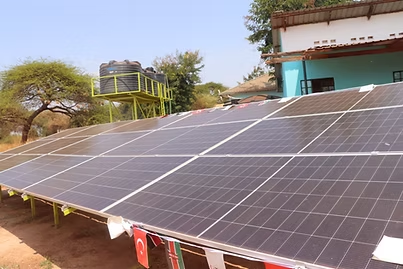
A mini solar field at a rural hospital in Tanzania. Photo Credit Winile Ximba

A Journalist for The Energy Pioneer toured Turkana and Kagera, the two poorest rural districts in Kenya and Tanzania, respectively – places where just 20% of homes and facilities are connected to the national hydroelectricity/coal power grids.

“Securing meds, vaccines especially those Varicella and MMRV vaccines, (which must be frozen between -50°C and -15°C), was a huge issue each time floods meant two weeks of powerlines down,” says Dr Inno Kong, a visiting physician who supervises procedures at Namoruputh Health Centre, one of the major hospitals in the remotest regions of Turkana, northern Kenya.

Buy JNews
ADVERTISEMENT

Namoruputh, which serves 40,000 rural patients annually, was only connected to Kenya’s hydroelectric grid 10 years ago. Since then, whenever extreme floods or heat strike Turkana, thousands of medical supplies and vaccines are discarded. This was a difficult decision until 2022, when modular solar plants were installed on its premises. Pharmacy fridges can now operate without interruption, even after floods.

With solar modular plants automatically supplying power to hospital fridges during floods or droughts, nurses are trained to safely and quickly transfer vaccines from electric-powered fridges to solar-powered backup fridges. This maintains the correct temperature range for the specific vaccines and minimizes temperature fluctuations until normal power is restored.

“This is a game changer,” Nyono Yasim, the head of hospital operations at Kagera Regional Hospital in neighboring Tanzania’s poorest district. Pharmacy fridges automatically operate on solar power when hydro or thermal power lines are down, such as during extreme heat or floods. The critically important job of dispensing vaccines and medicines to patients, even in the aftermath of devastating floods no longer stops, he says. “With solar, medicines (using) cold storage stays online. Whilst we can’t control climate extremes, we can save lives by preserving vital medicines in solar fridges, he says.

Due to infrastructure deficits, access to hydroelectricity in Kenya can be as low as 25% of households in some rural districts. However, nationally, the country has made ‘tremendous’ progress in reducing energy inequality. In neighboring Tanzania, the rural energy access situation is likewise concerning. Only 24% of rural households and facilities have access to the country’s power grid, according to the World Bank.

A technician installing solar lithium-ion batteries in a hospital in Tanzania. Photo Credit Winile Ximba.

Before solar fridges powered by rechargeable lithium-ion batteries were rolled out in rural Tanzania, each time there was an extended power outage due to floods, healthcare workers binned some critical vaccines like those for rotavirus, tetanus, and certain antibiotics like (Amoxicillin/clavulanate suspension) because they needed ambient cold temperatures to remain safe, Yasim adds.

But now, across rural East Africa, cheap Chinese-made PV solar panels and portable lithium-ion batteries are creating a network of mobile ‘mini grids’ for low-income rural clinics, he says. “In the last 5 years, we have equipped 36% of all hospitals in Tanzania’s rural with PV solar systems as (a) defense against climate damage of clinical cold-storage assets. We aim to reach 50% in (the) next two years,” Shekalaghe reveals.

At a large scale across Kenya and Tanzania over the last 7 years, partners like the UN have also joined, supporting the health ministry in strengthening cold storage for medicines in hospitals and medical warehouses.

“We no longer panic,” says Kong, the rural doctor in Turkana, Kenya.

Even when drought or floods meant that power lines connecting hospitals remained unrepaired for four months, the critical rotavirus, tetanus vaccines, and certain antibiotics were kept cool and fresh because the solar battery-powered fridges continued to operate.

“It’s such a cool thing to see for us as medics – renewable energy adding an extra protection to emergency medicines,” he concludes.
Finished the story? Meet the people behind it.

EP Network is where energy journalists, investors, companies, and clean energy leaders connect.

Join EP Network →
ShareTweetShare
Winile Ximba

Winile Ximba

Related Posts

RE100: Corporate Demand for Renewable Energy Is Outpacing Market Readiness
Policy

RE100: Corporate Demand for Renewable Energy Is Outpacing Market Readiness

July 30, 2026
Zimbabwe Civil Society Groups Rally Behind Buhera Residents Amid Lithium Mining Dispute
Policy

Zimbabwe Civil Society Groups Rally Behind Buhera Residents Amid Lithium Mining Dispute

July 29, 2026
Closing the Circle: How Morocco Is Building a Wind Energy Supply Chain
Wind

Closing the Circle: How Morocco Is Building a Wind Energy Supply Chain

July 29, 2026
Agrivoltaics in Bangladesh: Growing Food and Solar Power on the Same Land
Solar

Agrivoltaics in Bangladesh: Growing Food and Solar Power on the Same Land

July 27, 2026
How the Viet Nam-Thailand-Malaysia-Singapore Framework Could Accelerate ASEAN Power Grid Integration
Energy Efficiency

How the Viet Nam-Thailand-Malaysia-Singapore Framework Could Accelerate ASEAN Power Grid Integration

July 23, 2026
GH2 Warns Water Security Will Be Critical to Namibia’s Green Hydrogen Ambitions
Green Hydrogen

GH2 Warns Water Security Will Be Critical to Namibia’s Green Hydrogen Ambitions

July 22, 2026
Next Post
The Making of a Middle Power: Angola’s Lobito Corridor

The Making of a Middle Power: Angola’s Lobito Corridor

Morocco Bets on Solar Desalination to Tackle Water Stress

Morocco Bets on Solar Desalination to Tackle Water Stress

Popular Stories

  • The Race to Host AI: Data Centres in Water-Scarce India

    The Race to Host AI: Data Centres in Water-Scarce India

    0 shares
    Share 0 Tweet 0
  • Vietnam’s Oil Buffer Faces Pressure as the Iran War Disrupts Global Oil Flows

    0 shares
    Share 0 Tweet 0
  • Caught Between India’s Military Ambitions and Green Promises: The Future of the Andaman and Nicobar Islands

    0 shares
    Share 0 Tweet 0
  • The Philippines’ Nuclear Gamble

    0 shares
    Share 0 Tweet 0
  • South Sudan’s Missed Opportunity: Untapped Renewables Leave Millions in the Dark

    0 shares
    Share 0 Tweet 0

Actionable Info

From The Energy Pioneer

Where the energy transition connects.

Journalists, investors, companies, and clean energy leaders — all in one network.

Explore EP Network →

The Energy Pioneer

The Energy Pioneer covers the global energy transition — from clean tech and green finance to policy and renewable energy.

Recent Posts

  • RE100: Corporate Demand for Renewable Energy Is Outpacing Market Readiness
  • Zimbabwe Civil Society Groups Rally Behind Buhera Residents Amid Lithium Mining Dispute
  • Closing the Circle: How Morocco Is Building a Wind Energy Supply Chain

Quick Links

  • Home
  • Clean Tech
  • Renewable Energy
  • Green Finance
  • Policy
  • Regions
  • Features
  • Who We Are

© 2026 The Energy Pioneer | All Rights Reserved. |

From The Energy Pioneer

You read about the energy transition. EP Network connects you to it.

Join the network of journalists, investors, companies, and professionals building the clean energy future.

No thanks
Please enter a valid email.
You're in. We'll be in touch soon.
No Result
View All Result
  • Home
  • Clean Tech
    • Electric Vehicles
    • Energy Efficiency
    • Green Hydrogen
    • Smart Grid
    • Battery Storage
  • Green Finance
    • Public Financing
    • Private Financing
    • Carbon Markets
  • Policy
  • Renewable Energy
    • Wind
    • Solar
    • Hydropower
    • Nuclear
    • Hydrogen
    • Fossil Fuels
    • Geothermal
  • Regions
    • Africa
    • Asia
    • Europe
    • North America
    • Latin America
    • West Asia
  • Features
  • Who We Are
    • About Us
    • EP Investing
    • Contact Us

© 2026 The Energy Pioneer | All Rights Reserved. |