
Chipendeke area is a thriving farming community about 65 kilometers south of Zimbabwe’s eastern border city of Mutare. In this part of the country, farmers grow various crops, from the staple maize to leafy and fruiting vegetables.
After a day’s work on the farm, a farmer is now assured of an ice-cold beer or a soft drink at the local business center, thanks to electricity from a local micro hydropower station. Alongside the business center, the local school and clinic have also been electrified.
Mini-power stations, particularly solar and hydro mini-grids, are revolutionizing Zimbabwe’s rural communities by providing clean, reliable electricity. These initiatives are transforming lives, fostering economic growth, and improving access to essential services.
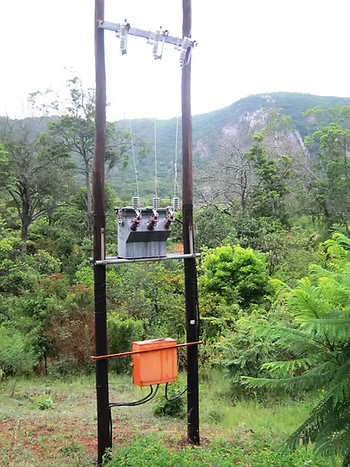
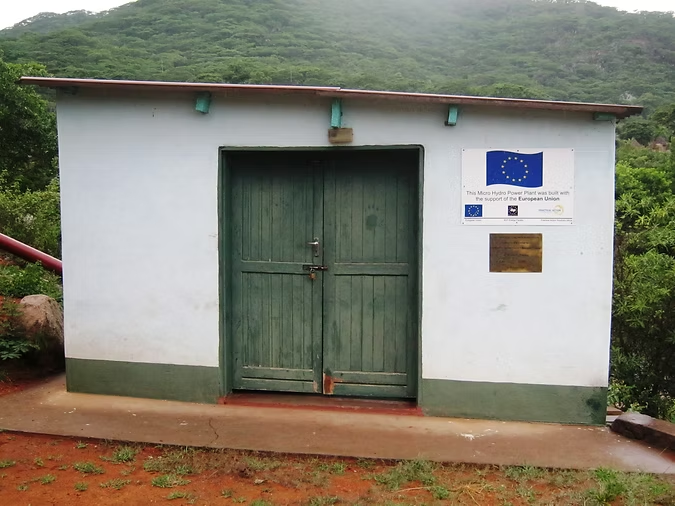
Chipendeke is a rural settlement tucked at the foot of mountain ranges that form part of Zimbabwe’s Eastern Highlands. While the area is far from the national grid, a few years ago, the European Union donated $65,000 for the Chipendeke Micro-Hydropower Project through the African Caribbean Pacific Energy Facility. An international nongovernmental organization, Practical Action, implemented the project. The 25 kW micro-hydro plant is situated along Chitora River.
A study published by the IEEE Journals & Magazine reveals that since the inception o
f micro hydropower, this community has registered considerable development.
“After the micro-hydro project, a rapid increase in energy demand was observed, and a forecast of future demand growth was estimated in the Chipendeke community. Chipendeke has proven that it thrives with the use of electricity, with improvements at the health center, education, and businesses,” the researchers say.

However, the researchers were quick to caution that due to climate change, rainfall had dropped, making the micro-hydro project alone incapable of meeting the energy demand and its growth.
“Hence, implementation of a hybrid REPS could provide opportunities to extend the health services, education, and business as well as to improve the social living standards,” the researchers add.
However, across Zimbabwe, rural communities are benefiting from microgrids, both solar and hydro. They are enabling local businesses and agricultural activities to thrive. Clinics and schools are benefiting from reliable electricity, allowing them to provide better healthcare and education services. At the same time, women are gaining economic independence through initiatives like solar-powered grain mills.
The Zimbabwean government has made off-grid solar provision part of its national energy strategy, with initiatives like the Climate Adaptation Water and Energy Infrastructure Programme (CAWEP) supporting rural electrification. Collaborations between the government of Zimbabwe, the United Nations Development Programme (UNDP), private sector companies, and other nongovernmental organizations are driving the development of mini-grids and promoting sustainable energy solutions.
Similarly, the Hakwata 200 kW solar microgrid system in Chipinge district is powering the local clinic, school, and shops and providing reliable power to more than 80 households. The Hakwata solar project was funded to the tune of US$614,000, which is part of the broader US$13.6 million Climate Adaptation Water and Energy Programme. It is meant to assist rural communities in adapting to and building resilience against the impacts of climate change. It is funded by the government of the United Kingdom and delivered in partnership with UNDP Zimbabwe, the Rural Electrification Fund, and the Zimbabwe government.
“The microgrid will not only bring clean power to the Hakwata community but also sets the example for similar renewable energy projects across the country, designed to bridge the energy access gap in remote areas, providing rural communities with reliable and clean energy,” the UNDP Resident Representative Dr. Ayodele Odusola said at the commissioning of the project last year.
The 1.6 MW Kupinga small hydropower station at Rusitu River in Chimanimani district has begun generating electricity. According to Renewable Energy World, the Zimbabwe-based integrated financial group Old Mutual funded about US$5.7 million for the project through a joint venture company, Kupinga Renewable Energy Private Ltd, formed between Old Mutual and various individuals. Another project, the Hauna Hydroelectric Power Station—a 2.3 MW station on the Ngarura River in Mutasa district—is already transforming the local community.
Zimbabwe development expert and gender justice advocate, Linda Tsungirirai Masarira, told The Energy Pioneer that as Zimbabwe continues to strive for inclusive development and equitable access to basic services, the emergence of mini and micro-grids, particularly solar and small-hydro systems, has become a cornerstone of rural transformation.
“These community-based energy solutions are not only bridging the rural-urban energy divide but also catalyzing sustainable livelihoods and social progress,” says Masarira, who is also the president of a political party, Labour Economists and African Democrats (LEAD).
She says that for many years, rural communities have remained in darkness due to the high cost of extending the national grid.
“Today, mini and microgrids are democratizing energy access, lighting up schools, clinics, and homes that once depended on firewood and candles. This is a crucial step towards achieving universal access to affordable and clean energy, in line with Sustainable Development Goal 7,” Masarira explains.
Masarira says access to electricity is revitalizing rural entrepreneurship, supporting welders, small-scale millers, agro-processors, and other cottage industries.
“Electrified irrigation systems are enhancing food production and resilience against droughts, while rural women and youth are finding new income streams through energy-enabled micro-enterprises,” she says.
In electrified communities, Masarira adds that clinics can now refrigerate vaccines, power medical equipment, and offer safer maternal health care. Schools benefit from digital learning and extended study hours.
“This is driving tangible improvements in health and education outcomes, particularly in remote districts,” she says.
She says women bear the brunt of energy poverty, and renewable microgrids reduce the time women spend collecting firewood, minimize exposure to indoor smoke, and open pathways for entrepreneurship and empowerment. Masarira outlines that in this sense, clean energy is a feminist and climate justice issue, one that restores dignity, productivity, and equality.
She then explains that to sustain this transformation, Zimbabwe must strengthen its policy environment to encourage community ownership models, affordable tariffs, and local technical capacity building.
“Partnerships between government, private investors, and communities will ensure that mini-grid systems are maintained and scaled up sustainably. Innovative financing models such as pay-as-you-go solar, carbon credits, and green bonds should also be explored. Mini and microgrids represent energy democracy in action, where access to power literally empowers the people. They illuminate not just homes, but the path to economic inclusion, gender equity, and environmental sustainability,” she explains.
Mini-grids have the potential to transform Zimbabwe’s rural communities, providing clean, reliable energy and driving economic growth. With continued investment and support, these initiatives can help bridge the energy access gap and improve the lives of millions of Zimbabweans.