


Unlike many larger countries, Bangladesh cannot easily set aside vast stretches of unused land for utility-scale solar farms. Every hectare allocated to energy production could mean one less hectare available for agriculture. This is a growing concern in a country where cultivable land is already shrinking due to urbanisation, industrial expansion and climate change. As the nation seeks to strengthen energy security while feeding a growing population, the challenge is no longer choosing between food and clean energy, it is finding ways to achieve both.
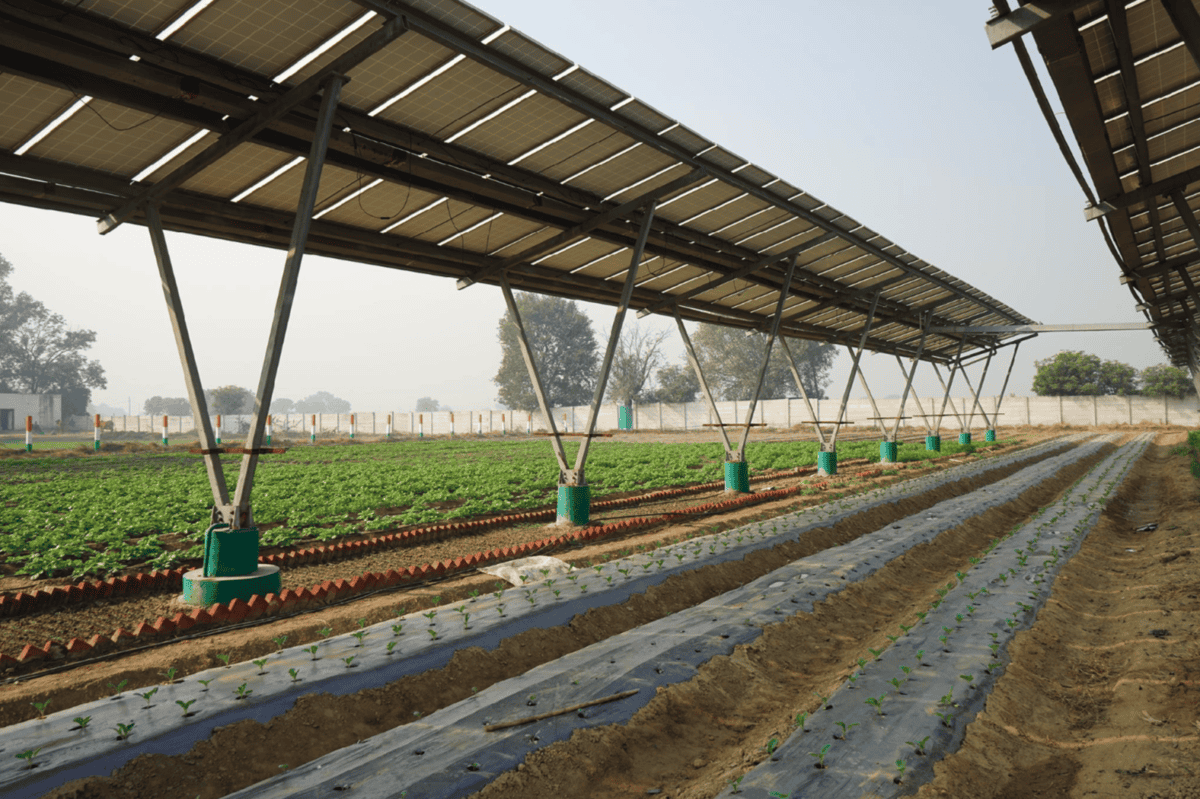
Agrivoltaics, or AgriPV, offers one such opportunity.
Agrivoltaics combines solar photovoltaic panels with crop cultivation on the same piece of land, enabling simultaneous food and energy production. Instead of replacing farms with solar installations, crops can be grown, livestock reared or other agricultural activities carried out beneath or between elevated solar panels. The concept is simple: one landscape, two outputs – food and electricity.
For Bangladesh, this approach could help transform a perceived land-use conflict into a shared opportunity.
Meeting Climate Goals Without Sacrificing Farmland
Bangladesh’s Renewable Energy Policy 2025 has set ambitious targets of generating 20 percent of electricity from renewable sources by 2030 and 30 percent by 2040. Solar energy will play a central role in achieving these goals, but land availability remains one of the biggest constraints to large-scale deployment.
Bangladesh has also committed, through its Nationally Determined Contributions (NDCs), to reducing greenhouse gas emissions while strengthening climate resilience across sectors. The country is also working to improve food security, protect agricultural land, promote efficient water use and build climate-resilient farming systems.

Depending on crop type and local conditions, well-designed agrivoltaics systems may reduce heat stress, lower soil moisture evaporation and improve water-use efficiency. These benefits are becoming increasingly valuable as rising temperatures and erratic rainfall affect farming across South Asia.
Rather than viewing energy, agriculture and climate adaptation as separate challenges, agrivoltaics encourages integrated solutions that maximise the value of limited land.
Bangladesh is Building Momentum
Research institutions, government agencies, development partners and private companies are testing different approaches to dual land use. Pilot initiatives are exploring crop cultivation and poultry farming within solar facilities, while a National Working Group on Agrivoltaics and Floating Solar has been established to coordinate policy discussions, technical learning and investment planning.
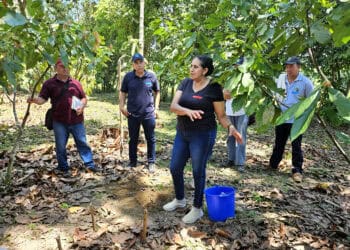
In Kushtia and Chuadanga, locally cultivated crops such as turmeric, ginger, tomatoes and cucumbers are growing around existing solar infrastructure, highlighting the practical opportunities for integrating agriculture with future agrivoltaic systems.
These developments indicate that Bangladesh is entering a new phase of renewable energy planning, one that recognises agriculture and energy production do not always have to compete. Yet important questions remain. Which crops grow best beneath solar panels? How high should panels be installed? How much shade is beneficial? How should irrigation systems be adapted? Most importantly, will farmers earn more from agrivoltaics than from conventional farming?
The answers will determine whether agrivoltaics becomes a niche innovation or a scalable national solution.
Lessons from India
Bangladesh does not have to start from scratch. India has emerged as one of the world’s leading laboratories for agrivoltaics, with research institutions, state governments and private developers testing a range of system designs.
Projects in several states have demonstrated that vegetables, spices, fodder crops and pulses can be successfully cultivated beneath elevated solar panels. In some cases, farmers have benefited from improved microclimates, lower irrigation requirements and an additional income stream from electricity generation. At the same time, India’s experience shows that agrivoltaics is not simply about installing solar panels over farmland. System design matters. Panel height, spacing, orientation and row distance all influence crop growth. Different crops respond differently to shade. Economic models must ensure that farmers share fairly in the financial benefits, while maintenance activities should not interfere with agricultural operations.
These lessons are relevant for Bangladesh, where farming systems vary considerably between floodplains, coastal areas, drought-prone regions and irrigated agricultural landscapes.
Science Before Scaling
Agrivoltaics should be implemented through a context-specific framework rather than a one-size-fits-all solution, taking into account agroecological suitability, water resources, market demand and farmer preferences.
Being a rice dominated country Bangladesh needs a promising model for integrating rice cultivation with solar energy generation while balancing crop productivity and electricity generation on the same land. A single-axis solar tracking system can be installed at sufficient height allowing for rice cultivation, mechanized farming and water management practices.
In existing solar installations, conventional ground-mounted systems can be retrofitted by increasing panel height, widening row spacing and improving structural clearance, enabling the cultivation of high-value vegetables without significantly compromising energy generation.
New models, such as monopole Agri-PV designs, offer greater flexibility by reducing the number of ground foundations, thereby minimizing interference with cultivation and facilitating water management. These approaches are particularly suitable for Bangladesh, where land scarcity necessitates dual-use solutions that enhance farm profitability, improve land-use efficiency, and support the simultaneous achievement of food production and renewable energy goals.
Determining the most suitable models requires scientific evidence rather than assumptions. Researchers need to understand how different crops respond to varying levels of shade, how water demand changes under solar panels, how soil conditions evolve over time and whether integrated systems remain profitable over many years. Equally important are the social dimensions like farmer acceptance, labour requirements, land tenure arrangements and equitable benefit sharing.
Without this evidence, scaling agrivoltaics would carry unnecessary risks for both investors and farming communities.
From Pilot Projects to National Policy
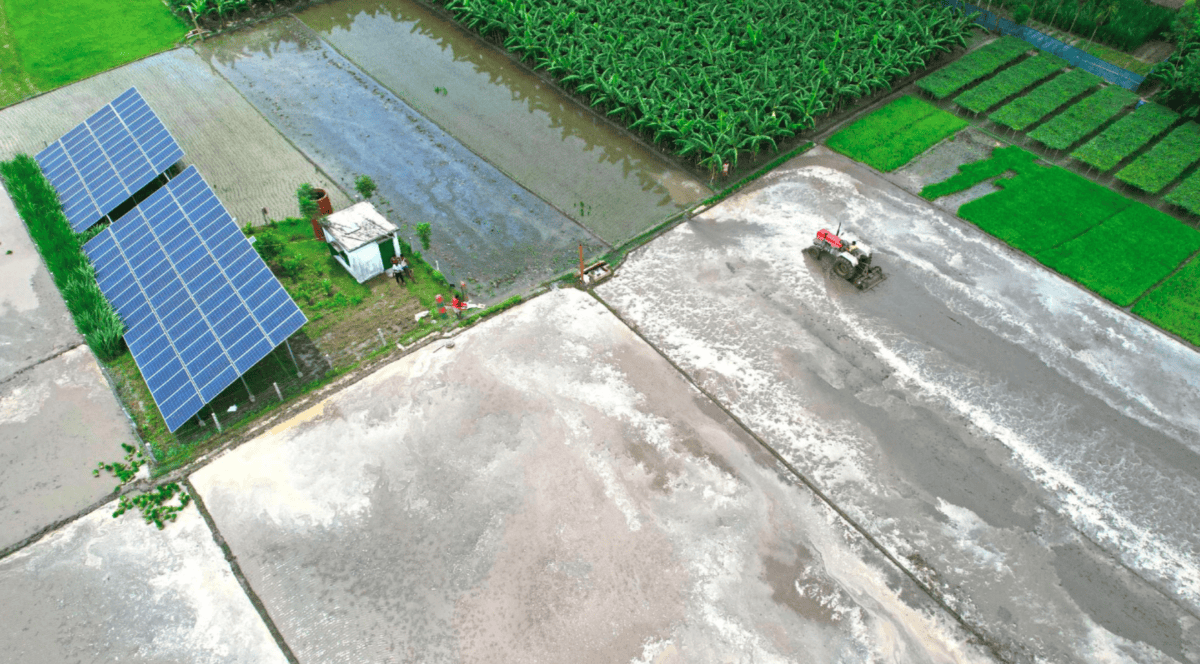
The growing interest in agrivoltaics presents Bangladesh with an opportunity to shape a uniquely local model based on its own agricultural systems, climate conditions and development priorities. Several organisations are contributing to this emerging knowledge base. Research institutions are evaluating economic viability, development partners are supporting demonstration projects, and government agencies are examining policy frameworks that could encourage wider adoption.
The International Water Management Institute, in partnership with the Infrastructure Development Company Limited and Eco-Social Development Organization, is developing a pilot agrivoltaic system under the Solar Energy for Agricultural Resilience project, supported by the Swiss Agency for Development and Cooperation. The intervention aims to generate evidence on how renewable energy, water management and agricultural production can be effectively integrated under Bangladesh’s agroecological conditions, helping farmers become more resilient to climate variability while reducing dependence on costly fossil fuels, lowering irrigation costs and supporting sustainable agricultural livelihoods.
The value of these interventions extends beyond individual demonstration sites. Collectively, they can generate the evidence needed to guide future investment, inform national policy and reduce uncertainty for farmers and private investors alike.
Agrivoltaics will not replace conventional agriculture, nor should it. Agrivoltaics is not a silver bullet. It will not be suitable for every crop, landscape or farming system. However, where conditions are right, it offers a practical way to produce food and clean electricity from the same land, increasing land productivity while strengthening climate resilience, supporting Bangladesh’s renewable energy transition and rural livelihoods, and advancing the country’s low-carbon development ambitions.
In a country where every hectare counts, the future may not lie in choosing between solar farms and agriculture. It may lie in designing landscapes where both can thrive together.
The authors work with International Water Management Institute.