
The Energy Pioneer
No Result
View All Result
  • Home
  • Clean Tech
  • Renewable Energy
  • Green Finance
    • Crash Course
    • Private Financing
    • Public Financing
    • Carbon Markets
  • Policy
  • Regions
    • Africa
    • Asia
    • West Asia
    • Latin America
    • North America
    • Europe
  • Features
  • Who We Are
    • About Us
    • Contact Us
    • EP Investing
  • Home
  • Clean Tech
  • Renewable Energy
  • Green Finance
    • Crash Course
    • Private Financing
    • Public Financing
    • Carbon Markets
  • Policy
  • Regions
    • Africa
    • Asia
    • West Asia
    • Latin America
    • North America
    • Europe
  • Features
  • Who We Are
    • About Us
    • Contact Us
    • EP Investing
No Result
View All Result
The Energy Pioneer
No Result
View All Result
  • Home
  • Clean Tech
  • Green Finance
  • Policy
  • Renewable Energy
  • Regions
  • Features
  • Who We Are
Home Clean Tech

The Importance of New Technologies for Grid Development

Otto GundersonbyOtto Gunderson
April 1, 2026
Reading Time: 3 mins read

With the anticipated growth in energy demand, the creation of a “smart grid” can improve distribution, incorporate more renewable projects, and handle the expected increase from EVs, data centers, and AI. Rather than pressuring utilities into a costly, time-intensive, and hardware-based improvement for every line in the country, new technologies that provide similar benefits can reduce cost and prevent delays. These technologies encompass both hardware and software innovations, with applications that range from enhanced efficiency to mitigating the effects of disasters. By adopting new technologies now, utilities can build a transmission grid well-positioned for an efficient and resilient renewable-based economy.

RELATED POSTS

Zimbabwe’s Growing Solar Garbage Problem

A Policy Lag in Zimbabwe’s Energy Sector

David Energy, Distributed Energy Resources, and the Future of the Grid

Updating the power grid in the United States is a necessity, but has thus far proven to be an expensive and slow process. This is partly due to the current state of the infrastructure. Kaitlyn Albertoli, Co-founder and CEO of Buzz Solutions, explained that utilities cannot simply “build their way out” of their current situation. Albertoli outlined how providing utilities with accurate information regarding asset location is critical to improving resiliency and efficiency, enabling improvements to be made where they are most needed. Similarly, using AI technologies to analyze thousands of images and structures can play a role in preventing grid strain and allow for more efficient and targeted upgrades.

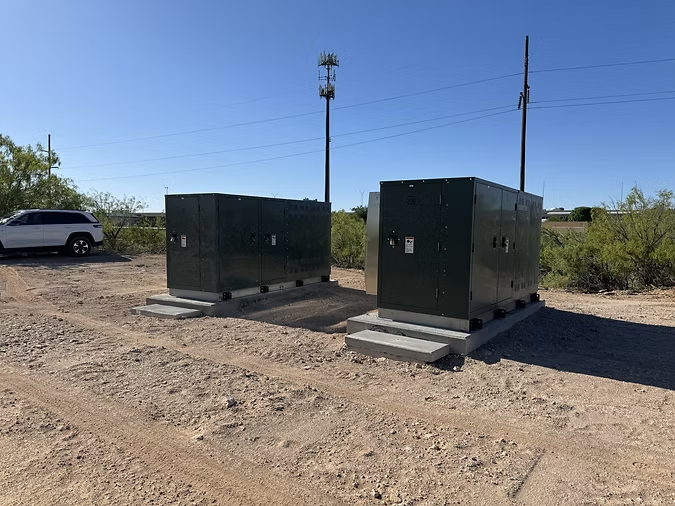
Rather than shouldering the cost of updating an entire grid infrastructure, utilities may turn to new technologies, which allow for better flows of both electricity and information at a fraction of the cost. One of these new technologies, developed by the Chicago-based company Switched Source, enables power grids to allocate power more effectively in the event of a disruption. Utilities can use these automation tools to locate outages, develop load management, and improve distribution. During a tour of the Switched Source Facility, Switched Source Co-Founder and President Charles Murray outlined how utilities already stretched to the limit can utilize new technologies to increase capacity by 10-15% in a matter of hours, for a fraction of the cost of upgrading an entire network.
From The Energy Pioneer

Meet EP Investing — now live and free through July 15th.

1,300+ companies · 350+ investors · 185+ grants. Capital discovery for the energy transition.

EP Investing is now live
Register Free →
New technologies, such as the Phase EQ, allow for greater resiliency and a 10-15% capacity increase without the need to rebuild grid infrastructure. Photo Provided by Switched Source

Grid improvement technologies will also prove crucial in the addition of new distributed generation renewable energy projects. An article by the Institute of Electrical and Electronics Engineers (IEEE) found that constant communication between renewable projects and a smart grid would allow for less downtime and optimize energy usage. Additionally, smart grids can incorporate renewable energy projects while limiting the need for expensive and slow-moving infrastructure build-out.

To best understand where changes need to be made to the grid, vast amounts of data must be gathered continuously. Colin Gibbs, Vice President at Sense, outlined how new software platforms can provide a constant stream of information back to the user. These platform, which allows for 15,000 reads per second, can reduce strain on the power grid while generating savings for owners. For instance, homes with electric vehicles would be able to optimize charging times. Using raw electrical signals can facilitate an understanding of exactly where energy is being used and how to utilize it more efficiently. Additionally, the methods of communication used at Sense are bi-directional, meaning the utility can monitor real-time data to see faults in a distribution network, reducing downtime.

In certain situations, forgoing interconnection and relying instead on microgrids may be the best solution. This is particularly true for large power users, such as data centers. Kevin Pratt, Chief Operating Officer at Pacifico Energy, explained how microgrids are a strong alternative in situations where a single off-taker could require the same amount of power as a whole line of small off-takers. As Pratt outlined, requiring the utility to build new distribution lines to power something as large as a data center is not only expensive and slow-moving but could negatively affect power access to other people on the grid. This would undoubtedly be a case where utilities should not attempt to “build their way out”. 

While all of these technologies, along with many others currently in testing and production, will contribute to improvements across the transmission grid, they will not replace the need for certain infrastructure upgrades. As a report from Grid Strategies outlines, electricity demand is expected to grow 15.8% by 2029. Undoubtedly, utility companies will need to construct new transmission lines and upgrade their infrastructure to varying degrees. However, new technologies can improve this process, increase grid efficiency, and facilitate the growth of green energy.

Buy JNews
ADVERTISEMENT
From The Energy Pioneer

Meet EP Investing — now live and free through July 15th.

1,300+ companies · 350+ investors · 185+ grants. Capital discovery for the energy transition.

EP Investing is now live
Register Free →
Tags: energy distributionnew techrenewablessmart gridtechnologies
ShareTweetShare
Otto Gunderson

Otto Gunderson

Otto Gunderson has been working in clean energy for the last 7 years, with the last two being spent split between South America, Africa, and Southeast Asia, reporting on the transition to clean energy. After traveling and writing for two years, he founded The Energy Pioneer to create a news outlet with a global approach to clean energy journalism. He particularly enjoys writing about entrepreneurship, investment, and innovations that are contributing to greenhouse gas reduction and clean energy development.

Related Posts

Zimbabwe’s Growing Solar Garbage Problem
Solar

Zimbabwe’s Growing Solar Garbage Problem

June 12, 2026
A Policy Lag in Zimbabwe’s Energy Sector
Features

A Policy Lag in Zimbabwe’s Energy Sector

June 15, 2026
David Energy, Distributed Energy Resources, and the Future of the Grid
Smart Grid

David Energy, Distributed Energy Resources, and the Future of the Grid

June 10, 2026
The Sargassum Paradox: Why the Caribbean’s Clean Energy Hope is a Supply Chain Trap
Clean Tech

The Sargassum Paradox: Why the Caribbean’s Clean Energy Hope is a Supply Chain Trap

June 8, 2026
Who Really Pays When the Lights Go Out?
Public Financing

Who Really Pays When the Lights Go Out?

June 4, 2026
EV Tax Breaks Will Fail Without Charging and Power-Sector Reform
Features

EV Tax Breaks Will Fail Without Charging and Power-Sector Reform

June 2, 2026
Next Post
Cooling the AI Boom: Innovative Strategies for Greener Data Centers

Cooling the AI Boom: Innovative Strategies for Greener Data Centers

Adopting New Technologies for Carbon Accounting

Adopting New Technologies for Carbon Accounting

Popular Stories

  • The Race to Host AI: Data Centres in Water-Scarce India

    The Race to Host AI: Data Centres in Water-Scarce India

    0 shares
    Share 0 Tweet 0
  • Vietnam’s Oil Buffer Faces Pressure as the Iran War Disrupts Global Oil Flows

    0 shares
    Share 0 Tweet 0
  • Caught Between India’s Military Ambitions and Green Promises: The Future of the Andaman and Nicobar Islands

    0 shares
    Share 0 Tweet 0
  • The Philippines’ Nuclear Gamble

    0 shares
    Share 0 Tweet 0
  • South Sudan’s Missed Opportunity: Untapped Renewables Leave Millions in the Dark

    0 shares
    Share 0 Tweet 0

Actionable Info

From The Energy Pioneer

Meet EP Investing — now live.

1,300+ companies · 350+ investors · 185+ grants

Free through July 15th

Register Free →

The Energy Pioneer

The Energy Pioneer covers the global energy transition — from clean tech and green finance to policy and renewable energy.

Recent Posts

  • Climate Investment and Scaling Decarbonization Solutions
  • The Energy Transition Only Works if Development Works
  • Zimbabwe’s Growing Solar Garbage Problem

Quick Links

  • Home
  • Clean Tech
  • Renewable Energy
  • Green Finance
  • Policy
  • Regions
  • Features
  • Who We Are

© 2026 The Energy Pioneer | All Rights Reserved. |

From The Energy Pioneer

You read about the energy transition. EP Investing is where it happens.

Source deals, raise capital, hire talent, track the market. Free through July 15th.

No thanks
Please enter a valid email.
You're in. We'll be in touch with your access link soon.
No Result
View All Result
  • Home
  • Clean Tech
    • Electric Vehicles
    • Energy Efficiency
    • Green Hydrogen
    • Smart Grid
    • Battery Storage
  • Green Finance
    • Public Financing
    • Private Financing
    • Carbon Markets
  • Policy
  • Renewable Energy
    • Wind
    • Solar
    • Hydropower
    • Nuclear
    • Hydrogen
    • Fossil Fuels
    • Geothermal
  • Regions
    • Africa
    • Asia
    • Europe
    • North America
    • Latin America
    • West Asia
  • Features
  • Who We Are
    • About Us
    • EP Investing
    • Contact Us

© 2026 The Energy Pioneer | All Rights Reserved. |