
The jump from pilot projects to commercial production has long constrained the energy storage industry. As new battery chemistries continue to develop to meet electricity demand, companies face the challenge of scaling production while keeping the costs of new facilities and manufacturing tools low. Capital expenditure (CapEx) to build a commercial battery manufacturing facility, regardless of chemistry, is enormous. To limit scaling costs, companies across industries are partnering with existing manufacturers, creating drop-in technologies that fit existing batteries, or developing less expensive production methods.
Battery companies have gotten creative in how best to expand production while limiting capital expenditure. During a conversation with Jas Kandola of Eqonic, he explained that they are using a modular production approach to scale production, licensing their technology to existing manufacturers while developing their own production lines. This lets the company see how the technology works in the field while developing its pilot project, reducing risk before large capital investment is required.
Zenthos Energy, which specializes in aluminum-based battery production, is similarly working with existing manufacturers while also simplifying the manufacturing process itself. Gunjan Agarwal, CEO of the New Mexico-based battery company, explained that by eliminating rare earth minerals and streamlining the electrode coating process, it reduces manufacturing process complexity by 30-35% compared to lithium-ion production. To produce pilot-scale battery components and demonstrate battery capabilities, Zenthos has partnered with a domestic manufacturer in Indiana. Agarwal explained that the aim is to produce a few megawatt-hours of production by 2027 before scaling in the following years.
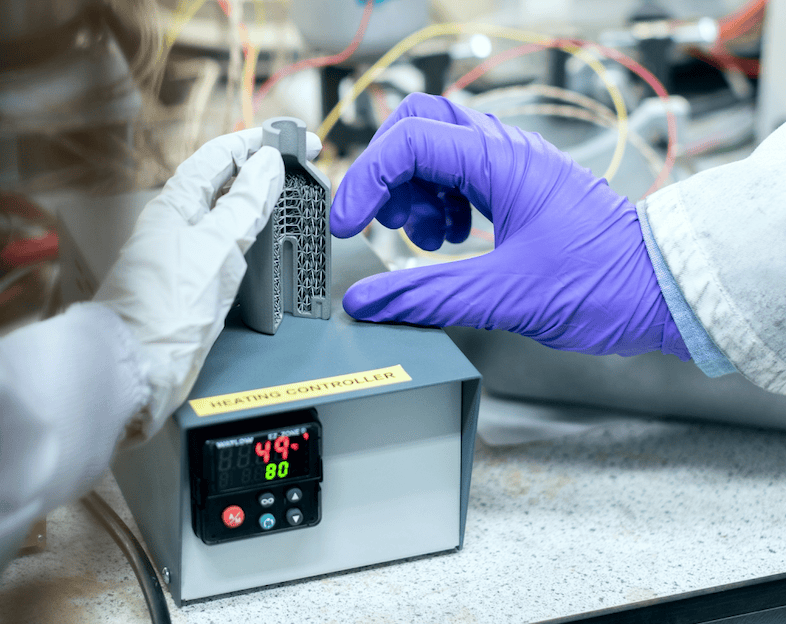
The challenge is not simply reducing technology risk, but finding market fit to secure customers once batteries start coming off the line. Thomas Sisto, CEO and co-founder of XL Batteries, emphasized the importance of field testing and identifying early offtaker markets before scaling manufacturing. XL Batteries, a flow battery technology well suited for long-duration energy storage, needs to demonstrate commercial viability in the utility-scale energy storage market to scale. Sisto explained that a key reason for a pilot project before commercial scale-up is collecting system data. XL will then use that data to optimize the design and improve the project’s bankability.
To stand up a full-scale manufacturing plant, they need to demonstrate the commercial viability of flow batteries for utility storage. Because utilities are historically cautious, they often require significant product data before considering a project. Sisto hopes to demonstrate the potential of XL’s batteries and secure customers before scaling production.
Denis Phares, Chief Executive Officer at DragonFly Energy, explained that the domestic battery manufacturing industry in the United States is already facing an uphill battle in commercializing battery manufacturing. Phares added that China’s gigafactory development and control over the battery supply chain mean US battery manufacturers struggle to compete in the market. A report by the McKinsey Global Institute reaffirms this finding, reporting that more than three-quarters of advanced batteries are produced in Asia.
Faced with this market dominance, companies such as DragonFly have decided to focus on very specific markets, aiming to generate cash flow that will allow them to scale overall production. DragonFly continues to produce batteries for RVs and trucking solutions using their dry electrode technology. Continuing to grow market share in this area allows continued product iteration in the field and provides an available customer base as production scales.

Hui Du, Co-Founder CEO and CTO of Ampcera, reiterated this approach when asked about the plan to scale Ampcera’s solid-state batteries and sulfide-based electrolytes. Ampcera began exploring solid-state batteries in 2018, driven by the chemistry’s safety advantages and energy density.
Du explained that while the long-term goal for these batteries remains electric vehicles and energy storage for the growing data center market, they need to target niche markets to finance scaling. They have done this by focusing initially on industries such as semiconductors, down-hole drilling in mining, and extreme-cold-environment aerospace environments where unique high- or low-temperature tolerance is necessary. Ampcera aims to scale production gradually, which Hui described as a phased modular approach to mass market adoption.”
One of the clearest demonstrations of a successful partnership approach to scaling production comes from Factorial Energy. Factorial Energy has created a two-sided approach to scaling its battery production technology. By developing the Factorial Electrolyte System Technology, Factorial can work alongside conventional lithium-ion manufacturing equipment. Dr. Raimund Koerver, Senior Vice President at Factorial Energy, explained how Factorial can use its proprietary anode and electrolyte processing alongside conventional cell assembly, cell-finishing processes, and cathode production to scale quickly. Koerver outlines “this (compatibility) reduces retooling, capital requirements, and time to production.”
He follows up with a concise summary of the route that has proven successful for Factorial.
“Our (Factorial’s) capital-light model combines internal capabilities with contract manufacturers and industrial partners, allowing us to use existing capacity rather than fund additional greenfield capacity.” As Factorial Energy’s solid-state battery manufacturing process is compatible with approximately 80% of lithium-ion battery manufacturing equipment, the technology can scale while limiting the need for entirely new production facilities.
While partnering with manufacturers has proven successful for companies such as Zenthos and Factorial, others have developed in-house technology allowing for lower CapEx during facility construction. Alex Kosyakov, Co-Founder and CEO of Natrion, a solid-state electrolyte separator for lithium batteries, emphasized how Natrion, which operates a production facility in Buffalo, New York, kept costs down during construction. Kosyakov outlined how their electrolyte separator can be produced, stored, and handled in ambient air without degradation. He estimates that running production out of almost any open-air warehouse rather than a dry room has saved 800 USD per square foot in factory CapEx.
Kosyakov adds that another area of CapEx savings came from designing very specific quality systems. These systems, while technically complex, let them avoid buying off-the-shelf feature systems and software stacks that charged for features the company did not need.
When a new battery manufacturing facility runs into the hundreds of millions of dollars, scaling production is no easy feat. Battery companies have developed different methods to overcome this hurdle, from partnerships with existing plants to focusing on niche markets. If there is a comfort, however, it likely lies in market size. With battery energy stationary storage (BESS) reaching its highest installed quarter ever in Q2 2026, and the lithium-ion battery market worth over 150 billion, there is plenty of motivation to scale production.
Readers can join our climate and clean energy network for updates and developments from companies across the sector, including Eqonic, XL Batteries, DragonFly Energy, Ampcera, Zenthos, Natrion, and Factorial Energy.