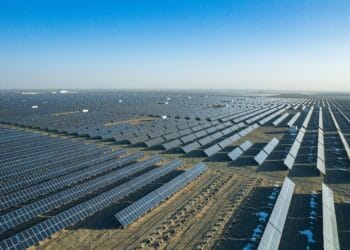

Tunisia has entered a new phase in its energy transition after recently approving five major solar projects with a combined capacity of 500 MW and investments estimated at 1.2 billion Tunisian dinars (USD 400 million).
Solar energy currently accounts for only about 2.7% of Tunisia’s national electricity mix, but natural gas still dominates the country’s power generation, representing around 95% of the electricity mix.
These projects are expected to increase solar energy’s contribution to around 14% of national electricity production by 2027. With the country planning to reach a 30% renewable share in its electricity mix by 2030, these investments are expected to significantly advance its renewable energy ambitions.
According to figures from Tunisia’s Ministry of Energy and the National Agency for Energy Management, installed solar photovoltaic capacity reached around 900 MW in 2025, while total renewable electricity generation capacity rose to about 1,206 GW in the same year. Solar accounts for roughly three-quarters of Tunisia’s total renewable capacity, underscoring its dominant role in the country’s clean energy expansion.
Small Scale and Large Scale Solar Projects
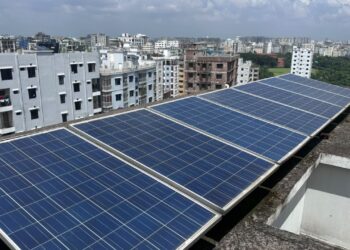
Solar panels are appearing on residential and commercial rooftops, allowing consumers to meet part of their electricity demand independently.
Small-scale solar projects are also being developed by private investors, often financed through bank loans, with revenues secured via long-term power purchase agreements with the national grid operator.

To regulate mid-sized developments, the Tunisian government has introduced a licensing system for projects between 1 MW and 2 MW, allocated through competitive bidding rounds. Under this framework, authorities set a purchase tariff of approximately 0.217 Tunisian dinar (USD 0.07) per kilowatt-hour.
For larger projects, solar plants exceeding 50 MW are developed through international tenders, with land allocations designed to attract major foreign investors and energy companies.
Solar is Cheaper
Ali Kanzari, a senior expert in renewable energy and energy efficiency, says that despite significant progress in recent years, renewable energy’s contribution to Tunisia’s electricity generation remains below the country’s vast natural potential.
He notes that Tunisia’s most prominent solar projects are located in Tataouine, Gafsa, Kairouan (Metbasta), Sidi Bouzid (Mezzouna), and Tozeur, and form part of the country’s long-term energy transition strategy aimed at increasing the share of renewable energy to 80% by 2050 while strengthening national energy sovereignty.
Electricity generated from natural gas currently costs around 540 millimes per kilowatt-hour, while solar-generated electricity costs between 100 and 240 millimes per kilowatt-hour depending on project size, location, and investment structure, Kanzari adds.
He explains that electricity generated from solar energy can be between 50% and 80% cheaper than gas-generated power, reducing production costs for the national grid operator and the government’s subsidy burden.
Solar Power Beyond Tunisia’s borders
Kanzari argues that renewable energy’s economic impact extends far beyond electricity production. Tunisia enjoys a strategic geographic position between Europe and Africa, and has more than 3,000 hours of sunshine annually, making it one of the Mediterranean region’s most attractive destinations for clean energy production.
As renewable energy projects expand, Tunisia could position itself as a regional hub for green electricity generation and trading, particularly as electricity interconnection projects with the northern Mediterranean shore move forward.
This renewable energy drive is also expected to stimulate economic growth, attract new capital, and create thousands of direct and indirect jobs across engineering, manufacturing, installation, maintenance, and energy-related services, according to Kanzari.
“If Tunisia fully leverages its natural advantages and strategic location, it has all the ingredients needed to become a regional clean energy hub and a major exporter of green electricity to European and African markets in the decades ahead,” he says.
Reducing the Energy Trade Deficit
Kanzari says solar energy plays a central role in addressing Tunisia’s structural energy trade deficit, as energy imports, particularly natural gas and petroleum products, remain a major contributor to the country’s trade imbalance. By increasing solar electricity production, Tunisia can reduce its reliance on imported fossil fuels, easing pressure on foreign currency reserves and strengthening its external financial position.
Official estimates suggest that the five recently approved solar projects could save nearly 300 million Tunisian dinars (around USD 100 million) annually in energy import costs.
International Financing
Renewable energy projects require substantial long-term investments, making diversified financing sources essential. Tunisia has therefore relied on partnerships with international financial institutions, development banks, and global climate funds to support solar, wind, and related infrastructure projects, explained Kanzari.
Nevertheless, challenges remain. Kanzari says that limited domestic financial resources, the need for greater private-sector participation, regulatory improvements, and the modernization of electricity transmission and distribution networks all remain key priorities.
According to Kanzari, the next phase requires accelerating investment and implementation, including streamlined procedures, stronger incentives, and improved grid integration which Tunisia has the capacity to deliver.
Critics Warn Against Energy Privatization
Not everyone shares this optimistic view.
Ilyes Ben Ammar, a co-founder of the Working Group for Energy Democracy, opposes the participation of both domestic and foreign investors in renewable energy projects. He argues that international financing could constrain national energy policies and undermine Tunisia’s energy sovereignty.
The Working Group for Energy Democracy is a Tunisian research center and community network advocating energy sovereignty and climate justice. It promotes a transition away from fossil-fuel monopolies and centralized corporate control toward a democratic energy system managed by communities and designed to support local economies. It believes that private investment in electricity generation prioritizes profit and could eventually threaten the public-service nature of electricity provision.
Ben Ammar proposes citizen-led cooperative financing as an alternative to international funding and believes that current government policies represent the main obstacle to achieving a fair and nationally driven energy transition.
Instead, the group advocates for collective energy-production structures, including consumer and community-owned cooperatives, alongside a stronger public-sector role in renewable energy generation.
Whether driven by private investment, international finance, public institutions, or citizen-led cooperatives, Tunisia’s solar expansion reflects the challenge of balancing energy security and economic growth in its transition to clean energy.