


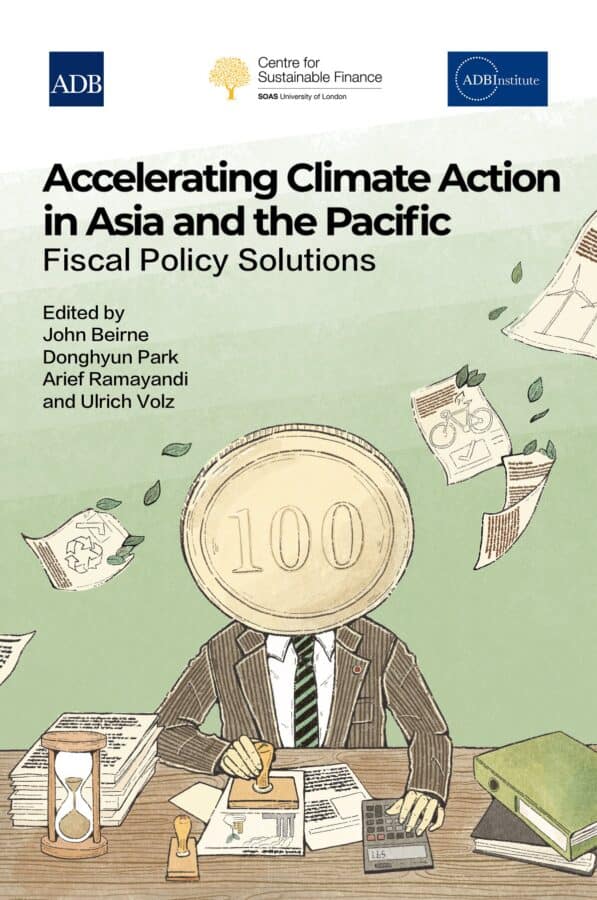
In this Q&A, Genevieve Mallet speaks with John Beirne, Principal Economist in the Economic Research and Development Impact Department of the Asian Development Bank (ADB), and Arief Ramayandi, Senior Research Economist at the Asian Development Bank Institute (ADBI), about the role of fiscal policy in advancing climate action and sustainable development across Asia and the Pacific. The conversation explores key themes from Accelerating Climate Action in Asia and the Pacific: Fiscal Policy Solutions, a recently published volume they co-edited.
Q: Chapter 4 highlights how debt burdens are constraining climate investment across much of Asia. Given that many Asian economies are increasingly indebted to Chinese lenders and institutions, do you see a risk that the PRC’s successful domestic climate finance model could indirectly widen the fiscal gap between China and its debtor countries? How can climate related fiscal gains in China translate into regional climate resilience rather than reinforcing financial dependence?
From John Beirne:
A: A key concern is that Asian economies with heavy debt burdens have less fiscal space available to finance climate-related investment, potentially increasing reliance on external financing. While uneven fiscal capacity could create differences in climate investment potential, improved access to affordable finance, knowledge sharing, and partnerships can help ensure that all economies are better positioned to advance resilient, low-carbon development.
Climate-related fiscal gains in China can strengthen regional resilience through expanded collaborative investments, multilateral partnerships, technology sharing, and capacity building. Greater support for debt-for-climate swaps and co-financed regional projects would also help economies to increase climate investment, reduce fiscal pressures, and build longer-term climate resilience.

Q: Chapter 7 points out that the PRC’s emissions trading system generated both environmental benefits and fiscal gains. Looking beyond the PRC, what elements of that experience are realistically transferable to developing economies in Southeast Asia and the Pacific, where administrative capacity, market depth, and fiscal conditions may be very different?
From Arief Ramayandi
A: The People’s Republic of China (PRC) model suggests that emissions trading can deliver fiscal gains on top of emissions reduction. It is scalable in principle, but there are notes to be considered for its replication. Beyond the PRC, there are several aspects that are transferable. First, the gradualism approach of applying the model on pilots before scaling up nationally would allow regulators to build experience in strengthening the emissions monitoring system while improving market rules at the same time. Second, the strong monitoring, reporting, and verification system through investing in data collection, compliance system, and regulatory oversight. Third, integrating emission trading systems (ETS )with broader fiscal reform as healthy fiscal balances would improve ETS effectiveness. Regardless, there is no one-size-fits-all kind of approach to this issue. Countries in the region would need to adapt these principles to their market size, administrative capacities, and fiscal realities when attempting to replicate the model.
Q: Chapter 9 suggests that the most efficient carbon tax design from a national equity perspective may not adequately compensate the provinces and communities that experience the highest levels of industrial pollution. Does this create a political legitimacy problem for carbon pricing? Why should heavily affected communities support a policy if a large share of the benefits is redistributed elsewhere?
From Arief Ramayandi:
A: Spatial diversity could pose a political economy challenge to carbon pricing. A nationally efficient policy may not be perceived as spatially fair for the economy. Tensions between income equity and geographical equity could arise when industrial regions perceive themselves as net losers by losing their tax base and economic activity. As a result, communities in these areas may oppose the policy as they become the concentrated losers of the decarbonization policy. To minimize this risk, authorities could consider a hybrid policy design that would imply a benefit-sharing mechanism, which will support income redistribution to offset impact of higher energy prices while spending parts of the revenue to fund local compensation to offset the direct negative implication on the highly affected region. Improvements in health, jobs, infrastructure, and economic opportunities would have to be visible in the highly affected regions to avoid unnecessary resistance. An effective carbon pricing is not just about efficiency, but also about distributive justice across communities. An economically optimal decarbonization program that ignores geographic fairness may struggle in maintaining political support.
Q: Chapter 11 concludes that the renewable energy transition can improve fiscal sustainability in PIDS, but only if infrastructure vulnerabilities are addressed simultaneously. Since many of these infrastructure investments are financed through external borrowing, is there a danger that the transition itself could deepen debt vulnerabilities before the fiscal benefits materialize (despite PIDS minimally contributing to greenhouse gas emission)? How should governments balance climate urgency against the risk of creating a new generation of debt?
From John Beirne:
A: There remains a risk that the renewable energy transition could increase debt vulnerabilities in the short-term if large upfront investments rely heavily on external borrowing. However, with careful project selection, resilient infrastructure planning, and sustainable financing, these investments can generate long-term fiscal benefits that outweigh initial costs.
Governments can balance the need for climate action while not aggravating debt sustainability risks by aligning climate investments with long-term fiscal capacity, securing favorable financing terms and diversifying financing sources. Prioritizing resilient, high-impact investments, strengthening public financial management, and coordinating with development partners can accelerate the energy transition while maintaining debt sustainability and reducing long-term fiscal and climate risks.
Q: A recurring theme across several chapters is that countries with stronger fiscal capacity are generally better positioned to implement effective climate policies. This is evident in Asia, where higher income economies such as Singapore can finance large scale coastal protection and long-term adaptation infrastructure, while more climate exposed countries such as the Philippines face tighter fiscal constraints and greater reliance on external financing despite higher vulnerability. Does this imply that climate ambition in Asia is becoming increasingly dependent on fiscal space? Should climate vulnerability play a larger role in debt sustainability assessments and concessional financing decisions across the region?
From John Beirne:
A: Fiscal space is becoming an increasingly important enabler of climate action, as stronger public finances can support sustained investment in mitigation and adaptation. However, fiscal capacity is not the only aspect. Private capital mobilization, international partnerships, and innovative financing mechanisms can also help to bridge funding gaps across Asia. This creates opportunities for fiscally constrained countries to strengthen climate ambition despite limited domestic resources.
Climate vulnerability is already increasingly reflected in debt sustainability assessments, but there is scope for it to play a more prominent role in financing decisions. Strengthening its consideration could help to better align concessional financing with resilience needs, reduce long-term fiscal risks, and enable climate-vulnerable countries to pursue sustainable development with greater financial certainty.