
This story was originally published by Grist through Covering Climate Now. Sign up for Grist’s weekly newsletter here.
On August 26, the side of a mountain near the border between Nepal and Tibet collapsed. Seven billion cubic feet of glacial ice and rock, enough to fill 100 football stadiums, crashed roughly a mile straight down into the river below. The impact created a muddy wall of water that swept through the valley as fast as 100 miles per hour, destroying villages dozens of miles downstream and killing more than 1,300 people. Thousands more remain missing.
The scale of the disaster is extraordinary, even for a region accustomed to deadly floods and landslides. It will take months for scientists to confirm exactly what happened. But, they warn, one thing is already clear: As climate change melts icy landscapes worldwide, tragedies like this are more likely to happen. They are also incredibly hard to predict.
“Glacial loss destabilizes slopes in many far-reaching ways that are often unpredictable and catastrophic,” said Mark Carey, a professor of environmental studies and geography at the University of Oregon who leads a lab that studies glaciers. Proactive research and monitoring have saved lives in some parts of the world, Carey said, but in a place like the Himalayas, where thousands of glaciers are spread over vast areas, “it’s impossible to predict everything and establish early warning systems everywhere.”
The world’s glaciers have shrunk by about one-fifth in the last century and are expected to lose at least another quarter of their mass by 2100. Each fraction of a degree of warming makes them vanish faster, with hundreds of billions of tons of ice lost each year.
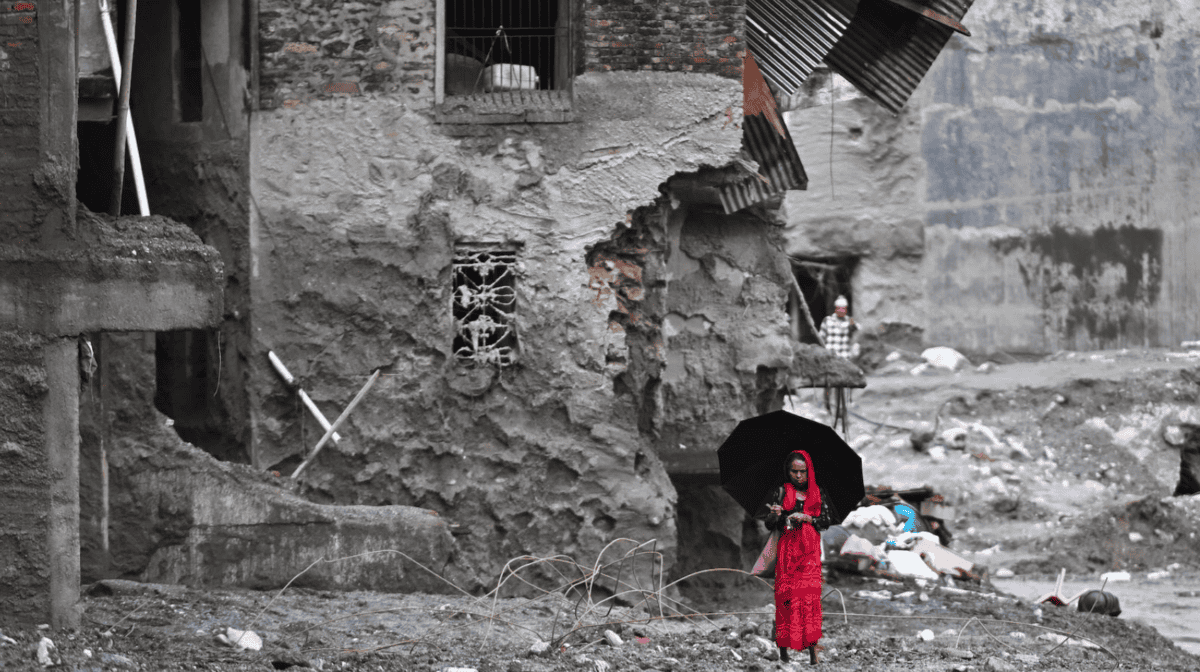
The downstream effects of this disappearing ice are complex and varied. Glaciers often buttress the sides of mountains and, as they retreat, newly exposed silt and rock can become unstable. The soil itself is also often glued together by a frozen layer known as permafrost, which helps lock slopes into place, but thaws when temperatures become too warm. Glacial meltwater can eat into the cracks in the bedrock, weakening it over time. All of these processes can result in sudden avalanches or rock slides — like one that caused a 1,500 foot tsunami in Alaska last summer, or possibly like the collapsed mountain slope in Nepal.
It’s also common for retreating glaciers to leave behind ridges of dirt and rock, known as moraines, that trap meltwater and rain. These natural dams can release enormous amounts of water if they break.

Glaciers themselves can behave as dams, too. In Juneau, Alaska, glacial meltwater has triggered flooding every year since 2011. Just north of the city, a glacier-dammed valley, known as Suicide Basin, fills with meltwater and rain throughout the year. When it becomes too full, the ice holding back the water lifts up, releasing billions of gallons at once. But while the yearly flood causes plenty of property damage, it has never killed anybody. That’s because it’s carefully monitored, said Eran Hood, a hydrologist and professor of environmental science at the University of Alaska who studies the basin.
“Every single cell phone in Juneau goes off when the lake starts to drain,” he said. “We have a lake in a known location, we have cameras all over it, we have a laser measuring the elevation of the water, and we have the ability to make drone maps every few weeks to update our estimates of the volume of water in the lake.”
Close monitoring and engineering has successfully prevented disaster in Peru as well. The country has spent decades draining dozens of high-risk glacial lakes across the Andes, “no doubt saving tens of thousands of lives,” said Carey, who wrote a book, In the Shadow of Melting Glaciers, about these measures. And last year, Swiss authorities were able to evacuate 300 residents from the Alpine village of Blatten just days before a glacier collapsed and engulfed it in an avalanche.
But success stories like these stand in stark contrast to what happened in Nepal, Hood said. While early-warning systems in the Himalayas monitor water levels in some high risk rivers and lakes, there is no regional system capable of continuously watching for the kind of sudden rock-and-ice collapse that triggered the disaster. Doing so would require intensive research and surveillance across a vast, remote, and difficult-to-access landscape where resources are limited.
“There’s really no effective way to monitor all these glaciers,” Hood said. “When you’re dealing with something that releases immediately and moves downslope so quickly, how can you find a way to provide people with any warning?”
Emerging or repurposed technology may be able to help fill some of these gaps, said Dan McGrath, a glaciologist and associate professor at Colorado State University.
In places like Mexico City, seismic early-warning systems have sometimes given residents more than a minute to prepare before strong earthquake shaking arrives. Scientists are now wondering whether these same networks could be used to detect landslides and floods caused by glaciers. The glacial-break in Nepal caused readings equivalent to a 5.2 magnitude earthquake that traveled as far as Alaska, leading authorities to initially assume a seismic event had caused the disaster. There, too, just a few minutes of warning was shown to make all the difference. After warnings of the flood reached a school downstream, the principal was able to evacuate 900 studentsto safety before the torrent submerged it.
Researchers have also recently experimented with laying fiber-optic cables across a glacier in Switzerland to detect “icequakes,” or tiny fractures in the ice that generate seismic vibrations and could provide clues about changes in a glacier’s stability.
A new satellite, recently launched jointly by the United States’ and India’s space agencies, also holds promise. Known as NISAR, it was designed to detect subtle changes in Earth’s surface, like shifting glaciers, and can capture detailed information about ice and snow cover while seeing through cloud cover in ways that previous satellite sensors were not capable of. Recent analysis of the satellite’s data showed that it had recorded slumping on the mountain slope in Nepal several weeks before it collapsed.
But still, there’s no silver bullet, McGrath said. “Many of these mountain ranges are at a tipping point,” he said. “Freezing, or not freezing, is binary. And as temperatures warm above that and permafrost thaws, that is undoubtedly going to lead to an increase in disasters like this.”