

Energy transition only works if development works
The energy transition is reshaping economic structures across Asia and the Pacific. Where it is managed well, it can unlock new economic growth opportunities. Where it is not, it can trigger inflation and political backlash that stalls reform. The difference lies in whether transition policies are designed with socioeconomic development at their core.
The Economic and Social Survey of Asia and the Pacific 2026 argues that the real policy challenge in pursuing energy transition is not a lack of available options, but how to identify and prioritize reforms that simultaneously support macroeconomic stability, sustain economic growth and improve people’s wellbeing. In other words, transition policy must become development policy.
Development and transition are inseparable
Fossil fuel-based energy is not just a source of emissions. It is a core economic variable. Its domestic price influences inflation. Its import costs affect trade balances and foreign exchange pressures. Its subsidies absorb fiscal space that could otherwise support investments in infrastructure, health or social protection. As a production input, energy access determines whether industries remain competitive globally.
When these linkages are overlooked, transition policies risk imposing concentrated costs on those least able to bear them. Measures that appear sound through a narrow energy lens may generate inflationary pressures, weaken fiscal positions, or disrupt employment and incomes. Across Asia and the Pacific, where economies differ widely in structure and vulnerability, these trade-offs matter greatly.
Indonesia showed what is possible when these dynamics are managed well. When oil prices declined in 2014, the government decreased gasoline subsidies. This reduced explicit energy subsidy spending from 3.2% to 1.0% of GDP in a single year, and redirected the savings into infrastructure and social protection. Fossil fuels continue to dominate export revenues in several countries of the region, which makes them highly exposed to global price swings and the long-term decline in hydrocarbon demand.

This is why the Survey 2026 places socioeconomic development at the centre of energy transition strategy. It defines prosperity as: macroeconomic stability, sustained economic growth and people’s wellbeing. The question is not simply how to decarbonize, but how to do so in ways that reinforce all three.
Across Asia and the Pacific, that question demands different answers depending on whether a country is a fossil fuel exporter facing revenue risk, a net importer vulnerable to price shocks, or an economy where modern energy services are still out of reach for many households.
Looking at transition through a development lens
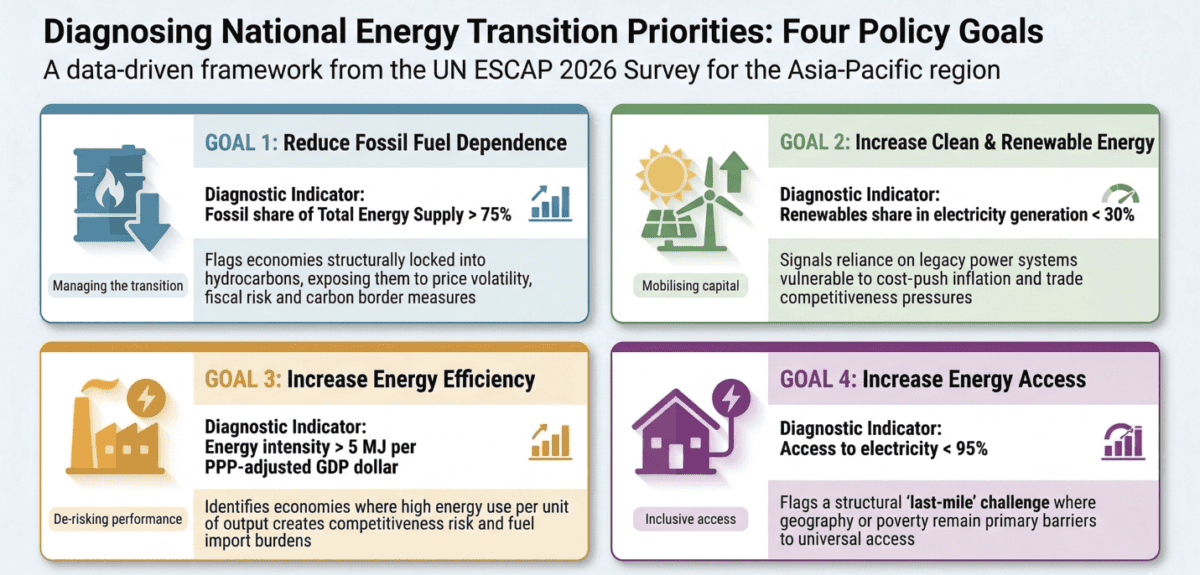
The Survey 2026 proposes a structured framework for identifying priority national energy transition policy goals. It recognizes that countries face different structural pressures within their energy systems. For some, the priority is reducing fossil fuel dependence. For others, it is expanding clean and renewable energy, improving energy efficiency or ensuring access to modern energy services. In practice, most countries will need to pursue more than one of these goals simultaneously, as their energy systems face overlapping structural challenges.
These goals are not purely technical or sectoral. Each carry considerable macroeconomic implications; from fiscal sustainability and trade balances to export competitiveness and household incomes. The challenge for policymakers is to assess transition goals keeping in view these considerations.
India’s solar manufacturing incentive scheme illustrates this point. By conditioning government payouts on domestic sales and local content, it catalyzed 48 gigawatts of manufacturing capacity and is projected to save around US$1.8 billion annually in foreign exchange. This has turned an energy transition goal into a win for trade balances and industrial competitiveness. Nepal’s electrification drive shows the same logic applied to access. By expanding electricity coverage from 53% to 95% of total population between 2010 and 2024, the national utility moved from chronic deficit to profitability, while reliable power saved the economy an estimated 6-7% of GDP annually.
What appeared to be narrow infrastructure or industrial goals turned out to be powerful stability and growth dividends. That is precisely the kind of connection the Survey 2026 argues transition policy must be built around.
Making transition durable
A transition that does not deliver visible development gains will struggle to last. In contrast, policies are more likely to endure when they strengthen macroeconomic stability, support economic growth and improve people’s lives. That is not a secondary concern. It is what makes (the) transition credible.
The examples from across the region share a common thread: the reforms that have continued were designed to produce tangible gains that people could see and feel, not just environmental targets that governments could merely report. When energy transition generates jobs, lowers energy costs, reduces import dependence or frees up fiscal space for social spending, it builds the political constituency for further change. When it does not, it becomes a political liability. A companion piece will explore how countries can sequence and implement these transition priorities in practice.
In Asia and the Pacific, the energy transition will only work if development works too.
—
Authors:
- Shuvojit Banerjee, Economic Affairs Officer, ESCAP
- Weiwen Qi, Former Intern, Macroeconomic Policy and Financing for Development, ESCAP